Introduction
Most people assume they'll own their life insurance policy for life. That's not always true. Absolute assignment lets you hand over every ownership right to someone else, permanently.
This matters more in 2026 than it did a few years ago. The federal estate tax exclusion jumped to $15,000,000 for individuals dying in 2026, up from $13,990,000 in 2025.
That increase, driven by Public Law 119-21, is pushing more families and business owners to reconsider how they hold their policies.
Here's the problem: many policyholders confuse absolute assignment with collateral assignment. One is permanent. The other isn't. Mixing them up can cost you control of a policy you never meant to give away.
This guide breaks down the definition, the real difference between the two assignment types, common use cases, the step-by-step process, and the risks worth weighing before you sign anything.
Key Takeaways
- Absolute assignment permanently transfers all ownership rights to a new owner
- It differs from collateral assignment, which only secures a loan temporarily
- The original owner loses control over beneficiaries, cash value, and the death benefit
- Reversal requires the new owner's consent, making professional guidance essential before signing
What Is an Absolute Assignment of Life Insurance?
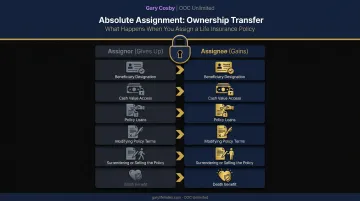
An absolute assignment is the complete, unconditional, and irrevocable transfer of ownership rights in a life insurance policy from one person (the assignor) to another (the assignee). Once it's recorded, the original owner has no more say over the policy. None.
Rights that transfer to the assignee include:
- Changing or naming beneficiaries
- Accessing or withdrawing cash value
- Taking out policy loans
- Modifying policy terms
- Surrendering or selling the policy
- Receiving the death benefit
The assignee also takes on premium payment responsibility once the insurer records the change. Full ownership rights carry full financial obligations.
Assignor and Assignee, in Plain Terms
Think of a parent who owns a $500,000 policy and decides to transfer it entirely to their adult child. The parent is the assignor, giving up every right they had. The child is the assignee, gaining full control, including the power to name a different beneficiary or cash the policy out someday, with no partial handoff in between.
Absolute vs. Conditional Assignment
Don't confuse absolute assignment with a conditional assignment, which transfers specific rights tied to a condition, often loan repayment, with those rights automatically reverting to the original owner once the condition is satisfied. Absolute assignment has no such trigger. It's final the moment it's completed, according to Coventry Direct's guide on absolute assignment.
Absolute Assignment vs. Collateral Assignment: What's the Difference?
This is where most confusion happens, and it's an expensive mistake to make. Here's the side-by-side breakdown:
| Factor | Absolute Assignment | Collateral Assignment |
|---|---|---|
| Duration | Permanent | Temporary |
| Control | Assignor keeps none | Assignor retains ownership |
| Purpose | Gifting, sale, estate transfer | Securing a loan |
| Beneficiary changes | Only assignee can make them | Assignor can still make them |
| Death before resolution | Assignee gets full proceeds | Lender paid first, remainder to beneficiaries |
With a collateral assignment, the policyholder stays in the driver's seat. You can still change beneficiaries and borrow against the policy, though the lender's interest takes priority in a claim.
Once the loan is paid off, the creditor's interest disappears automatically, and full control reverts to you without any extra paperwork. If the insured dies before the loan is settled, the creditor gets paid first from the death benefit, and named beneficiaries receive whatever's left over.
Choosing between the two comes down to intent:
- Absolute assignment fits permanent transfers, meaning gifts, sales, or estate planning moves
- Collateral assignment makes sense when the only goal is securing a loan and you plan to keep the policy afterward
Common Reasons and Real-World Examples of Absolute Assignment
Absolute assignment shows up in a handful of predictable scenarios. Here are the ones that come up most often.
Estate planning gifts. A policyholder transfers ownership to a spouse or family member, often through an irrevocable trust, to remove the policy's value from their taxable estate. One catch: if the insured dies within three years of the transfer, the proceeds can still be pulled back into the gross estate under IRC 2035. Timing matters here.
Business succession and buy-sell agreements. When business partners insure each other's lives to fund a future buyout, absolute assignment can shift full ownership of a policy to the surviving partner after a co-owner's death, giving them the liquidity to purchase the deceased owner's share.
Business owners setting this up typically work with a licensed insurance professional who structures the coverage, while a CPA determines valuation and an attorney drafts the actual agreement. At GFI, Gary Cosby Jr. and his team focus specifically on the insurance-funding piece, coordinating with the business's own CPA and attorney rather than replacing them.

Divorce settlements. Courts sometimes order a policy reassigned entirely to one spouse as part of dividing marital property, giving that spouse complete authority moving forward.
Life settlements. Selling a policy to a third-party purchaser requires absolute assignment to legally finalize the ownership handoff. This market isn't small. LISA members alone completed 2,955 transactions in 2025, paying policyholders $626.6 million, an average of $212,066 per settlement, nearly nine times what insurers offered in surrender value, according to LISA's 2025 market data.
A quick scenario: Imagine a business owner who no longer needs a $1 million policy after selling their company. Instead of surrendering it for a fraction of its value, they assign it absolutely to a life settlement provider.
The provider becomes the new owner and beneficiary, pays future premiums, and eventually collects the death benefit. The original owner walks away with a lump sum far larger than any surrender check would have offered.
How to Complete an Absolute Assignment in 2026
The process is straightforward on paper, but every step matters because there's no undo button once it's finished.
- Notify the insurer in writing that you intend to assign the policy.
- Complete the insurer's official assignment form, listing the assignor, assignee, and policy details.
- Get the assignee's signed acknowledgment, confirming they accept ownership and its responsibilities.
- Submit all paperwork to the insurer for review and recording.
Insurers like Prudential record assignments without vetting their legality. They log the transaction; the responsibility for a valid, enforceable assignment falls on you and your advisors.
Once the insurer confirms the change, notify existing beneficiaries. The new owner now controls that designation, so everyone affected should know where things stand. Talk to a licensed advisor before signing anything, since undoing the assignment requires the new owner's cooperation, which they're not obligated to give.
Consequences and Risks to Consider Before You Assign
The biggest consequence is loss of control. Full stop. The assignor can no longer change beneficiaries, access cash value, take a loan against the policy, or cancel it. That authority belongs to someone else now.
Tax exposure is another factor to weigh carefully:
- Gifting a policy can trigger gift tax reporting on Form 709, depending on the policy's value and available exclusions
- Transferring ownership within three years of the insured's death can pull the proceeds back into the taxable estate under IRC 2035
- Selling a policy later can trigger the transfer-for-value rule, which may make otherwise tax-free death proceeds partially taxable to the new owner
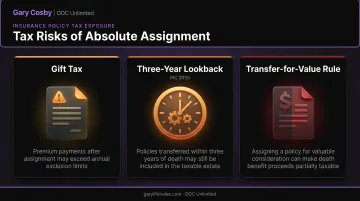
These aren't identical risks. A gift, a sale, and a life settlement each carry their own tax questions, so don't assume one blanket answer covers all three.
Beyond the tax implications, remember that absolute assignment is permanent: only the assignee can later modify or reassign the policy. Undocumented intentions upfront can spark disputes years down the line.
Before finalizing any absolute assignment, loop in a licensed life insurance professional alongside an estate attorney or CPA. Confirming whether absolute or collateral assignment actually fits your goal can save you from a decision you can't take back.
Frequently Asked Questions
What is an example of absolute assignment?
A common example is gifting a life insurance policy to an adult child or transferring ownership to fund a business buy-sell agreement after a partner's death.
What is the difference between collateral and absolute assignment?
Absolute assignment permanently transfers full ownership to a new party. Collateral assignment only secures a loan temporarily, with the original owner keeping control until the debt is repaid.
What are the consequences of an absolute assignment?
The original owner permanently loses all rights, including changing beneficiaries, accessing cash value, and canceling the policy. The transfer cannot be undone without the new owner's consent.
Can an absolute assignment be reversed or canceled?
Only the assignee, the new policy owner, can reverse or modify the assignment once it's completed. The original owner has no legal path to undo it alone.
Does an absolute assignment trigger tax obligations?
It can. Gifting a policy may require gift tax reporting, and selling one later can trigger the transfer-for-value rule. Talk to a tax professional before finalizing anything.
Who should I talk to before starting an absolute assignment?
A licensed life insurance professional, CPA, and estate attorney should all weigh in before you sign. Each one covers a different piece of the decision, from insurance structure to tax exposure to legal drafting.