That gap is more common than you'd think. A buy-sell agreement is a legally binding contract that spells out exactly what happens to an owner's stake when a defined event, like death, disability, or divorce, hits the business. It's one of the most overlooked documents in small business planning, and also one of the most consequential.
This article breaks down what a buy-sell agreement is, why it matters, the four main types, the provisions every agreement needs, and how funding, usually through life insurance, makes the whole plan actually work.
Key Takeaways
- A buy-sell agreement dictates what happens to an owner's stake at death, disability, divorce, retirement, or exit.
- Four main structures exist: cross-purchase, entity-purchase, hybrid, and wait-and-see.
- Life insurance is the most common funding tool because it delivers cash exactly when a buyout triggers.
- LLCs, corporations, and partnerships can all use one; for LLCs it's often built into the operating agreement.
- Review the agreement every 2-3 years, or after major business or tax law changes.
What Is a Buy-Sell Agreement?
A buy-sell agreement is a contract that governs how an owner's interest transfers when a specific event—death, disability, divorce, or retirement—occurs. It's used primarily by partnerships and closely-held corporations, though any multi-owner LLC benefits just as much.
The document does three jobs:
- Restricts transfer of ownership. No shares go to an outside party without the remaining owners' consent.
- Establishes a valuation method. Everyone agrees, in advance, on how the business (and each owner's slice of it) gets priced when a trigger hits.
- Specifies how the buyout gets funded. Most agreements name a funding source, such as life insurance, so the payout is ready when needed.
Who actually needs one? Any business with more than one owner. It doesn't matter whether you're structured as an LLC, an S-corp, or a general partnership—the risk of an unplanned ownership transition is the same.
Why Every Business Needs a Buy-Sell Agreement
The core purpose is simple: keep the business running, pay the departing owner (or their family) fairly, and stop unwanted co-owners from showing up on the cap table.
This isn't a niche problem. A 2023 Principal survey of 1,000 business owners with 2-499 employees found that 39% had no formal succession plan in place, despite running multi-owner operations. That's nearly four in ten businesses exposed to exactly the chaos a buy-sell agreement is designed to prevent.
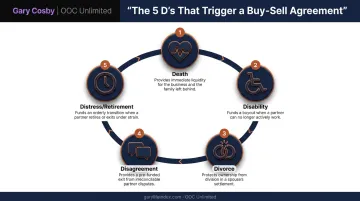
The Five Triggering Events (The "5 D's")
Every buy-sell agreement should address these scenarios directly:
- Death. Without an agreement, a deceased owner's shares can pass straight to a spouse or heir with zero interest or experience running the business. That's a recipe for conflict.
- Disability. The agreement needs to define what actually counts as "disabled" and how long an owner can be sidelined before the buyout kicks in.
- Divorce. A messy divorce settlement can hand a chunk of the business to an ex-spouse who has nothing to do with day-to-day operations.
- Disagreement. Irreconcilable partner disputes can deadlock every major decision unless there's a defined exit path built in.
- Distress or retirement. Bankruptcy, financial hardship, or a planned retirement all need predefined buyout terms. Otherwise, you're negotiating price under pressure, and that rarely ends well.
Leave any of these unaddressed and you're looking at costly litigation, a forced liquidation, or losing control of the company to someone nobody wanted at the table.
Types of Buy-Sell Agreements
There are four structures, and picking the right one depends mostly on how many owners you have.
Cross-purchase agreement. Remaining owners individually buy the departing owner's shares. Works cleanly with two or three owners; gets unwieldy fast with more, since each owner may need a separate life insurance policy on every other owner.
Entity-purchase (redemption) agreement. The business itself buys back and retires the shares. This scales far better for companies with several owners, since the entity holds one policy per owner instead of a tangle of cross-policies.
Hybrid agreement. Blends both. The entity typically gets first right to purchase, and remaining owners buy whatever's left over.
Wait-and-see agreement. Neither structure gets locked in ahead of time. The decision on who buys, entity or individual owners, gets made at the moment the trigger occurs, based on what makes the most sense then (tax situation, cash position, owner circumstances).
A quick way to think about it:
| Structure | Best for | Key consideration |
|---|---|---|
| Cross-purchase | 2-3 owners | Each buyer's basis increases by the purchase price |
| Entity-purchase | 4+ owners | Surviving owners typically get no basis step-up from the redemption |
| Hybrid | Mixed ownership groups | Basis treatment depends on who ends up buying |
| Wait-and-see | Owners wanting flexibility | Decision deferred until the actual trigger event |
Tax treatment differs meaningfully between these structures, particularly around basis. Don't finalize a structure without your CPA weighing in first.
Key Provisions, LLC Considerations & Getting Professional Guidance
A solid agreement covers far more than a valuation number and a signature. It should spell out:
- Current ownership stakes for every owner
- The specific triggering events that activate a buyout
- The valuation method used to set price
- How the buyout gets funded
- Transfer restrictions on outside sales
- Tax considerations tied to the chosen structure
Can an LLC Have a Buy-Sell Agreement?
Yes. For LLCs, these provisions are commonly written directly into the operating agreement rather than as a separate document, though a standalone agreement works too.
State law rarely mandates one. Texas, for example, makes these agreements permissive rather than required. Even so, any multi-member LLC benefits from locking down these terms regardless of what the state requires.
Building the Right Advisory Team
No single professional should handle this alone. You need:
- An attorney to draft the agreement and make sure it's enforceable
- A CPA to handle valuation input and tax treatment across ownership changes
- A licensed life insurance agent to structure the funding mechanism
With the team in place, the agreement still needs regular upkeep. Review the whole thing every 2-3 years, according to J.P. Morgan Private Bank's guidance, or immediately after a major ownership change, valuation shift, or tax law update. An agreement built for a $2 million company doesn't hold up once you're worth $8 million.
Valuation Methods & Funding Your Buy-Sell Agreement
Common Valuation Methods
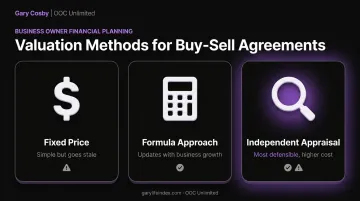
Three approaches show up most often:
- Fixed price. Owners agree on a dollar figure upfront. Simple, cheap, but it goes stale fast if nobody revisits it on a set schedule.
- Formula approach. Ties value to a financial metric, book value, EBITDA multiple, revenue, so it updates naturally as the business grows.
- Independent appraisal. A qualified appraiser sets the value at or near the trigger date. Most defensible option, especially for higher-value or complex ownership situations, but it costs more and takes longer.
Funding the Buyout
Setting a valuation method solves half the problem. The other half is having actual cash available when the trigger hits. Common funding methods include:
- Life insurance
- Disability insurance
- Cash reserves or a sinking fund
- Installment notes
- Borrowing
Life insurance is the most widely used funding tool, and for good reason: it delivers a lump sum exactly when a death-triggered buyout is needed, without forcing the sale of business assets or straining cash flow.
A sinking fund takes years to build. A bank loan depends on credit availability at a moment when the business may already be disrupted. A life insurance policy is sitting there, ready the day it's needed.
That said, structuring matters. Improperly structured life insurance funding can create unintended estate tax exposure.
The Supreme Court's 2024 ruling in Connelly v. United States made this clear: a corporation's obligation to redeem a deceased shareholder's shares did not offset the $3 million in life insurance proceeds used for that redemption when valuing the company for estate tax purposes. The result was an extra $889,914 in estate tax liability for one family business.
Coordination between insurance, tax, and legal professionals is what keeps a well-intentioned funding strategy from backfiring.
This is where working with a licensed agent who understands the funding side pays off. Gary Cosby Jr. and the team at OOC Unlimited focus on exactly this piece, helping business owners explore insurance-funding options for buy-sell, key person, and business overhead needs through access to 25+ A-rated carriers, including Prudential, Lincoln Financial Group, and Mutual of Omaha.
The agent's role stays scoped to the funding mechanism, whether term, whole life, or IUL, matched to the owners' ages, budget, and agreement structure. The business owner's attorney drafts the legal document, while their CPA handles valuation and tax treatment.
Frequently Asked Questions
Can an LLC have a buy-sell agreement?
Yes. It's typically built directly into the LLC's operating agreement, though a standalone buy-sell document works just as well. Any multi-member LLC benefits from having one, regardless of state requirements.
What are the four types of buy-sell agreements?
The four main structures are:
- Cross-purchase: remaining owners buy the departing owner's shares individually
- Entity-purchase: the business itself redeems the shares
- Hybrid: blends cross-purchase and entity-purchase elements
- Wait-and-see: the buyer isn't determined until the trigger event occurs
How is a buy-sell agreement funded?
Life insurance is the most common method since it provides immediate cash exactly when needed. Cash reserves and installment notes are the other main options, though both come with more risk or delay.
Is a buy-sell agreement legally required?
Not universally. Federal law doesn't mandate one, and most state statutes don't either, though some close-corporation rules require transfer restrictions. It's a best practice for any multi-owner business, not a legal obligation.
What happens if a business doesn't have a buy-sell agreement?
Expect disputes with heirs, forced asset sales, probate delays, or an unwanted party ending up with a controlling stake. None of these are quick or cheap to resolve.
How often should a buy-sell agreement be updated?
Review it every 2-3 years, or immediately after a major ownership change, valuation shift, or tax law update. An outdated valuation clause is often worse than having no agreement at all.