Do they sell the business to strangers? Take out a loan against grief-stricken judgment? Or let the corporation buy back stock, only to get hit with dividend tax rates on top of everything else?
This is the exact situation Section 303 was written to solve. Under the right conditions, it lets a corporation redeem a deceased owner's stock and have that payment taxed as a sale instead of a dividend. Planned in advance, it can mean the difference between keeping the business in the family and losing it to a fire sale.
Key Takeaways
- Section 303 shifts redemptions from dividend to capital gains treatment, often near-zero tax via stepped-up basis.
- The 35% test requires redeemed stock to exceed 35% of the adjusted gross estate.
- The corporation needs cash at death, typically via corporate-owned life insurance, or the strategy fails.
- Poor estate planning, especially will language, can disqualify an otherwise perfect redemption.
What Is a Section 303 Stock Redemption?
Section 303 of the Internal Revenue Code (26 U.S.C. §303) lets a corporation redeem a decedent's stock and treat the payment as a sale or exchange, not a dividend. The proceeds must go toward death taxes, funeral costs, and administration expenses.
That distinction matters more than most families realize.
Sale Treatment vs. Dividend Treatment
| Treatment Type | Tax Impact |
|---|---|
| Dividend treatment | Taxed on the full distribution amount, at ordinary income rates, up to the corporation's earnings and profits |
| Sale/exchange treatment (Section 303) | Taxed only on the gain above the stock's basis |
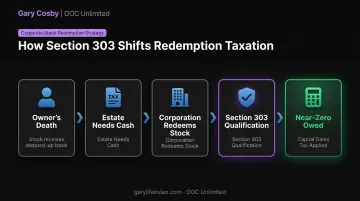
Because inherited stock generally receives a stepped-up basis to fair market value at death under IRC §1014, the gain on a redemption completed near that value is often minimal. In many cases, the tax owed on the redemption is close to zero.
Here's the typical scenario: a decedent owned a large stake in a closely held C corporation. The estate needed cash for taxes, so it sold part of that stake back to the company.
Because the redemption qualified under Section 303, the estate paid capital gains tax on the (small) difference between the redemption price and the stepped-up basis, not ordinary dividend rates on the whole amount.
Section 303 is built for closely held stock, but there's a nuance worth knowing: nothing in the statute requires the corporation's stock to remain nonpublic all the way through the redemption date.
If a company later goes public after the decedent's death, the qualification is still generally based on values at the time of death. This "once closely held" reading hasn't been tested in a specific IRS ruling.
Does It Require a Buy-Sell Agreement?
No. Section 303 doesn't legally require a buy-sell or redemption agreement to be in place. But skipping one is risky, especially for minority shareholders who could otherwise face disputes over price, timing, or whether the redemption happens at all. A written agreement removes the guesswork.
Why Section 303 Planning Matters for Business Owners
Closely held business interests are illiquid by nature. You can't sell a slice of a private company the way you'd sell shares of a public stock overnight.
Yet federal estate tax returns are generally due 9 months after death under 26 U.S.C. §6075. That's not much runway to raise six or seven figures in cash.
A properly structured Section 303 redemption solves this by letting the family:
- Keep operating the business instead of selling it to outside buyers under pressure
- Pull cash out of the corporation without triggering dividend tax rates
- Cover taxes, funeral costs, and administration expenses in one coordinated transaction
Here's the catch: none of this works if the corporation doesn't actually have the cash. Without pre-planning, the company may be forced into emergency borrowing or asset sales at the worst possible moment.
Securing a funding source before death is what turns Section 303 from a paper strategy into cash the family can actually use.
Key Requirements to Qualify for Section 303 Treatment
Qualifying isn't automatic. The IRS lays out specific tests under 26 U.S.C. §303, and missing any one of them can unravel the tax benefit.
The 35% test. The value of the redeemed stock must exceed 35% of the gross estate, after allowable debts and expenses. Owners of multiple businesses can combine ownership percentages under an aggregation rule, but only if each business represents at least 20% of the estate's value.
The three-year gift lookback. Section 2035 requires certain gifts made within three years of death to be added back into the estate for this calculation. Gifting stock away shortly before death to dodge estate tax can backfire and shrink the redeemed percentage below the 35% threshold.
Timing. The redemption generally must happen within the statute of limitations period for the estate tax return, plus 90 days. If there's a Tax Court dispute, or a Section 6166 installment election, the window can extend further.
Who bears the burden. The estate, acting through its executor or administrator, must be the party legally obligated to pay the estate taxes and administration expenses the redemption is meant to cover.
The distribution cap. Only redemption proceeds up to the total of death taxes, funeral costs, and administration expenses qualify. Anything beyond that cap loses the automatic Section 303 protection.
Reporting. The transaction is reported on Form 1041, with the stock transaction detailed on Schedule D.
How to Plan a Section 303 Redemption, Step by Step
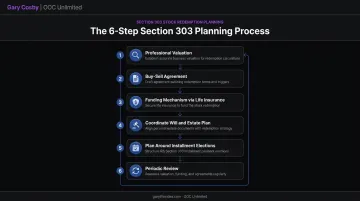
Waiting until after a death to figure this out rarely works. Here's the planning sequence that actually holds up:
- Get a professional valuation early. Confirm the estate will clear the 35% threshold well before it becomes urgent, so gaps can be fixed while there's still time.
- Draft or update a buy-sell agreement that explicitly contemplates a Section 303 redemption. This protects minority shareholders from disputes over price or timing later.
- Establish a funding mechanism. Corporate-owned life insurance is the most common way to guarantee the company has cash the moment it's needed. OOC Unlimited's licensed insurance specialists work alongside the CPA and attorney to structure this funding. They typically use permanent policies like Indexed Universal Life or Whole Life, since the death benefit must last no matter when the triggering event occurs.
- Coordinate with the will and estate plan. Make sure the executor, not an heir who received stock through joint tenancy, remains responsible for paying the taxes. This detail alone can disqualify a redemption if it's overlooked.
- Plan around Section 6166 installments if elected. Instead of one lump-sum redemption, structure a series of Section 303 redemptions timed to match each installment payment.
- Revisit the plan periodically. Business growth and ownership changes can shift whether the estate still clears the 35% test, so this isn't a one-time exercise.
Gary Cosby Jr., who leads OOC Unlimited, focuses specifically on the insurance funding piece of this puzzle. Valuation and legal drafting stay with the CPA and attorney; the insurance strategy is where his team steps in.
Advantages and Trade-offs to Weigh
Section 303 has real strengths, but it's not a free pass. Weigh both sides before locking in a plan.
Advantages:
- Liquidity without forcing a sale of the business
- Favorable capital gains treatment instead of dividend tax rates
- Family attribution rules can be waived in certain redemptions, opening up more flexibility
- Usable even when the estate isn't entirely cash-poor, as long as the 35% test is met
Trade-offs:
- The redemption amount is capped at total death taxes and expenses. Anything more doesn't automatically qualify.
- Poorly drafted wills can disqualify the entire strategy if the wrong person ends up responsible for the tax bill.
- The corporation still needs cash or financing lined up ahead of time.
There's also a variation worth knowing about, sometimes called a "reverse" arrangement. A surviving spouse or adult child loans money to the corporation, letting it fund the buyback when the company itself doesn't have enough cash on hand.
One more wrinkle to watch: if life insurance funds the redemption, the proceeds can increase the corporation's value for estate tax purposes.
The Supreme Court addressed this directly in Connelly v. United States (2024). It ruled that insurance proceeds used to fund a redemption still count toward the company's estate-tax value, and the redemption obligation doesn't offset that increase. Good planning has to account for this ripple effect, not just the death benefit itself.
Common Pitfalls When Planning a Section 303 Redemption
Even solid strategies fall apart over small mistakes. Watch for these three:
- Starting too late. Waiting until after death leaves no time for a proper valuation, agreement drafting, or securing a funding vehicle like life insurance.
- Letting will language shift the tax burden. If stock passes via joint tenancy to someone who isn't obligated to pay the estate taxes, the redemption can be disqualified entirely.
- Relying on unpredictable cash flow. Betting on organic cash flow instead of a dedicated funding source risks forced asset sales or rushed loans when the family can least afford it.
Frequently Asked Questions
What is a Section 303 exemption?
Despite the common name, Section 303 is a tax provision, not an exemption. It lets a qualifying stock redemption be taxed as a capital sale instead of a dividend, easing the tax burden on the estate.
What is a Section 303 request?
This usually refers to the formal redemption transaction initiated by the estate's executor or administrator, asking the corporation to buy back stock to cover death taxes and expenses.
What is the new Section 303?
There's no major recent overhaul of Section 303 itself. Always check current IRS guidance or recent legislative activity before relying on older interpretations.
What is a Section 303 plan?
It's the pre-death groundwork: valuation, a buy-sell agreement, and a funding strategy (often life insurance) that ensures a future redemption will qualify for favorable tax treatment.
How is a Section 303 redemption taxed?
Qualifying redemptions are taxed as a sale or exchange, meaning tax applies only to the gain above the stock's basis. That gain is often minimal thanks to the stepped-up basis at death.
Who qualifies for a Section 303 redemption?
Estates generally qualify when closely held stock exceeds 35% of the adjusted gross estate and the shareholder is legally responsible for the tax burden, subject to timing rules.