
Nearly half of small business owners have no succession plan at all, according to Gallup's 2024 survey of business owners. A business exit strategy is simply the formal plan for how an owner will transition or liquidate their stake, and it applies whether you're running a two-year-old startup, a 30-year family business, or a company that's struggling to stay afloat.
This guide breaks down the main types of exit strategies, how to pick the right one, and how to prepare so the transition protects both your business and your family's financial future.
Key Takeaways
- Decide your exit strategy years in advance, not at the finish line
- Exit paths fall into two buckets: internal (family, employees) and external (sale, IPO, liquidation)
- Only 13% of owners have a formal exit plan, despite 75% expecting to transition within a decade
- Buy-sell agreements funded with life insurance often make internal exits work smoothly
What Is a Business Exit Strategy?
A business exit strategy is the plan you use to reduce or fully liquidate your ownership stake and realize the financial value you've built. It's how you move on, whether that means retiring, launching a new venture, or simply stepping away from day-to-day stress.
This is **different from a succession plan**. An exit strategy is about your financial outcome. A succession plan is about who runs the company next. They're related, but they answer different questions:
- Exit strategy: How do you get paid, and when?
- Succession plan: Who takes over leadership and operations?
The two need to work together. A family succession, for example, is both an exit strategy (how you get bought out) and a succession plan (who leads afterward).
Here's the part most owners miss: you don't need to be selling soon to benefit from an exit strategy. Building one into your original business plan shapes decisions you make every day, from how you structure ownership to whether you document processes or keep critical knowledge locked in your own head.
Businesses built with an eventual exit in mind tend to run leaner and sell for more, whenever that exit actually happens.
Types of Business Exit Strategies
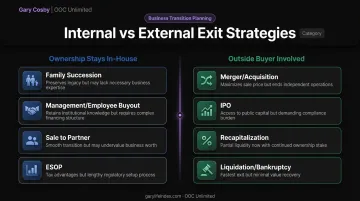
Exit strategies split into two categories: internal exits, where ownership stays inside the company, and external exits, where an outside buyer or the public markets get involved. Each path has different implications for price, speed, and control.
Internal Exit Strategies
Family or intergenerational succession: Passing the business to a child or relative preserves legacy and control at a lower cost than an outside sale, though family dynamics and next-generation readiness often complicate the transition. Family transfer was the top intended exit for 26% of Baby Boomer owners, 42% of Gen X owners, and 47% of Millennial owners, per the Exit Planning Institute's 2025 State of Owner Readiness report. Intention alone rarely becomes a documented, funded, executed plan.
Management or employee buyout (MBO/MEBO): Existing leadership purchases the company they already run. This offers continuity and motivated buyers who know the business inside out. The tradeoff: financing is often hard to secure, and the sale price tends to land lower than a third-party deal.
Sale to a partner or co-owner: The "friendly buyer" scenario: a co-owner buys your stake, speeding due diligence and minimizing disruption. It only works smoothly with a well-funded buy-sell agreement in place; otherwise, price and timing depend entirely on your partner's available cash.
Employee Stock Ownership Plan (ESOP): Employees gradually acquire ownership through a trust. ESOPs offer real tax advantages and tend to boost employee morale and retention. They're also more complex and expensive to set up than most owners expect, and repurchase obligations require steady cash flow for years afterward.
External Exit Strategies
Merger, acquisition, or sale to a third party: Often the highest-value exit available, since outside buyers will pay for growth potential, not just current cash flow. The tradeoff is a lengthy due diligence process, with real risk that the deal falls apart before closing.
Initial Public Offering (IPO): Taking the company public brings prestige and access to serious capital. It also comes with heavy regulatory burden, ongoing disclosure requirements, and a permanent loss of privacy and control most private owners underestimate.
Recapitalization: You sell a partial stake to a private equity firm or investor, take some money off the table, and keep working. Owners call this a "second bite of the apple," since a smaller share in a larger, better-capitalized company can eventually outvalue the original business.
Liquidation and bankruptcy: Last-resort strategies for businesses that are failing rather than thriving. Liquidation is quick but delivers the lowest financial return of any exit path. Bankruptcy can discharge debt, but it comes at a steep cost to credit and reputation.
How to Choose the Right Exit Strategy for Your Business
There's no universal "best" exit. The right choice depends on your goals, your business, and who else has a stake in the outcome.
Weigh these five factors before settling on a direction:
- Personal and financial goals. How much money do you actually need after you leave? Retirement lifestyle, healthcare costs, and whether the business is your only major asset all shape which exits are realistic.
- Desired control and involvement. Some owners want a clean break, while others prefer to stay on as an advisor or keep a hand in operations. Recapitalization and partial sales suit the second group; a third-party sale or liquidation suits the first.
- Business health and market timing. M&A activity rises and falls with the broader economy, and buyer demand softens during downturns. Deloitte's M&A trends research tracks these cycles closely. The pattern holds: businesses that exit during strong performance and favorable market conditions consistently command higher valuations than those forced to sell during a slump.
- Tax and legal structure implications. A stock sale is taxed very differently than an asset sale, and an ESOP carries different tax treatment than a straight M&A deal. These differences can swing your net proceeds by hundreds of thousands of dollars. That's exactly why a CPA and attorney belong on your team from day one, not after you've already signed a letter of intent.
- Number of stakeholders involved. A solo owner has far more flexibility than a business with multiple partners, shareholders, or family members. More stakeholders means more competing interests, and your exit strategy needs to balance all of them, not just yours.
How to Plan and Prepare for a Business Exit
Preparation timelines vary by source, but most advisors agree on starting well before you want to leave.
Build your advisory team early. A banker, CPA, attorney, and valuation specialist should be in place years before your target exit date. Most exits take three to five years to execute properly, so waiting until you're ready to leave means starting too late.
Get a professional valuation. Don't guess at what your business is worth. A real valuation identifies what drives value: recurring revenue, management that can run things without you, and documented processes buyers can trust.
Clean up financials and operations. Buyers and lenders want several years of accurate financial statements. They also want to see a business that doesn't fall apart the moment the owner steps back.
Protect key relationships and legal exposure. Document customer and supplier contracts. Resolve outstanding liabilities. Retain the key employees whose departure could tank the deal or spook a buyer mid-negotiation.
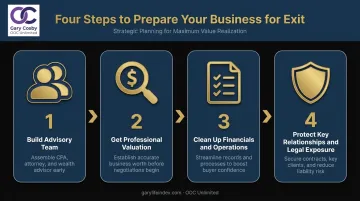
These four steps only pay off if the business can eventually run without you.
Owner dependence is one of the biggest value killers in any sale. If the business can't function without you personally, buyers will discount their offer, or walk away entirely.
Funding Your Exit Strategy: Where Insurance Fits In
Here's something a lot of owners overlook until it's almost too late: most internal exit strategies, whether a partner buyout, family succession, or management buyout, depend on a buy-sell agreement. And a buy-sell agreement is only as strong as the mechanism funding it.
Life insurance is the most common way to guarantee the cash is actually there when a triggering event, like death, disability, or retirement, happens. Without it, remaining owners often have to scramble for financing, dip into business cash reserves, or renegotiate terms under pressure.
A few ways this plays out in practice:
- Buy-sell agreement funding: Life insurance proceeds let remaining owners or the business itself purchase a departing owner's interest without a cash shortfall or a fire sale of assets.
- Key person insurance: Softens the financial hit of losing an essential owner or executive mid-transition, helping cover lost revenue while a successor gets up to speed.
- Section 162 executive bonus plans and split-dollar arrangements: Both build permanent life insurance coverage that can later fund a buy-sell agreement, giving owners flexibility to structure funding around their tax situation.
Turning these strategies into a funded plan takes more than picking a policy. It requires someone who understands how the insurance piece fits into your broader business and tax picture.
Gary Cosby Jr., a licensed life insurance agent in all 50 states, works with business owners on exactly that piece, exploring insurance-funding options for key person and buy-sell needs.
He coordinates with the owner's existing CPA and attorney, making sure the funding strategy fits into the broader legal and tax plan rather than operating as a separate afterthought.
Pairing your exit strategy with the right insurance funding removes one of the biggest risks in the entire process: being forced into an underpriced, rushed sale because the cash simply wasn't there when you needed it. That protection is what lets an exit plan actually protect the legacy you spent years building.

Frequently Asked Questions
What are the four basic exit strategy possibilities?
The four commonly cited paths are selling to a third party, passing the business to family, liquidating the business, or taking it public. Most specific strategies, like MBOs or ESOPs, fall under one of these broader umbrellas.
What is the 5-year exit strategy?
It refers to the common practice of planning an exit three to five years in advance. That window gives you time to grow business value, clean up financials, and build the advisory team needed for a smooth transition.
What is the most common exit strategy for small business owners?
Selling to a third party or to a partner or family member tends to be most common for small businesses. Larger companies more often pursue M&A, recapitalization, or an IPO.
How long does it actually take to exit a business?
The three-to-five-year window mostly covers planning and preparation. Once you have a qualified buyer, the sale itself often closes within six to twelve months, though complexity and market conditions can stretch that timeline.
Do I need a CPA or attorney to plan a business exit?
Yes. Tax structure, valuation, and legal agreements are complex enough that a coordinated advisory team is standard practice for any serious exit plan, not an optional extra.
Can life insurance really help fund a business exit?
Yes. Life insurance is a standard tool for funding buy-sell agreements and key person protection, so partners, family members, or employees can execute a buyout without a sudden cash shortfall.