Introduction
Picture this: your top salesperson, the one responsible for nearly half your annual revenue, dies unexpectedly in a car accident. Or your co-founder, the person who built every client relationship from scratch, suffers a stroke and can't work for months.
What happens to your business next? For many small and growing companies, the answer isn't reassuring. Lost revenue, missed deadlines, and lenders asking hard questions often follow.
Research shows 71% of firms say they're highly dependent on one or two key people, yet only 22% carry key person life insurance to protect against that risk, according to the Insurance Information Institute.
This guide breaks down what key person insurance is, who actually needs it, how much coverage makes sense, and how it compares to other business coverage like D&O insurance.
Key Takeaways
- Key person insurance ("key man insurance") is a business-owned policy on a key employee's life or ability to work
- The business, not the employee's family, receives the payout if that person dies or becomes disabled
- Lenders and investors often require this coverage before approving financing
- Premiums aren't tax-deductible, but death benefits are typically received tax-free
- Coverage amounts are based on revenue contribution, replacement costs, or salary multiples
What Is Key Person Insurance & Who Needs It?
Key person insurance is a life or disability policy a company buys on a critical employee, with the business named as both owner and beneficiary. If that employee dies or becomes disabled, the payout goes to the business, not their family.
The purpose isn't complicated. The money offsets lost revenue, covers replacement costs, and buys the business time to stabilize while it figures out its next move.
How Ownership, Premiums & Consent Work
The business owns the policy and pays every premium, which makes this a form of company-owned life insurance. That structure directly answers a common question: who owns key person insurance? The company does, from the day the policy is issued.
That ownership comes with a legal requirement, though. Under IRC Section 101(j), the insured employee must receive written notice of the coverage amount and give written consent before the policy is issued, acknowledging the company will be the beneficiary.
Skip this step, and the IRS may limit the tax-free death benefit to only the premiums paid, rather than excluding the full payout. Advisors who specialize in business insurance funding, including the team at OOC Unlimited, routinely walk owners through this notice-and-consent requirement to keep the payout tax-free.
Who Qualifies as a "Key Person"?
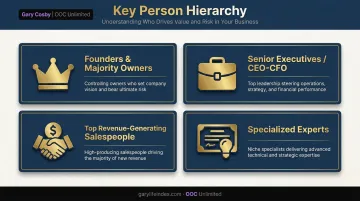
Typical candidates include:
- Founders and majority owners whose vision, relationships, and decision-making drive the business
- Senior executives like a CEO or CFO who manage financing, operations, or major vendor relationships
- Top revenue-generating salespeople who carry a disproportionate share of the client book
- Specialized experts holding proprietary knowledge, licenses, or client relationships that are genuinely hard to replace
Here's the guiding test: if this person disappeared tomorrow, would the business struggle to survive or lose significant revenue? If yes, they're a key person.
Think of a five-person marketing agency where one strategist holds every client relationship. If she left, would those clients follow her out the door? This gap between dependency and protection shows up in small businesses more often than owners expect. Owners recognize the risk long before they act on it.
Types of Key Person Insurance Policies
Most businesses build protection around two categories: life insurance and disability insurance. Many carry both, since death and disability create similar financial gaps but arrive under very different circumstances.
Life Insurance: Term vs. Permanent
Term life insurance covers a set period, usually 10 to 30 years, and costs less than permanent coverage. Businesses often size the term to match a loan repayment schedule or a funding round timeline, so protection lasts exactly as long as the risk does.
Permanent life insurance costs more but never expires, and it builds cash value the business can borrow against. It's also the more common vehicle for funding a buy-sell agreement, since ownership transitions can happen decades into a company's life, well past the point a term policy would have lapsed.
Cost is often the deciding factor:
- Term: Premiums run a fraction of permanent costs for the same face amount, making it the default for younger companies or loan-tied coverage
- Permanent: Costs more upfront, but it fits businesses that have stabilized and want protection that never needs renewing
Disability Insurance for Key Employees
Life insurance only covers death. Disability insurance fills the other gap: it pays the business a monthly benefit if a key person becomes unable to work, whether from illness, injury, or an unexpected medical event.
Every disability policy includes an elimination period, the waiting stretch between the disability and the first benefit payment. That window varies by carrier and policy design, so it's worth reviewing against your business's cash reserves before you choose a policy.
GFI's licensed agents specialize in this area, including Gary Cosby, who helps business owners explore insurance-funding options for both key person disability coverage and business overhead expense (BOE) insurance.
The two work well as a pair: one replaces the person's value to the business, and the other covers rent, payroll, and other fixed costs while a replacement gets up to speed.
How Much Key Person Insurance Coverage Does Your Business Need?
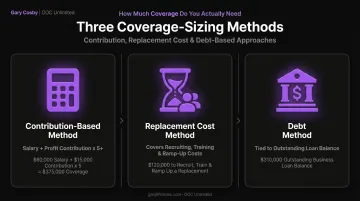
There's no universal formula for sizing key person coverage, but three methods give you a reasonable starting point.
- Contribution-based method – Add the key person's annual salary to their direct contribution to company profit, then multiply the total by at least five. A sales director earning $120,000 who drives $500,000 in annual profit points toward a starting figure above $3 million.
- Replacement cost method – Total the recruiting fees, onboarding time, training costs, and productivity gap you'd absorb while a replacement ramps up. For a specialized role, that ramp-up alone can run a year or more.
- Debt method – If a lender required this policy as collateral, coverage should at least equal the outstanding loan balance tied to that person's role.
A few more factors worth layering in:
- Any minimum face amount your lender or investors require as a financing condition
- Outstanding business debt beyond what's tied specifically to the key person
- How long it would realistically take to stabilize operations without this person
None of these methods spit out an exact number on their own, which is exactly why a licensed advisor matters here. GFI's team, for example, coordinates with a business's CPA and attorney on the tax and legal considerations that affect the right coverage amount for that specific situation.
You can book a free consultation to walk through the numbers for your business.
Revisit the figure periodically, too. As revenue grows or new debt gets added, an original policy amount can fall short of what the business needs.
Benefits, Costs & Tax Considerations
For most businesses that depend heavily on one or two people, the benefits of key person coverage outweigh the cost. The core value drivers:
- Protects revenue during the transition after losing a critical person
- Covers recruiting and training costs for a replacement
- Satisfies lender or investor requirements tied to financing
- Preserves business value for owners, partners, and shareholders
Premium costs depend on the key person's age, health, and the coverage amount tied to their role. Term policies cost less for short-term needs; permanent policies build cash value at a higher price.
Tax treatment follows a fairly consistent pattern, covering three areas:
- Premiums: Generally not deductible, since the business is both the policy's owner and beneficiary, per IRS Publication 535
- Death benefits: Received income-tax-free if the Section 101(j) consent steps were completed before the policy was issued
- Cash value: Grows tax-deferred inside a permanent policy, with no tax owed unless the business takes a distribution
A few exclusions to keep in mind:
- Coverage doesn't pay out if the key person resigns or is terminated; the policy simply gets canceled, converted, or reassigned
- Undisclosed pre-existing health conditions can void the death benefit
- Standard exclusion periods apply, such as suicide clauses during a policy's early contestability window
Key Person Insurance vs. D&O and Other Business Coverage
Key person insurance is a life or disability policy, not a liability policy. That distinction matters once you start comparing it to other business coverage.
| Coverage | What It Protects |
|---|---|
| Key Person Insurance | Pays the business after losing a critical employee, owner, or partner to death or disability |
| D&O Insurance | Protects directors and officers personally from lawsuits over management decisions |
| Buy-Sell Insurance | Funds the purchase of a departing owner's share of the business |
| E&O Insurance | Covers claims of negligence or inadequate professional work |
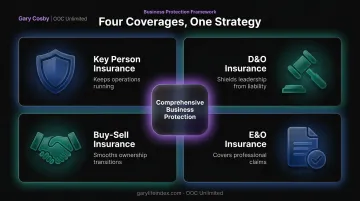
Many growing businesses carry several of these at once. Key person insurance keeps operations running after a critical loss, D&O shields leadership from personal liability, buy-sell funding smooths ownership transitions, and E&O covers claims tied to professional work.
Frequently Asked Questions
Is key person insurance worth it?
If losing one person would seriously hurt your revenue, operations, or financing terms, yes. It's especially valuable if your business is founder-led or built around a handful of key client relationships.
Who owns key person insurance?
Your business owns the policy, pays the premiums, and is the beneficiary. The employee is only the insured party and must give written consent before coverage begins.
What type of insurance is key person insurance?
It's typically structured as term or permanent life insurance, often paired with a disability rider or a standalone disability policy for full protection.
What's the difference between key person insurance and D&O insurance?
Key person insurance protects your business financially from losing a critical employee. D&O insurance protects directors and officers personally from lawsuits tied to management decisions.
How much does key person insurance cost?
Cost depends on your key person's age, health, coverage amount, and policy type. A licensed advisor can help you compare options based on financial impact rather than premium price alone.
What happens if the key person leaves the company?
Coverage doesn't automatically transfer. You can cancel the policy, let the employee convert it personally, or restructure coverage around a replacement.