
Succession planning is rarely a spreadsheet problem. It's an emotional one, tangled up with family relationships, sibling rivalries, and a founder's identity. Add in estate taxes, buy-sell agreements, and leadership readiness, and it's no wonder so many owners keep putting it off.
This guide breaks down what succession planning actually involves: the stages, the human side of handing over control, and the financial and tax strategies (including insurance-based funding) that protect both the business and the family's wealth.
Key Takeaways
- Only 34% of U.S. family businesses have a documented, communicated succession plan
- Planning typically takes 5-10 years or longer to execute well
- Ownership and leadership transfer are two separate decisions, not one
- A structured, insurance-funded buy-sell agreement prevents forced sales during a crisis
- Poor family communication, not poor tax planning, causes most succession disputes
What Is Family Business Succession Planning?
Family business succession planning is the process of transferring two distinct things: management (who runs daily operations) and ownership (who holds equity and control). These don't have to go to the same person, and they don't have to happen on the same timeline.
A daughter might take over as CEO while ownership stays split among several siblings. A trusted non-family executive might run operations while the founder's children retain shares as passive owners. Treating these as one decision is where a lot of plans go sideways.
Why This Differs From Standard Corporate Succession
Public companies replace executives through boards and performance reviews. Family businesses carry extra weight:
- Legacy and identity: the business often is the family's story
- Multi-generational goals: retirement income for founders, career paths for the next generation, and fairness among heirs who may not all work in the business
- Relationship risk: a bad handoff can fracture a company and a family at the same time
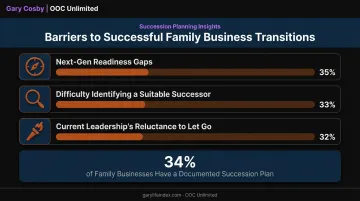
Despite the stakes, only 34% of U.S. family businesses report having a "robust, documented and communicated succession plan" in place, according to PwC. That leaves roughly two-thirds operating without a real plan, relying on informal assumptions instead.
Why Family Businesses Need a Succession Plan
The Family Business Consulting Group's (FBCG) oft-cited 30%-13%-3% survival formula has been challenged by more recent research, which points out that family wealth and business continuity aren't automatically linked. Still, the underlying warning holds: businesses without a deliberate transition plan face avoidable risk.
Recent research quantifies that risk. Deloitte's 2025 global family business study found the top barriers to successful transitions were next-generation readiness (35%), difficulty identifying a suitable successor (33%), and current leadership's reluctance to let go (32%). The study surveyed 1,587 family businesses with at least $100 million in revenue across 35 countries.
What happens without a plan:
- Sudden leadership vacuums when a founder dies, retires abruptly, or becomes incapacitated
- Financial disruption if the business can't cover a buyout or estate tax bill
- Family conflict over who's "in charge" without documented criteria
- Loss of institutional knowledge that walks out the door with the founder
What a plan protects:
- Business continuity and client/employee confidence during the transition
- A stronger leadership pipeline built years in advance
- Preserved family wealth through coordinated tax and estate strategy
- Fewer costly disputes among heirs and non-family stakeholders
The Stages of Family Business Succession Planning
According to the Family Business Consulting Group (FBCG), succession is a process that can run 15-20 years, built in deliberate stages rather than tackled in a single meeting.
Stage 1: Start Early and Treat Succession as an Ongoing Process
Ideally, planning begins 5-10 years before a transition. This starts with informal conversations, not legal documents, exposing next-gen family members to the business from an early age without pressuring them into it.
Stage 2: Clarify Business and Family Goals
Business strategy and family aspirations don't always align. One child may want rapid expansion; a parent may want stability for retirement income. Separating these conversations prevents conflicting priorities from derailing the plan.
Stage 3: Identify and Develop Potential Successors
Outside work experience matters. FBCG recommends 3-5 years working elsewhere before returning, followed by another 3-5 years in a defined role with a mentor who isn't a parent. Real job titles and responsibilities beat vague "learning the ropes" arrangements.
Stage 4: Establish Governance Structures
A family council, advisory board, or written family constitution creates decision-making criteria before emotions run high. It answers questions like:
- Who can join the business
- How disputes are resolved
- What happens if a successor underperforms
Stage 5: Build the Financial, Legal, and Tax Plan
This stage coordinates estate plans, buy-sell agreements, and funding mechanisms — the financial backbone covered in detail below.
Stage 6: Execute the Transition and Set a Timeline
Set a firm date. Communicate it to staff, family, and clients. Then follow through, resisting the urge to hover or override the new leader's decisions once authority has formally shifted.
How to Handle Succession: Choosing and Preparing the Right Leader
Choose a Successor Objectively, Not by Default
The eldest child or the loudest voice at family dinner isn't automatically the best CEO. A selection committee with defined leadership criteria (financial acumen, people management, industry knowledge) removes birth order and personality from the equation.
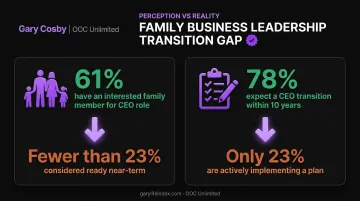
The gap between interest and readiness is wide. A recent survey of 300 U.S. family business executives found that 61% had at least one family member interested in the CEO role. Fewer than 23% believed those candidates were actually ready to step in near-term.
The same study found 78% expected a CEO transition within 10 years, yet only 23% were actively implementing their plan.
Prepare Successors Through Experience and Mentorship
A pattern that works well:
- Outside experience first: 3-5 years at another company builds credibility and skills
- Structured mentorship: pair the successor with a non-parent executive inside the business
- Defined milestones: tie promotions and expanded authority to demonstrated performance, not tenure
Manage Family Dynamics and Communication
Regular family meetings and transparent criteria-sharing head off resentment before it festers. This matters even more with complicated family structures: in-laws with business opinions, blended families with half-siblings, or non-family executives who feel overlooked despite years of loyal service.
Address the Emotional Challenge of Letting Go
Founders often struggle to step back because the business has become part of their identity. Achieving personal financial independence outside the company through retirement savings, investments, or insurance-funded strategies like buy-sell agreements and key person policies is often what makes a clean handoff possible.
Without it, founders cling to control out of financial necessity, not just emotional attachment.
Financial and Tax Strategies for a Smooth Ownership Transition
Ownership transfers trigger several overlapping tax regimes:
- Gift tax: applies when a business interest transfers for less than full value; the donor typically files Form 709
- Estate tax: the business interest's fair market value counts toward the taxable estate at death
- Generation-skipping transfer (GST) tax: a separate layer that can apply when assets pass directly to grandchildren or other "skip persons"
- Capital gains tax: basis rules differ for gifted versus inherited assets, affecting future tax on a sale
Common Tax-Minimization Strategies
Families frequently combine two proven approaches to reduce the tax hit on a transfer. Gradual gifting moves ownership in smaller increments over time, often using the annual gift tax exclusion to transfer shares each year with minimal tax exposure. Irrevocable trust structures, such as Intentionally Defective Grantor Trusts (IDGTs), let a grantor sell business interests to the trust while future appreciation grows outside the taxable estate.
These strategies require coordinated guidance from an attorney and CPA — they aren't do-it-yourself territory. Once ownership starts moving, the next question becomes how a departing owner actually gets paid, which is where buy-sell agreements come in.
Buy-Sell Agreements Need a Funding Mechanism
A buy-sell agreement formalizes how ownership transfers between family members or partners when a triggering event occurs: death, disability, retirement, or a dispute. The agreement is only as good as its funding. Without cash available, a surviving owner may be forced to liquidate assets or take on debt to buy out a departing partner's share.
Life insurance typically funds this gap. It's commonly used to:
- Fund buy-sell agreements so remaining owners can purchase a departing owner's interest immediately
- Cover key-person risk when a founder or specialist drives disproportionate revenue
- Provide liquidity for heirs so a business doesn't get sold under pressure
Gary Cosby Jr. and the Global Financial Impact team work specifically on this insurance-funding piece. Gary, licensed in all 50 states, helps business owners structure policies that fund buy-sell agreements and key-person protection, coordinating directly with the owner's CPA and attorney rather than replacing them.

His team handles the insurance mechanics. The attorney drafts the binding agreement, and the CPA or valuation professional determines what the business is actually worth.
No single advisor covers every angle here. An attorney, a CPA, and an insurance specialist working as a coordinated team give a succession plan its strongest financial foundation, with each advisor handling the piece they're actually qualified to handle.
Common Succession Planning Mistakes to Avoid
Even well-intentioned families stumble in predictable ways.
Assuming a successor will "naturally emerge." Waiting for clarity to arrive on its own usually just delays hard conversations. A deliberate, documented process with clear criteria works better than hoping the right person steps forward.
Treating ownership and management as the same decision. They're separate questions with separate answers. Conflating them forces an all-or-nothing choice that doesn't need to exist.
Communicating poorly with the broader family. PwC's global survey of over 2,000 family business leaders found that 41% of respondents said family members didn't share similar views on business direction. Only 19% had formal conflict-resolution mechanisms in place. Non-selected family members who feel blindsided or dismissed often carry that resentment for years, sometimes into litigation.
Frequently Asked Questions
What is succession planning in a family business?
It's the process of transitioning both leadership and ownership of a family business to the next generation or a chosen successor. The goal is preserving the business's continuity along with family relationships.
What are the stages of succession planning for a family business?
The core stages are: starting early, clarifying business and family goals, developing successors, establishing governance, building the financial and tax plan, and executing the transition on a set timeline.
How to handle succession in a family business?
Choose a successor objectively using defined criteria, provide outside experience and mentorship, communicate transparently with the whole family, and commit to a firm transition timeline.
How early should a family business start succession planning?
Most experts recommend starting 5-10 years before an expected transition. Given that full succession can take 15-20 years, earlier is almost always better.
What role does life insurance play in family business succession planning?
Life insurance commonly funds buy-sell agreements, providing the liquidity needed to complete a buyout after a death or disability. It also protects against key-person risk when a founder's absence would otherwise disrupt operations.
Who should be involved in family business succession planning?
The family itself, a governance body like an advisory board or family council, and outside professionals (an attorney, a CPA, and an insurance specialist) each play a distinct, necessary role.