There's a tool a lot of people overlook: the life insurance policy already sitting in a filing cabinet.
This post isn't about "collateral insurance" in some generic sense — that phrase gets searched a lot, but it's not really a product. What we're covering is collateral assignment of life insurance, a specific strategy that lets a policyholder use their death benefit to back a loan without handing over full ownership of the policy.
We'll walk through what collateral actually means, how a collateral assignment works step by step, how to set one up, and where the risks hide. By the end, you'll know whether this fits your situation or a business you're advising.
Key Takeaways
- Collateral assignment secures a loan with your death benefit; ownership stays with you
- Permanent policies are usually preferred, though some lenders accept term coverage
- You keep paying premiums — the lender doesn't take that over
- Repay the loan, and the death benefit reverts fully to your beneficiary
What Is Collateral? Understanding the Basics
Collateral is simple: it's an asset you own that you pledge to a lender to reduce their risk. If you can't repay, the lender has a legal claim to that asset. The FDIC defines it exactly this way: an owned asset pledged to secure repayment, which the lender may seize after nonpayment.
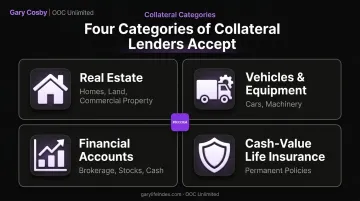
Lenders generally accept four broad categories of collateral:
- Real estate: homes, land, commercial property
- Vehicles and equipment: cars, machinery, business equipment
- Financial or investment accounts: brokerage accounts, publicly traded stock, cash
- Cash-value life insurance: permanent policies with accumulated value
That fourth category behaves differently than the other three. A house or a car can be seized and sold. A life insurance policy can't be repossessed and liquidated the same way.
Its value gets realized when the insured dies, not when a lender shows up with a tow truck. That distinction is exactly why collateral assignment exists as its own mechanism, separate from a standard lien.
Why This Matters for Borrowers
Loan denials tied to collateral shortfalls aren't rare. In the Federal Reserve's 2024 Small Business Credit Survey, 31% of applicants who were denied at least some requested financing cited insufficient collateral, up from 22% in 2021. If a business or individual has a policy with real cash value, that's a resource many borrowers don't think to bring to the table.
What Is Collateral Assignment of Life Insurance & How Does It Work?
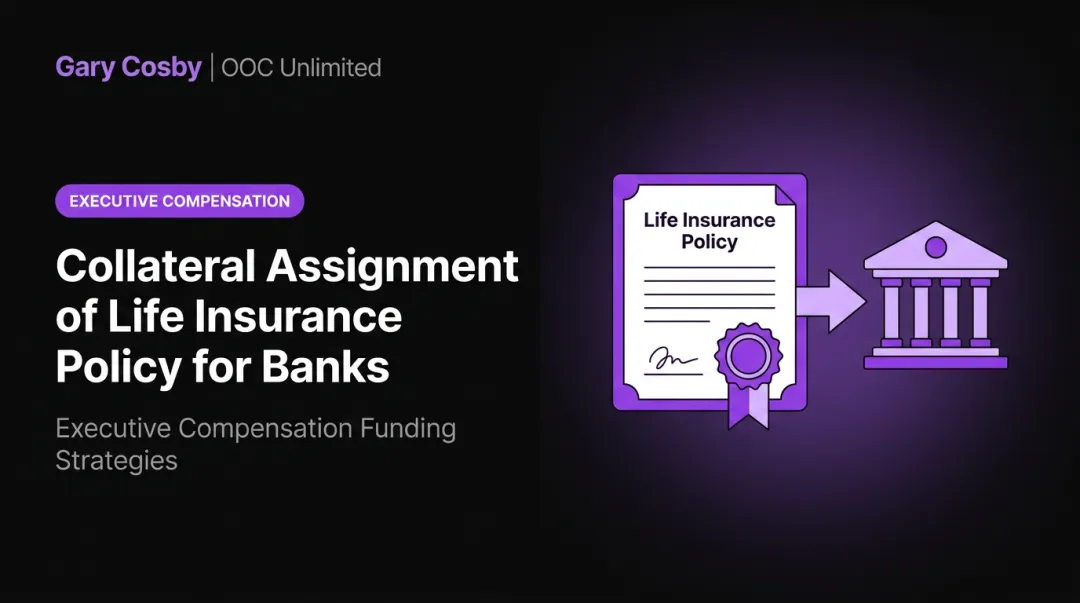
A collateral assignment names a lender as an assignee on your life insurance policy. Not the beneficiary. Not the owner. An assignee with a claim limited to the unpaid loan balance.
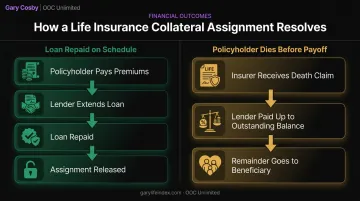
Here's the sequence if things go smoothly:
- You keep the policy, pay the premiums, and name your beneficiary
- The lender extends the loan, comfortable knowing the death benefit backs it up
- You repay the loan on schedule
- The assignment gets released, and the policy goes back to functioning exactly as it did before
Here's what happens if you die before the loan is paid off:
- The insurer receives the death claim
- The lender gets paid first, but only up to the outstanding loan balance
- Whatever remains goes to your named beneficiary
Who Pays the Premiums?
You do. The policyholder remains responsible for ongoing premium payments throughout the loan term, not the lender. MassMutual's 2024 guidance confirms this is the standard structure. Some lenders will negotiate an arrangement where they cover premiums to protect their interest and simply add that cost to the loan balance, but that's the exception, not the rule.
A Simple Example
Say you take out a $100,000 business loan and assign a life insurance policy with a $500,000 death benefit as collateral. If you pass away when $60,000 is still outstanding:
| Recipient | Amount |
|---|---|
| Lender (assignee) | $60,000 |
| Beneficiary | $440,000 |
The beneficiary still receives the bulk of the payout. That's the whole point of an assignment versus signing the policy over entirely.
Which Policies Qualify?
Permanent policies — whole life and indexed universal life (IUL) — tend to be the preferred choice because they build cash value, giving the lender an extra layer of security beyond the death benefit alone.
Term life can sometimes be accepted, but lenders take on more risk since coverage expires. If the term ends before the loan does, the lender loses its backstop, and acceptance ultimately comes down to the individual lender's requirements. Because carrier guidelines vary, working with an independent agent who represents multiple A-rated carriers makes it easier to match a policy to your lender's specific criteria.
How to Set Up a Collateral Assignment of Life Insurance
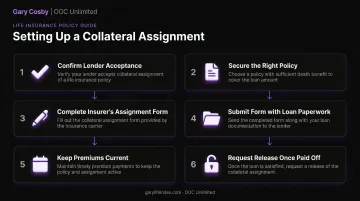
Setting this up isn't complicated, but skipping a step can cause real headaches later.
- Confirm lender acceptance. Ask directly whether they take collateral assignments, and what minimum death benefit or policy type they require.
- Secure the right policy. Apply for new coverage or verify your existing policy meets the lender's threshold.
- Complete the insurer's assignment form. This names the lender as assignee and requires signatures from both parties — it is not a change-of-ownership document.
- Submit the form with your loan paperwork. The insurer needs to record the assignment on file.
- Keep premiums current. Letting the policy lapse can trigger a loan default clause.
- Request a release once paid off. Notify the insurer so the assignment is removed and full beneficiary rights are restored.
Because the collateral assignment form is specific to each insurer, working with someone who understands the carrier landscape helps avoid delays.
Agents at OOC Unlimited/GFI work with a network of 25+ A-rated carriers, including Prudential, Lincoln Financial, and Foresters Financial. They can match a policy structure to what a specific lender requires, a step that matters most for business owners layering this into a broader financing plan.
Benefits, Risks & Mistakes to Avoid When Using Life Insurance as Collateral
Benefits:
- Improves loan approval odds or secures better interest rates without pledging your home or vehicle
- Preserves other personal or business assets by using an insurance policy as security instead
- Keeps the process reversible: once the debt clears, the assignment disappears
The main risk: if you die before the loan is repaid, your beneficiaries receive less than the full death benefit. That's a real tradeoff worth discussing with anyone who depends on that payout.
Common Mistakes Worth Avoiding
Three mistakes show up repeatedly in how this strategy gets misused:
- Naming the lender as primary beneficiary instead of using a proper collateral assignment form. This is a costly error: it can entitle the lender to the entire death benefit, not just the loan balance, leaving your family with nothing.
- Letting the policy lapse. Missed premiums can trigger default clauses in the loan agreement, forced repayment, or a spike in interest rates.
- Forgetting to remove the assignment after payoff. Skipping the formal release request can leave the policy encumbered longer than necessary, complicating future claims or refinancing.
A 2023 LIMRA study cited by MassMutual found that 75% of business owners recognize life insurance can serve as loan collateral. Awareness is high. Execution is where things go wrong, usually because the paperwork wasn't handled correctly from the start.
Alternatives & When to Get Expert Guidance
Collateral assignment isn't the only path. Depending on your situation, consider:
- Borrowing directly against a policy's cash value: no external lender, no assignment paperwork, but it reduces your death benefit and accrues interest
- Applying for an unsecured loan: no collateral needed, but expect a higher rate and stricter qualification
- Pledging other physical assets: real estate or equipment, if you'd rather leave the policy untouched
Business owners frequently pair collateral assignment with other insurance-funded strategies. A properly structured permanent policy can support key person coverage, protecting the business if a critical employee dies, or business overhead expense protection, which keeps operating costs covered during a disruption.
Layering these together strengthens a financing application rather than relying on one tool alone.
Before finalizing a new policy or signing an assignment form, talk to a licensed professional. Gary Cosby Jr. and the agents at OOC Unlimited/GFI work in all 50 states and specialize in helping business owners evaluate insurance-funding options for these scenarios. They match policy type, carrier, and structure to what a lender actually requires.
Frequently Asked Questions
Can you borrow money and use your life insurance as collateral?
Yes, in two ways: borrow directly against the policy's cash value from your insurer, or assign the policy as collateral to secure a loan from a third-party lender.
Who pays insurance for collateral?
The policyholder remains responsible for premium payments throughout the loan term, not the lender. Missing payments can put both the collateral assignment and the loan at risk.
What are the four types of collateral?
Real estate, vehicles or equipment, financial or investment accounts, and cash-value life insurance policies are the four common categories lenders accept.
Does collateral assignment affect my beneficiaries?
If you die before the loan is repaid, the lender is paid first from the death benefit, up to the outstanding balance. Your named beneficiary receives whatever remains.
Is collateral assignment of life insurance taxable?
No, assigning a policy as collateral isn't treated as transferring ownership under federal tax rules. However, surrendering the policy or letting it lapse with an outstanding loan can trigger separate tax consequences.
Can I remove a collateral assignment once my loan is paid off?
Yes. Once the loan is fully repaid, you can request the insurer release the assignment, which restores full death benefit rights to your named beneficiaries.