Introduction
Every employer wants the same thing: pay people for results, not just for showing up. But bonus plans have a bad habit of backfiring. Instead of motivating employees, a poorly built plan breeds confusion and resentment, sometimes even distrust in leadership.
Part of the problem is misunderstanding. Employees rarely know how their bonus is calculated. Employers often don't know how it's taxed or funded. 98% of organizations used at least one bonus program in 2024, up from 93% in 2021, yet only 12% actually measured whether the program worked.
This guide breaks down how bonus plans may work in practice: the structures available, how payouts get calculated and funded, design considerations to weigh, and how the IRS generally treats that extra check when it lands. This content is for educational purposes only and is not tax or legal advice; please consult your own CPA or attorney regarding your specific situation.
Key Takeaways
- Bonus plans tie pay to measurable outcomes, not hours logged
- Common structures include performance bonuses, profit-sharing, and equity ownership
- Payout formulas and honest communication build more trust than the dollar amount itself
- Employee-owners quit at roughly one-third the national average, per NCEO research
What Is an Employee Bonus Plan?
A bonus plan is formal, additional compensation paid on top of base salary. The Department of Labor defines a bonus simply as a payment made in addition to regular earnings. That distinction matters: base pay compensates time worked, while a bonus compensates outcomes.
This is what's often called the "payment for success" philosophy. Instead of paying someone the same amount whether the company has a record year or a rough one, bonuses put a slice of pay at risk, and in return, give employees a stake in the outcome. The relationship shifts from purely transactional to something closer to shared consequences.
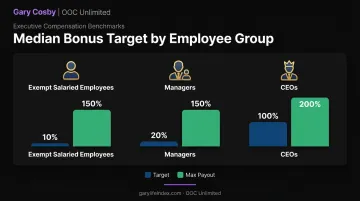
How big is that slice, typically? According to WorldatWork's 2025 survey of 706 organizations, median annual bonus targets at public companies break down like this:
| Employee Group | Median Target (% of Salary) | Median Max Payout |
|---|---|---|
| Exempt salaried employees | 10% | 150% |
| Managers | 20% | 150% |
| CEOs | 100% | 200% |
Note these are targets as a percentage of base salary, not total pay. Depending on the circumstances, a manager with a 20% target and a 150% max payout could see a bonus as large as 30% of salary in an exceptional year.
Bonus vs Commission vs Raise
These three terms get used interchangeably, and that's exactly where confusion often starts.
- Commission is typically tied to a fixed percentage of individual sales or revenue. It's narrow by design.
- Bonus can apply to any role and any measurable output: quality scores, project completion, team performance, company profit.
- Raise permanently increases base salary going forward.
So which is "better"? It depends on the goal. A bonus may give employers flexibility since it doesn't create a permanent cost increase, and it can flex down in a bad year.
A raise gives employees more predictability and may compound over time (your 401(k) match and future raises are often calculated off base salary, not bonus income). Employers may lean on bonuses when performance varies year to year; employees generally may prefer raises when they want stability they can budget around.
Why Employers Use Bonus Plans
Bonus programs are common. In 2024, 81% of organizations used performance bonuses, 80% used sign-on bonuses, and 66% used retention bonuses.
Done thoughtfully, bonus plans may boost engagement and reduce turnover, but generally only when the criteria are clear and applied consistently. Here's the catch: if a bonus becomes routine and predictable regardless of performance, it may stop motivating anyone. Employees may start to see it as guaranteed pay rather than an earned reward, which can undermine the point of having a bonus plan in the first place.
How Do Employee Bonus Plans Work?
Most bonus plans run on two variables: a target bonus and a performance multiplier.
- Target bonus: A percentage of base salary assigned by role or level (see the table above)
- Performance multiplier: A score reflecting how actual results compared to goals
The Payout Formula
The math is often simpler than most employees assume:
Base Salary × Target Bonus % × Performance Multiplier = Bonus Payout
The multiplier scale typically runs from 0% for missed goals up to 150-200% for exceeding stretch targets. Miss the threshold entirely, and the payout may drop to zero. Hit target exactly, and the multiplier commonly lands at 100%. Push well past stretch goals, though, and the multiplier can climb into the 150-200% range, sometimes doubling the expected payout.
Here's a simplified example:
An employee earns a $50,000 base salary with a 10% target bonus. Their weighted performance score for the year comes in at 96% of goal.
$50,000 × 10% × 0.96 = $4,800
That's the entire calculation for most employees. No spreadsheet required, as long as the employer communicates the formula clearly.
Funding, Eligibility, and Timing
Bonus payouts often aren't unlimited, even when an individual delivers a standout performance. Many plans draw from a bonus pool, funded as a percentage of company revenue or profit. That pool caps total payouts regardless of individual results. In a down year, even a stellar individual performance might get scaled back because the overall pool shrank.
Eligibility mechanics matter just as much as the payout math:
- Minimum tenure requirements (often 90 days or more before eligibility begins)
- Active-employment-at-payout clauses, meaning you generally must still be employed on the payout date
- Pro-rata calculations for employees who joined or left mid-year
On timing: annual bonus plans dominate the market, with the vast majority of public companies paying out once per year following the close of the performance period. A predictable, consistently honored payout date may matter just as much as the amount. Employees often remember when a check is late far more than when it's exactly what they expected.
Types of Employee Bonus Plan Structures
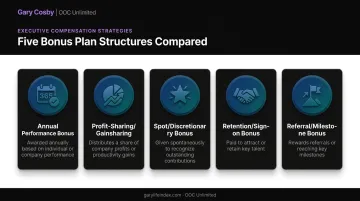
Not all bonuses work the same way. Here's how the major structures generally differ:
- Annual performance bonus — Tied to year-end review ratings and company or department results. Among the most common structures for corporate roles.
- Profit-sharing / gainsharing — Distributes a percentage of company profit broadly across employees, aligning personal outcomes with overall company growth rather than individual metrics alone.
- Spot/discretionary bonus — A one-time, manager-initiated reward for a specific contribution, issued outside any formal review cycle.
- Retention and sign-on bonuses — Address specific business needs, like attracting a new hire or preventing an existing key employee from walking out the door. These often vest over time rather than paying in full upfront.
- Referral and milestone bonuses — Reward employees for specific contributions, such as a successful hire referral or hitting a tenure or project milestone.
Executive Bonus Plans Using Life Insurance
A newer approach moves beyond cash bonuses altogether: giving key employees a permanent asset instead of a one-time payout.
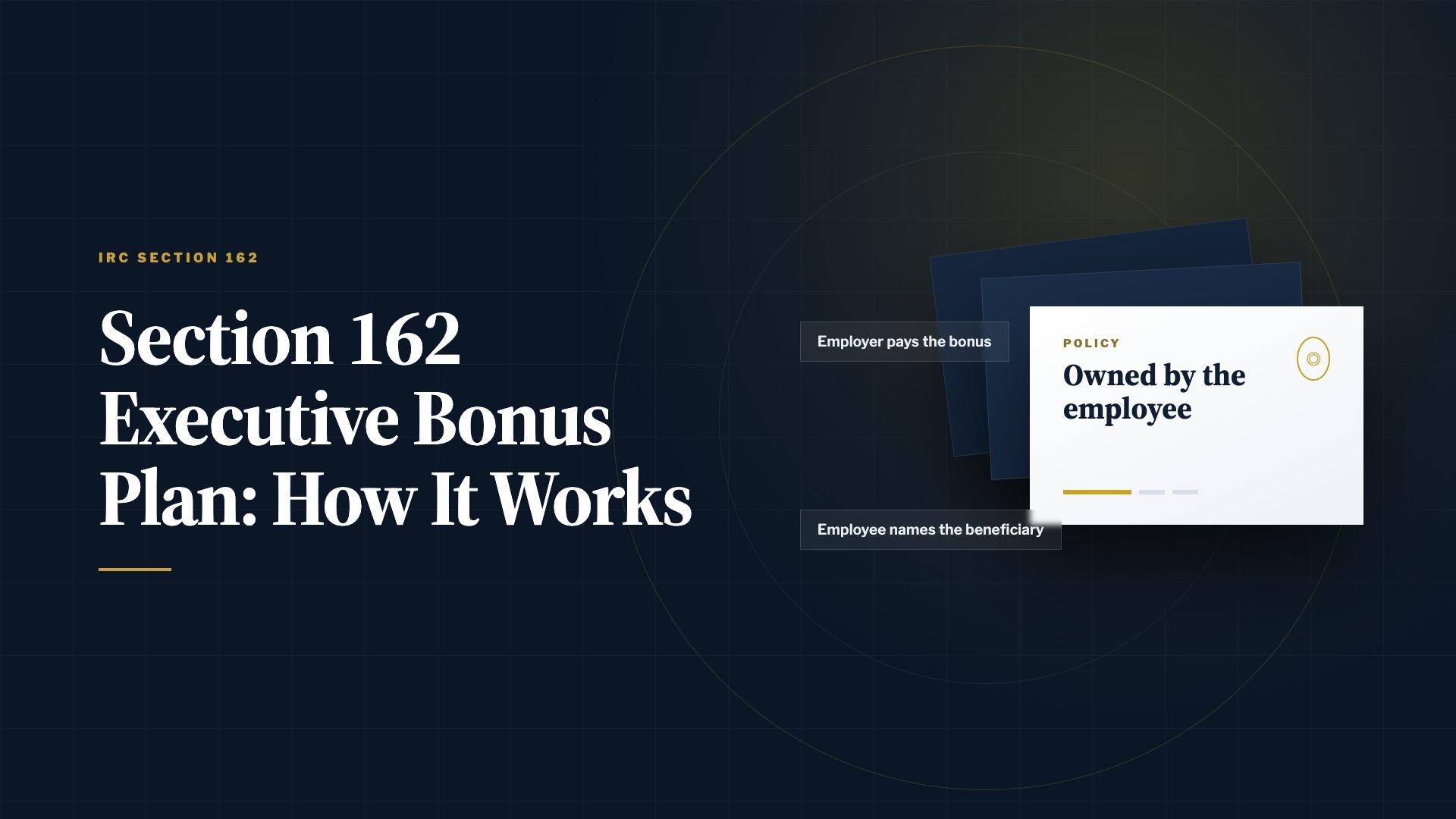
Section 162 executive bonus plans generally work this way. The business pays life insurance premiums for a key employee's policy, and the premium may be deductible as a business expense, depending on the facts.
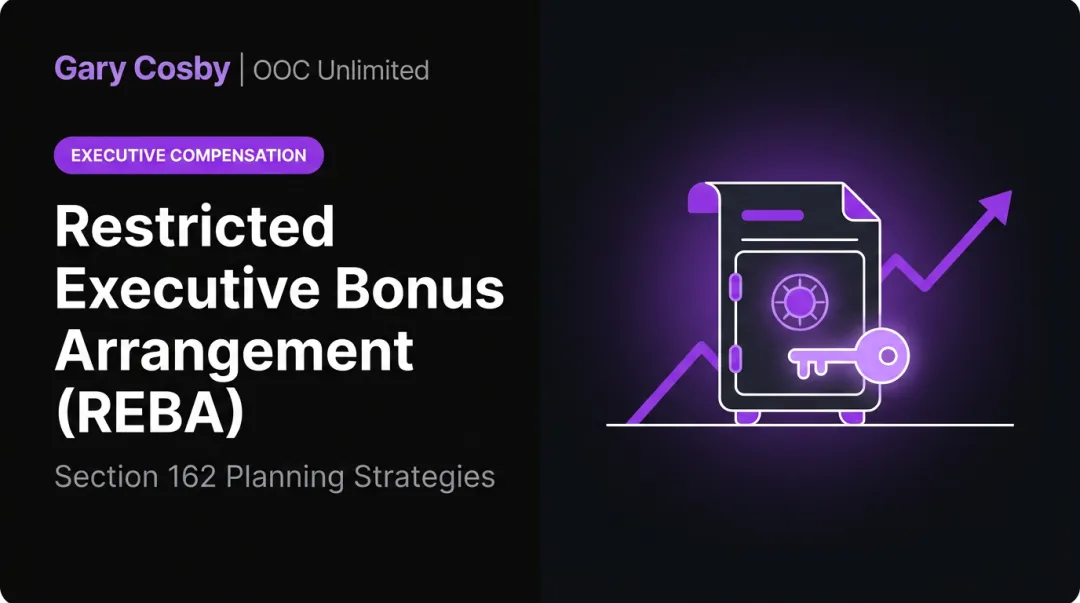
Some employers add a restricted executive bonus arrangement (REBA), tying full access to the cash value to a vesting schedule. That may turn the bonus into a retention tool, not just a payout.
This structure may appeal to closely held businesses that want to reward top performers without the administrative burden of a qualified retirement plan. The employee gets life insurance protection and access to cash value over time, subject to policy terms. Unlike an annual bonus, the value may compound long after the bonus check would have been spent.
Deductibility under §162 depends on the bonus being reasonable, ordinary, and necessary compensation, and on the business's specific facts. Say "may be deductible" — never "always" or "100%." Tax treatment depends on individual facts and must be confirmed by the reader's own CPA. Educational only; not tax advice.
Designing an Effective Bonus Structure
A generous bonus plan can still fail if it's badly designed. A few principles may help separate plans that motivate from plans that frustrate:
- Tie payouts to controllable outcomes. Nothing kills motivation faster than being measured against a company-wide metric an individual employee can't influence.
- Keep the formula simple. If an employee needs a spreadsheet or an HR meeting to estimate their bonus, the formula may be too complicated.
- Communicate progress regularly. A year-end surprise, good or bad, may not motivate anyone during the eleven months leading up to it. Quarterly updates can keep the plan front of mind.
Beyond these fundamentals, the number of measures used may matter just as much as clarity.
Some industry design research suggests limiting plans to roughly four or five measures, enough to capture what matters without burying employees in complexity. Fewer than half of organizations give employees full visibility into performance metrics at the start of the year, which may be exactly backward. Transparency may be best delivered first, not after the fact.
Tax Treatment of Employee Bonuses
The IRS generally classifies bonuses as supplemental wages, separate from regular pay, which can change how withholding works. The following is educational only and not tax advice; your CPA can determine how these rules apply to your circumstances.
Employers generally choose between two withholding methods:
- Flat 22% method: May apply when the bonus is identified separately from regular wages
- Aggregate method: Combines the bonus with a regular paycheck and withholds based on the total, using standard tax tables
Here's the part employees often get wrong: that 22% (or higher combined) withholding is generally not the actual tax rate on the bonus. Bonus income is generally treated as ordinary income for tax purposes, though the specific outcome depends on individual facts. Your CPA can confirm how this may apply to your situation.
The higher withholding people notice on a bonus check may be a timing issue rather than a permanent tax hit. Depending on the circumstances, it may even out at filing time through a refund or reduced balance due.
A few added wrinkles worth knowing (and confirming with your CPA):
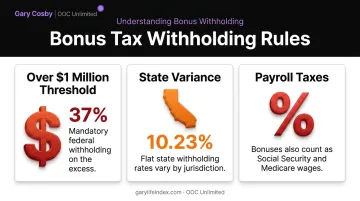
- Supplemental wages over $1 million in a calendar year may be subject to a mandatory 37% federal withholding on the excess
- State rules vary widely; California, for example, currently permits a flat 10.23% state withholding rate on bonuses
- Bonuses generally count as Social Security and Medicare wages
For business owners specifically, this is where bonus structuring may become strategic. A Section 162 executive bonus plan lets a business fund a bonus that pays for a life insurance policy owned by a key employee or executive. Depending on the facts, the arrangement may create a benefit that may be deductible to the business while helping retain leadership, without the complexity of a qualified retirement plan.
Deductibility under §162 depends on the bonus being reasonable, ordinary, and necessary compensation, and on the business's specific facts. Say "may be deductible" — never "always" or "100%." Tax treatment depends on individual facts and must be confirmed by the reader's own CPA. Educational only; not tax advice.
It's a narrower tool than a company-wide bonus pool, but it may solve a very specific retention problem for closely held businesses.
Frequently Asked Questions
How do bonus plans work?
Most plans multiply a target bonus (a percentage of base salary) by a performance multiplier based on results against goals. A funding pool, tied to company revenue or profit, ultimately may cap how much can be paid out.
Is a bonus better than a raise?
It depends on the goal. Bonuses may offer employers flexibility and tie pay to performance, while raises give employees more predictable, compounding income. Neither is universally "better."
What's the difference between a bonus and a commission?
Commission is typically a fixed percentage of individual sales. A bonus can be based on much broader criteria, including individual, team, or company-wide performance metrics.
How are employee bonuses taxed?
Bonuses are generally treated as supplemental wages, withheld at either a flat 22% or the aggregate method. The actual tax owed depends on your individual facts and typically aligns with your ordinary income tax rate once you file. Your CPA can determine how this applies to your situation. Educational only; not tax advice.
What percentage of salary is typically given as a bonus?
Mid-level and exempt salaried roles often see bonus targets around 10-20% of base salary. Executive and CEO-level targets often run higher, sometimes 100% or more, depending on the organization.
Can an employer legally take back a bonus that was already paid?
Whether that holds up may depend on the written plan terms and applicable state wage law. Clawback provisions are typically documented in advance, specifying triggering conditions and repayment timeline. Because this is a legal question that depends on your jurisdiction and specific facts, your attorney can advise on how it applies to your situation.