Introduction
Three friends start a company in Sacramento. They're excited, focused on growth, and never once discuss what happens if one of them dies, divorces, or becomes disabled. This scene plays out constantly across California, often with costly consequences.
Many business owners either skip a buy-sell agreement altogether or download a generic template that doesn't reflect their actual ownership structure. A recent Gallup survey found that roughly one-third of small business owners have no succession plan at all, or aren't sure if they do.
This guide breaks down what a buy-sell agreement is, the triggers unique to California, and the main agreement types. It also covers how to fund one, along with the tax and legal details that trip up unprepared owners.
Key Takeaways
- A buy-sell agreement dictates ownership transfer at death, disability, divorce, or retirement
- California's community property laws make these agreements urgent for married co-owners
- Life insurance offers the fastest, most tax-efficient way to fund a buyout
- These agreements belong in your operating or shareholder agreement, not as a standalone document
- Regular reviews with an attorney, CPA, and insurance professional keep the agreement current
What Is a Buy-Sell Agreement?
A buy-sell agreement is a contract between co-owners, whether LLC members, shareholders, or partners, that spells out exactly how an ownership interest gets sold or transferred when a specific event occurs. Think of it as a rulebook everyone agrees to before anyone actually needs it.
Despite the name, a buy-sell agreement functions as a "business prenup" among the co-owners who already run the company together, not a sale to an outside buyer.
Where it belongs: A buy-sell agreement shouldn't sit in a drawer as a separate document. It works best woven directly into your:
- LLC operating agreement
- Shareholder agreement (for corporations)
- Partnership agreement
Placement matters because a standalone form pulled from the internet often conflicts with your actual governing documents. When that happens, courts have to untangle which document controls.
That process is expensive, slow, and unpredictable. Building buy-sell terms into your core corporate documents from day one avoids that mess entirely.
What Triggers a Buy-Sell Agreement in California?
A "trigger" is the event that activates the buyout process. Get these wrong or leave one out, and you're gambling with your company's future.
The Standard Triggers
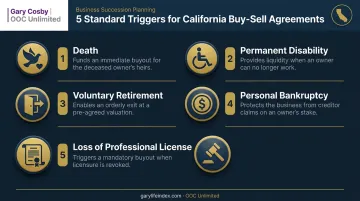
Most California buy-sell agreements address these events:
- Death of an owner
- Permanent disability or incapacitation
- Voluntary retirement or resignation
- Personal bankruptcy
- Loss of a professional license
Skipping licensure as a trigger for a professional practice is a common and costly oversight. If a physician-owner loses their license, the practice needs a clean mechanism to remove them as an owner, not just as a provider. Most owners fund this trigger, along with death and disability, through a life insurance policy sized to the buyout price, keeping the purchase from draining company cash. A licensed life insurance professional can help structure that funding alongside your attorney and CPA.
Divorce: California's Unique Wildcard
Here's where California really differs from most states. As a community property state, business ownership acquired during marriage typically counts as shared marital property under California Family Code Section 760. Divorce courts generally must divide community property equally.
That doesn't automatically hand your business partner's ex-spouse a board seat. But it can create a serious economic claim on the company's value, and without planning, resolving it gets messy fast.
A real-world lesson: In In re Marriage of Nichols, a law firm's ownership agreement required repurchase upon death, disability, or disqualification, but never mentioned divorce. When one owner divorced, the couple fought over whether the agreement's built-in formula or a separate, higher valuation should apply.
The court ultimately upheld the formula, but only because it predated the separation by roughly eight years and served a genuine business purpose, not just a tax dodge. Had the agreement been sloppier or more recent, the outcome could have gone the other way.
The Forced Buyback Solution
A well-drafted agreement includes a forced buyback provision. If a divorce court or bankruptcy trustee ends up with an economic interest in the business, that interest must be sold back to the company or remaining owners at a pre-agreed valuation. This keeps outside parties, ex-spouses, creditors, or trustees, from ever gaining a functional say in how the business runs.
Document these triggers while everyone's still on good terms. Waiting until a relationship sours or a health crisis hits is exactly when negotiations become impossible.
Types of Buy-Sell Agreements and How They're Valued
Once you know your triggers, you need to decide who buys and how much they pay. Here's how the main structures break down.
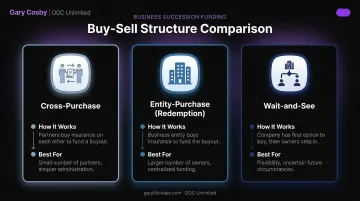
The Three Main Structures
| Structure | How It Works | Best For |
|---|---|---|
| Cross-Purchase | Remaining owners personally buy the departing owner's interest, usually funded through life insurance policies they hold on each other | Businesses with 2-3 owners |
| Entity-Purchase (Redemption) | The business itself buys back the interest using a single policy per owner | Companies with several owners |
| Wait-and-See | The company gets first option to buy; if it passes, individual owners step in | Businesses wanting maximum flexibility |
Cross-purchase agreements get complicated fast once you add owners. Four partners need six separate policies to cover every combination. That's why entity-purchase structures tend to simplify administration for larger ownership groups.
Locking In Valuation Before You Need It
The single biggest mistake owners make? Leaving the price undetermined until someone actually leaves. Emotions run high during a death or divorce, and that's the worst time to negotiate value.
Three common valuation methods:
- Independent appraisal: A qualified appraiser determines value when the trigger occurs
- Fixed price: Owners agree on a dollar amount, updated periodically (often annually)
- Formula-based: Value follows a set calculation, such as a multiple of earnings or book value
According to The Tax Adviser, these three approaches remain the standard menu for buy-sell valuation. Locking one in early prevents the exact dispute that played out in the Nichols case above.
California legal backdrop worth knowing: Corporate share transfer restrictions must be reasonable and conspicuously noted under California Corporations Code Section 204(b) and 418. LLC and partnership interests fall under separate Corporations Code provisions, and larger or more complex ownership arrangements can trigger securities law considerations.
This is exactly why an attorney needs to draft the actual language, not a template.
Funding Your Buy-Sell Agreement: Why Life Insurance Is the Preferred Method
Here's the problem nobody talks about until it's too late: even a perfectly drafted buy-sell agreement is worthless if nobody has the cash to execute the buyout.
When a trigger hits, remaining owners typically need a lump sum, fast. Without pre-funding, they're often stuck choosing between:
- Predatory loans with unfavorable terms secured under pressure
- Fire-selling business assets to raise cash quickly
- Payment plans stretched over years, straining cash flow and the departing owner's family
Why Life Insurance Wins
Life insurance solves the timing problem better than any other funding method. Death benefits are generally received income-tax-free under IRC Section 101(a)(1), and the payout arrives exactly when the buyout obligation kicks in.
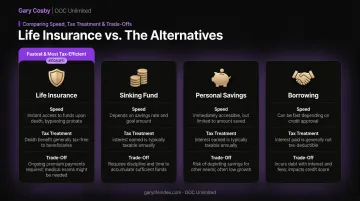
Comparing the funding options:
| Method | Speed | Tax Treatment | Trade-Off |
|---|---|---|---|
| Life insurance | Immediate upon death | Generally income-tax-free | Requires ongoing premiums |
| Sinking fund | Slow (years to build) | Taxable growth | Ties up capital long-term |
| Personal savings | Immediate, but limited | Already taxed | Rarely sufficient at scale |
| Borrowing | Immediate | Loan proceeds aren't taxed, but interest accrues | Adds debt during a crisis |
Life insurance is the only option on this list that delivers full funding on day one, regardless of how long the policy has been in force.
Don't Forget Disability
Standard life insurance only pays out on death. But disability is one of the most common triggers, and a living, disabled owner still needs to be bought out. Disability buy-out insurance fills this gap, reimbursing the buyout obligation when an owner becomes permanently unable to work.
Getting the Structure Right
With life insurance and disability coverage in place as funding sources, the remaining decision is how the policies should be owned and structured. Choosing between cross-purchase and entity-owned policies isn't a decision to make alone. It depends on your number of owners, tax situation, and long-term goals, and it benefits from insurance expertise working alongside your CPA and attorney.
This is where GFI × Team OOC's licensed life insurance agents come in. The team helps business owners explore insurance-funding options for buy-sell agreements, key person coverage, and business overhead expense needs. With access to 25+ A+ rated carriers, you're not stuck comparing a single company's products against itself.
Tax Implications and California Legal Considerations
Getting the insurance in place is only half the job. The tax structure around it can make or break the plan.
The Transfer-for-Value Trap
Life insurance death benefits are typically income-tax-free. But there's a catch: the transfer-for-value rule can strip away that tax-free status if a policy changes hands between owners without proper structuring. This trips up companies that switch from cross-purchase to entity-purchase arrangements (or vice versa) without updating who owns which policy.
Cost-Basis Differences Matter
- Cross-purchase agreements: Surviving owners generally receive a step-up in basis equal to what they paid, which can reduce future capital gains taxes on resale
- Entity-purchase agreements: Remaining owners typically keep their existing basis, with no increase from the buyout
This difference alone can influence which structure makes more financial sense for your specific ownership group.
Establishing Value for Estate Tax Purposes
A properly structured agreement can help establish the business's value for estate tax purposes, which reduces the odds of a dispute with the IRS down the road.
The U.S. Supreme Court's 2024 ruling in Connelly v. United States reinforced this territory. The Court held that entity-owned life insurance proceeds increase the company's fair market value and don't automatically offset the redemption obligation when valuing a deceased owner's shares. A CPA should walk through these specifics before you finalize funding.
California's Divorce Complication, Revisited
California's community property rules add another wrinkle here. A divorce-triggered buyout can carry different tax consequences than a death or retirement-triggered one, particularly around how the transferred interest is characterized. This is another spot where guessing isn't an option: professional guidance is essential.
Frequently Asked Questions
What triggers a buy-sell agreement?
Common triggers include death, permanent disability, divorce, personal bankruptcy, and voluntary retirement. In California, divorce deserves special attention because of the state's community property laws.
What are the tax implications of a buy-sell agreement?
Life insurance proceeds used for a buyout are generally income-tax-free, though the transfer-for-value rule can jeopardize that. Cross-purchase and entity-purchase structures also differ in their cost-basis treatment for future capital gains.
Do I need a buy-sell agreement if I only have one business partner?
Yes, often more than most owners realize. A two-owner business is especially vulnerable since a single trigger event could leave you unexpectedly running the company alongside an unwanted spouse or heir.
How much does it cost to fund a buy-sell agreement with life insurance?
Cost depends on each owner's age, health, and the coverage amount needed. Getting a personalized quote from a licensed insurance professional, such as an OOC Unlimited agent, is the only reliable way to know your actual numbers.
Can a buy-sell agreement be changed after it's signed?
Yes. Agreements should be reviewed and updated regularly, especially after ownership changes, new valuations, or significant business growth.
Is a buy-sell agreement required by California law?
No California statute mandates one, but a properly executed agreement is fully enforceable. Without one, default state rules apply, and they may not reflect what you and your partners actually intended.