A broken forklift can be repaired or replaced in days. The institutional knowledge, client relationships, and leadership judgment carried by one irreplaceable employee can't be reordered from a catalog. That's the risk this article breaks down: what key person risk actually is, who qualifies as a "key person," why it hits harder than most owners expect, and what tools — including insurance funding — exist to soften the blow.
Key Takeaways
- Key person risk is the disruption when a critical employee dies, becomes disabled, or leaves.
- Top revenue generators and specialized experts count as key persons, not just founders and CEOs.
- Losing a key person costs more than recruiting fees; lost knowledge and trust hurt longer.
- Key person insurance helps businesses fund that financial gap.
What Is Key Person Risk?
Key person risk is the exposure a business carries when it depends heavily on one or a few individuals. If that person becomes unavailable through death, disability, resignation, or retirement, operations, revenue, or leadership continuity can suffer material disruption.
This isn't hypothetical. According to NAIC's small business insurance guidance, a small number of people are often critical to a small business, and the death of just one can seriously damage the company's bottom line.
It helps to separate two terms people often blur together. Key person risk is the exposure itself: the vulnerability created by depending on a specific individual. Key person insurance is a funding tool businesses use to offset that exposure, typically a life or disability policy the company owns and pays for.
You can have key person risk without key person insurance, but insurance can't solve a problem you haven't identified first.
Common Triggers of Key Person Risk
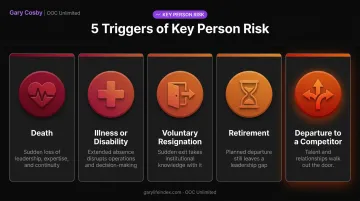
Key person risk doesn't only show up when someone dies. It surfaces through several common triggers:
- Death: the most obvious and often the most financially severe trigger
- Illness or disability: a temporary or permanent inability to perform their role
- Voluntary resignation: choosing to leave for personal or career reasons
- Retirement: a planned exit that still leaves a knowledge gap if not prepared for
- Departure to a competitor: often the most disruptive trigger, since it can take relationships and knowledge with it
This risk is especially acute for small and closely held businesses, where the owner's personal licenses, expertise, or client relationships are the business. A solo-practitioner law firm or a boutique engineering shop doesn't just lose an employee when its founder steps away: it can lose its entire operating capability overnight.
Who Is Considered a Key Person?
"Key person" is broader than a job title suggests. It's defined by how difficult someone would be to replace, not by their seniority or salary. A mid-level engineer with 15 years of undocumented process knowledge can represent more risk than a vice president whose duties are well-distributed across a team.
Executives and Founders
CEOs, founders, and managing partners typically drive company vision and strategic decisions, while also managing outside relationships with investors and major clients. Their absence can stall decision-making at the top and shake confidence among lenders or partners who dealt directly with them.
Top Revenue Generators
Rainmakers and top salespeople often carry a disproportionate share of revenue in their personal client relationships. According to Nationwide's guidance on key person risks, leading salespeople and product leaders are classic examples of employees whose loss creates immediate revenue exposure.
Specialized Experts
Technical specialists — engineers, compliance officers, IT leads, and security officers — carry institutional knowledge that's expensive and slow to rebuild. When this person leaves, the business isn't just short-staffed. It's short on know-how that took years to accumulate.
Emerging Leaders
Up-and-coming employees tied to succession plans or niche projects can represent real key person risk, even without a senior title. A junior analyst who's the only person who understands a critical internal system fits this category just as much as a department head does.
Quick self-check: Ask yourself two questions. Who would be hardest to replace on my team right now? And whose past absence, even something as brief as a vacation or unplanned leave, already caused visible disruption? The names that come to mind fastest are usually your key persons.
Why Key Person Risk Matters for Your Business
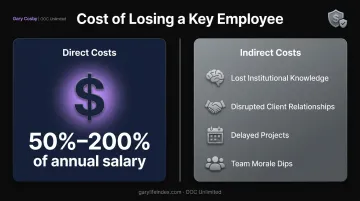
The direct cost of losing a key employee is more measurable than people assume. According to SHRM's 2025 research on the myth of replaceability, replacing an employee can cost 50% to 200% of their annual salary, depending on their level and role.
For a $150,000-a-year executive, that's potentially $300,000 in recruiting, onboarding, and lost-productivity costs alone.
The indirect costs are harder to put a number on, but they hit just as hard:
- Lost institutional knowledge that walks out the door with no documentation trail
- Disrupted client relationships built on personal trust, not just contracts
- Delayed projects stalled while someone learns a role from scratch
- Team morale dips as remaining staff absorb extra work and uncertainty
There's also a structural consequence many owners overlook. Banks and lending institutions often require key person coverage as a condition of financing, according to the Insurance Information Institute's guidance on insuring against the loss of key personnel.
A business heavily dependent on one person can look riskier to a lender than its financials alone suggest — and that dependency can affect loan terms, valuation conversations, and buy-sell negotiations down the road.
Assessing Your Business's Exposure to Key Person Risk
Before you can protect against key person risk, you need to size it up. A simple framework covers four areas:
- Leadership continuity: Is there a clear line of authority if a top leader is suddenly unavailable?
- Concentration of knowledge: How much critical information lives only in one person's head?
- Client and stakeholder dependency: Do major accounts or partnerships hinge on one relationship?
- Succession readiness: Is there anyone internally prepared to step in, even temporarily?
Here's a practical gut-check many advisors use: if your business would struggle to operate normally for an extended stretch without a specific person, that person represents meaningful key person risk. The exact timeframe varies by business and role, but the exercise is the same: picture the absence and see where things break.
This exercise often reveals more exposure than owners expect. Most business owners underestimate it until they're forced to respond to an actual loss, when options are limited and costly.
Running the assessment while everything is stable, rather than during a crisis, is what turns it into a real action plan, such as cross-training a successor or funding key person insurance to cover the gap.
How to Protect Your Business Against Key Person Risk
Protecting against key person risk works best as a layered approach: part operational, part financial.
Documentation and Cross-Training
Start with what costs nothing but time:
- Document critical processes so knowledge doesn't live in one person's head
- Cross-train other employees on essential functions before it's urgent
- Build written playbooks for client relationships, not just technical tasks
Succession and Continuity Planning
Identify and start developing internal successors before a transition becomes an emergency. Look at who already understands the role's client relationships and decision-making, not just its technical tasks. A successor who's had 18 months of mentoring performs very differently than one thrown in cold.
Key Person Insurance as a Funding Strategy
Documentation reduces dependency. It doesn't replace lost revenue or cover the cost of finding a replacement.
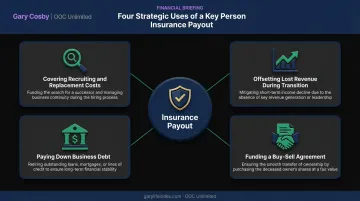
That's where key person insurance comes in — a life and/or disability policy taken out on a critical employee, with the business typically as owner and beneficiary. If that person dies or becomes disabled, the payout gives the company immediate funds instead of a financial hole.
Common uses for the payout include:
- Covering recruiting and replacement costs
- Offsetting lost revenue during the transition period
- Paying down business debt tied to that person's role or guarantee
- Funding a buy-sell agreement so remaining owners can buy out a departing partner's share
Some businesses layer in related strategies, like split-dollar arrangements for executive retention or buy-sell funding for multi-owner transitions, depending on their structure and goals.
None of this is one-size-fits-all. Coverage amount, policy ownership, and tax treatment depend on the specific business and role involved.
Gary Cosby Jr. and the team at OOC Unlimited work with business owners as licensed life insurance professionals. They explore key person disability and business overhead expense funding options, coordinating with each owner's CPA and attorney since tax and legal considerations fall outside the insurance scope.
Frequently Asked Questions
What does "key person" mean?
A key person is any employee whose loss would disrupt business operations, revenue, or leadership continuity. This isn't limited to executives; it includes anyone whose knowledge, relationships, or skills would be genuinely hard to replace.
Can the key person be the beneficiary?
No. In standard key person insurance arrangements, the business (not the employee) is typically the owner and beneficiary of the policy. This protects the company's financial interests rather than benefiting the insured employee personally.
Is key person insurance life insurance?
Most commonly, yes: key person insurance is a life insurance policy that pays the business upon the insured employee's death. Disability coverage can also be added or purchased separately to protect against a key employee's incapacitation.
How much does key person insurance cost?
Premiums vary based on the key person's age, health, and the coverage amount tied to their value to the business. There's no single formula, so a licensed agent can help calculate a figure specific to your situation.
Is key person insurance tax deductible?
Premiums are generally not deductible as a business expense, and proceeds are only tax-free if specific IRS notice, consent, and reporting requirements are met. Consult a CPA to confirm how these rules apply to your business.