Introduction
Picture this: your top salesperson, the one who single-handedly closes 40% of your deals, gets into a car accident and can't work for six months.
Or your technical founder, the only person who understands your proprietary process, decides to retire early. Revenue stalls. Clients get nervous. The bank starts asking questions.
This is key man risk, and it doesn't just haunt Fortune 500 boardrooms. It shows up in family-owned shops, dental practices, and three-person consulting firms just as often.
This article breaks down what key man risk actually means, how to spot it in your own business, and what it costs you financially. It also covers the practical steps (including insurance) that can protect what you've built.
Key Takeaways
- Relying on one or two people for revenue or client relationships creates a hidden vulnerability
- Losing that person can shrink your company's valuation and disrupt cash flow overnight
- Succession planning, cross-training, and documentation reduce dependency at the root
- Key person insurance provides the financial runway to recover or transition after a loss
What Is Key Man Risk?
Key man risk (also called key person risk) is the exposure a business faces when it depends too heavily on one or a few individuals whose skills, relationships, or leadership are essential to keeping things running. If that person disappears, the business feels it immediately, sometimes catastrophically.
Here's the part many owners miss: the "key person" isn't always the CEO.
It can be:
- A founder whose vision and industry connections built the company
- A top salesperson who personally holds the client relationships
- A technical specialist who's the only one who knows how a critical system works
- A department head who keeps three other functions running smoothly behind the scenes
How Common Is This Exposure?
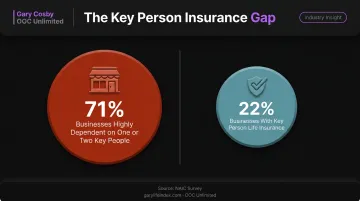
This isn't a rare edge case. According to Triple-I's small business insurance guide, citing an NAIC survey, 71% of small businesses reported being very dependent on one or two key people. Yet only 22% had key person life insurance in place. That's a massive gap between exposure and protection.
Temporary vs. Permanent Triggers
Not every disruption is permanent, but each type carries risk:
- Temporary triggers: extended illness, medical leave, sabbatical
- Permanent triggers: death, disability, resignation, retirement
Both can stall operations. Permanent triggers, though, tend to hit valuation and client confidence harder because there's no return date to plan around.
A Real-World Example
Permanent triggers don't just leave an operational gap. They can rattle the confidence of everyone who trusts the business, sometimes fast.
In 2014, PIMCO's star bond manager Bill Gross abruptly departed the firm. The fallout was immediate: PIMCO's open-ended funds saw $48.3 billion in outflows the following month alone, according to Reuters.
That's an extreme case, but the pattern holds at smaller scale, too. Clients and investors get nervous fast when the person they trust walks out the door.
Identifying Key Man Risk Factors in Your Business
Before you can fix key man risk, you need to find it. It's not always obvious, and it doesn't only live at the top of the org chart.
Where Key Man Risk Typically Hides
Watch for dependency in these areas:
- Founders and executives: those carrying institutional knowledge, vision, or major client relationships
- Niche technical specialists: engineers, developers, or tradespeople whose expertise isn't documented anywhere
- Relationship owners: staff who personally manage key clients, suppliers, or vendor contracts
A Quick Self-Assessment
Ask yourself these questions:
- Who would be hardest to replace on short notice?
- Whose absence has already caused a disruption, even a minor one?
- Who holds knowledge that exists only in their head, not in a shared document?
- Which relationships (clients, suppliers, lenders) run through one person?
If the same name keeps coming up, you've found your exposure point. And remember: this risk isn't limited to the corner office. A warehouse manager who's the only one who knows the shipping software can create just as much disruption as a missing CEO.
The Financial and Valuation Impact of Key Man Risk
Key man risk doesn't just create a scary "what if." It has a measurable price tag, both in day-to-day operations and at the negotiating table when you go to sell.
The Growth Bottleneck
When one person controls a disproportionate share of decisions, sales, or expertise, growth gets capped by that person's bandwidth. You can't scale past what one human can physically do. A $3 million consulting firm where the founder must approve every contract, for example, can't grow past what her calendar allows. This creates:
- Delayed decision-making when that person is unavailable
- Missed opportunities because approvals bottleneck through one desk
- Burnout for the key person themselves, which compounds the risk
The "Key Man Discount" in Valuation
When it's time to sell, buyers and investors don't ignore this exposure, they price it in. Valuation experts warn against applying a flat, arbitrary percentage, though.
According to business valuation expert Chris Mercer, an unsupported discount figure isn't a reasonable valuation approach. Instead, appraisers model the actual impact on cash flow, growth, customer retention, and replacement costs.
That said, the pattern is consistent:
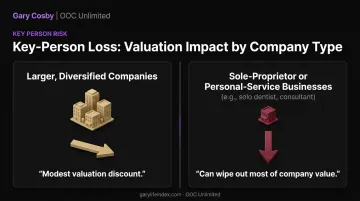
- In larger, diversified companies, the discount tends to be modest
- In sole-proprietor or personal-service businesses (think a solo dentist or consultant), losing the key person can wipe out most of the company's value
Beyond the Sale Price
Even if you're not selling, the operational cost is real. A key employee's sudden departure, for instance, can freeze a pending loan approval overnight. Day-to-day, this shows up as:
- Business interruption while operations catch up
- Lost client relationships that don't transfer to a new point of contact
- Reduced access to credit, since lenders often require key person coverage as a loan condition
How to Mitigate and Eliminate Key Man Risk
There's no single fix for key man risk; it takes a combination of operational changes and financial backstops working together.
Build a Succession Plan
Identify who could step into a critical role if needed, then start developing them now. This means:
- Naming a potential successor, even informally
- Giving them real responsibility ahead of time, not just a title
- Reviewing the plan annually since roles and people change
Cross-Train and Delegate
Spread specialized knowledge and client relationships across more than one person, because relying on a single employee to run a critical process is a red flag. Cross-training reduces the "bus factor" and builds a deeper bench.
Document Everything
Institutional knowledge shouldn't live only in someone's head. Create:
- Written SOPs for critical processes
- Updated CRM records so client history doesn't disappear with one employee
- A continuity plan that's actually been tested, not just written and filed away
These operational fixes reduce how much you depend on one person, but they don't erase the financial hit if that person is suddenly gone. That's where key person insurance comes in.
Key Person Insurance: A Critical Safety Net
Operational fixes take time to build. Key person insurance buys you that time.
Key person life insurance is a policy the business owns on a critical individual's life. The company pays the premiums and is named the beneficiary. If that person dies, the business receives a payout, not the employee's family.
What the Payout Can Cover
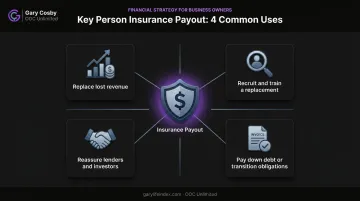
That money isn't just a cushion sitting in the bank. It's typically used to:
- Replace lost revenue while the business stabilizes
- Recruit and train a replacement for the critical role
- Pay down debt or obligations tied to the transition
- Reassure lenders and investors that the business can weather the loss
Life Insurance vs. Business Overhead Expense Coverage
Two related products cover different pieces of this risk:
| Product | What It Covers |
|---|---|
| Key person life insurance | Financial loss to the business from the key person's death |
| Business overhead expense insurance | Ongoing operating costs (rent, utilities, salaries) during a disability |
Both address the same underlying vulnerability from different angles: one replaces lost value, the other keeps the lights on.
Choosing between these two options, or combining them, usually starts with a conversation about your specific risk. Gary Cosby, a licensed life insurance agent with GFI × Team OOC, works with business owners across all 50 states to explore insurance-funding options for key person disability and business overhead expense needs.
He focuses on the insurance component, coordinating with the business owner's CPA and attorney when tax treatment, ownership structure, or legal agreements require their input.
If you're trying to figure out what coverage fits your situation, scheduling a consultation is a straightforward way to start that conversation.
Frequently Asked Questions
What does key man risk mean?
Key man risk is a business's exposure to loss when it depends too heavily on one or a few people for critical skills, leadership, or relationships. If that person leaves, gets sick, or passes away, the business can struggle to keep operating normally.
How can you eliminate key man risk?
You reduce it through a combination of succession planning, cross-training, documenting processes, and carrying key person insurance. No single strategy eliminates it alone; they work together.
Who needs key person insurance?
Any business that depends on a founder, executive, or specialist for a meaningful share of revenue or operations should consider it. This is especially true for small and privately held companies with thin management benches.
How much does key man insurance cost?
Cost depends on the insured person's age, health, coverage amount, and policy type. Since these factors vary widely, it's best to speak with a licensed agent for a personalized quote.
What is the difference between key man insurance and business overhead expense insurance?
Key man insurance covers the financial loss the business suffers from losing a key person's contribution. Business overhead expense insurance instead reimburses ongoing operating costs, like rent and salaries, while an insured owner is disabled.
Can key man risk affect a business's valuation when selling?
Yes. Buyers and investors often apply a valuation discount when a business is overly dependent on one person. Addressing this risk ahead of a sale helps protect the price you're able to negotiate.