This guide is written for owners of LLCs, partnerships, and closely held corporations with two or three partners. Getting this structure right protects business continuity, keeps family finances secure, and locks in a fair valuation before anyone needs it. Most owners have heard the term "buy-sell agreement" but few understand how it's actually funded and mechanically triggered. Below, we cover what it is, how it works, who it fits best, and when a different structure makes more sense.
Key Takeaways
- Each owner personally buys and owns a policy on every co-owner
- Best suited for 2-3 owners, as required policies scale by n × (n-1)
- Surviving owners get a stepped-up cost basis, lowering future capital gains
- Proceeds bypass business creditors since individuals, not the company, own the policies
- Entity purchase agreements differ: the business owns the policies instead
What Is a Cross Purchase Buy-Sell Agreement?
In a cross purchase agreement, each co-owner personally purchases, owns, and pays premiums on a life insurance policy covering every other co-owner, naming themselves as the beneficiary. If Partner A and Partner B run a company together, Partner A owns a policy on Partner B's life, and Partner B owns a policy on Partner A's life. Two owners, two policies.
The goal is simple: guarantee liquidity so surviving owners can buy a deceased or departing owner's stake at a pre-agreed price, without disrupting daily operations or being forced to sell to an outsider. No scrambling for a bank loan. No unwanted new "partner" showing up in the form of an inherited ownership stake.
The Four Types of Buy-Sell Agreements
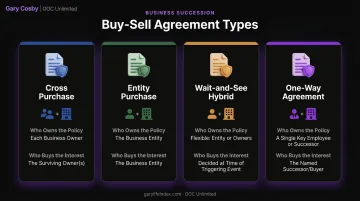
A cross purchase agreement is one of four common structures, and understanding the differences matters:
| Structure | Who owns the policy | Who buys the interest |
|---|---|---|
| Cross purchase | Each co-owner, on each other owner | Surviving co-owners |
| Entity purchase (stock redemption) | The business itself | The business entity |
| Wait-and-see hybrid | Determined after the trigger event | Business first, then owners |
| One-way agreement | A designated buyer (key employee, family member) | That single purchasing party |
Regardless of which structure fits your business, a cross purchase agreement is a legal contract combined with a funding mechanism. The agreement is valid the moment it's signed, whether or not policies have been purchased yet. The insurance simply funds the promise; it isn't the promise itself.
This structure tends to work most efficiently for businesses with two owners. It can still work well with three, though the math gets more complicated fast (more on that below).
Why Businesses Use Cross Purchase Agreements
Without a funded agreement, surviving owners often lack the cash to buy out a deceased owner's family. That forces a rough choice: sell business assets under pressure, take on debt, or accept the deceased owner's heirs as new, often uninvolved, co-owners. None of those outcomes are good for the business or the family left behind.
This scenario plays out more often than most owners expect. The succession planning gap is real. According to Kreischer Miller's research on family-owned businesses, 45.9% of family companies don't have a formal succession plan in place at all. A signed agreement without funding behind it is only marginally better than no plan.
Tax and Financial Advantages
A properly structured cross purchase agreement offers concrete financial benefits:
- Proceeds bypass business creditors. Because policies are individually owned rather than held by the entity, the cash values and death benefits sit outside the reach of business creditors.
- Surviving owners get an increased cost basis. Under IRC Section 1012, the purchase price becomes their new basis, which can reduce capital gains tax at a future sale.
- Death benefits are generally income-tax-free to the beneficiary under IRC Section 101(a)(1), giving survivors immediate, untaxed liquidity.
This structure is typically put in place at three points: when the business is first formed with multiple owners, shortly after a new partner joins, or during a broader estate and succession planning review. No state or federal law requires this structure. CPAs, attorneys, and financial planners recommend it anyway because it closes the funding gap before a death forces the issue.
How a Cross Purchase Buy-Sell Agreement Works
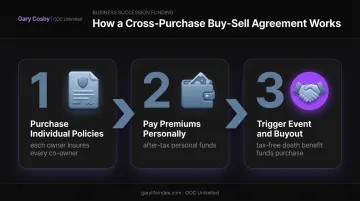
At a high level, the process runs like this: the agreement gets drafted, individual policies get purchased, premiums get paid over time, and when a triggering event happens, the death benefit funds the buyout at a pre-set valuation.
Setting it up requires three decisions upfront:
- A business valuation method: a formula or process for determining what the company (and each owner's share) is worth
- A buyout price or pricing formula: locked into the agreement so there's no dispute later
- Term versus permanent life insurance: the right fit depends on each owner's age, health, and how long the agreement needs to stay in force
Owners typically work with a licensed life insurance agent alongside their CPA and attorney to select the right policy types and coverage amounts.
Gary Cosby Jr., a licensed agent with OOC Unlimited, focuses specifically on the insurance funding piece: helping business owners size coverage and choose between term, whole life, or indexed universal life. Attorneys draft the legal agreement, and valuation professionals set the number.
Step 1: Purchase Individual Policies
Each owner applies for and purchases a life insurance policy on every other owner. They become the policyowner and named beneficiary of that specific policy. For a three-owner business, this means six total policies, since each owner must insure both remaining partners.
Step 2: Pay Premiums Personally
Owners pay premiums using after-tax personal funds for as long as the agreement stays in force. This keeps the arrangement independent of the business's cash flow or creditors.
Step 3: Trigger Event and Buyout
When death occurs, or disability/retirement if the agreement covers those events, the surviving owner receives the tax-free death benefit and uses it to purchase the departing owner's interest at the agreed valuation. The transaction typically closes within weeks, since the funds are already earmarked for this exact purpose.
Key Factors That Affect Cross Purchase Agreements
A handful of variables determine whether this structure fits, and how complicated it gets:
- Number of owners. Policy count follows n × (n-1): three owners need 6 policies, six need 30, per NAEPC's Journal of Estate & Tax Planning. That's impractical past three partners.
- Age and health disparities. A 35-year-old insuring a 60-year-old partner pays more in premiums than the reverse, creating friction between partners over time.
- Policy type. Term life keeps costs low but expires; permanent policies (whole life or IUL) cost more but build cash value and never lapse as long as premiums are paid.
- Business valuation upkeep. Coverage should track the company's current value; a policy sized for a $500,000 valuation five years ago won't cover a $2 million buyout today.
- Insurability. An owner who can't qualify for coverage, or only qualifies at a high rating, complicates the funding plan and may require an alternative arrangement.
Common Issues, Misconceptions & When It's Not the Right Fit
A few misunderstandings show up constantly, and they're worth clearing up directly.
Misconception: the business can pay or deduct the premiums. It can't. Premiums must come from each owner's after-tax personal funds. There's no business tax deduction here, and treating it otherwise creates real tax problems.
Misconception: the agreement and the insurance are the same thing. They're not. The legal agreement is valid the day it's signed, even before a single policy is purchased. It's just unfunded until coverage is in place, which leaves the promise resting on hope rather than cash.
Misconception: this scales fine with more owners. It doesn't. Once a business grows past three or four owners, the n × (n-1) policy count becomes an administrative headache nobody wants to manage.
When a Different Structure Fits Better
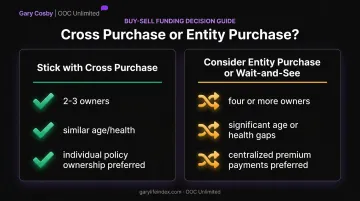
Consider an entity purchase or wait-and-see hybrid agreement if:
- Your business has four or more owners
- There are significant age or health gaps between partners
- You'd rather centralize premium payments through the business
A note on recent legal developments: In 2024, the U.S. Supreme Court ruled in Connelly v. United States. The Court held that a corporation's redemption obligation doesn't automatically reduce its value for estate tax purposes, even when the company holds life insurance to fund that redemption.
This ruling affects entity purchase structures specifically. It doesn't change how a properly funded cross purchase agreement works, but it's a good reminder to review your structure with a CPA and attorney periodically. A licensed life insurance agent can help evaluate funding options as ownership and business value shift over time.
Frequently Asked Questions
What is a cross purchase agreement?
It's a contract where each business co-owner personally buys, owns, and is named beneficiary of a life insurance policy on every other co-owner. The death benefit funds a buyout of the departing owner's interest.
What are the four types of buy-sell agreements?
The four types are cross purchase, entity/stock redemption, wait-and-see hybrid, and one-way agreements. They differ mainly in who owns the insurance policy: individual owners, the business, a deferred decision, or a single designated buyer.
How many total life policies are needed for a cross purchase buy-sell agreement?
Use the formula n × (n-1), where n equals the number of owners. Two owners need 2 policies; three owners need 6 policies. Beyond three or four owners, the count becomes impractical to manage.
Who should consider a cross purchase agreement instead of an entity purchase agreement?
Businesses with two or three owners of similar age and health are the best fit, especially when owners want individual policy ownership and the cost-basis benefits that come with personally purchasing the interest.
How is a cross purchase buy-sell agreement funded?
Owners typically fund it with individually purchased term or permanent life insurance. Working with a licensed life insurance agent alongside tax and legal advisors ensures coverage amounts and policy types match the business's needs.
What happens if a co-owner is uninsurable?
An uninsurable owner may need to rely on existing coverage, alternative funding like cash reserves or installment payments, or the business may need to shift toward an entity purchase structure instead.