Introduction
Picture a manufacturing company with a VP of Operations they can't afford to lose. She's turned down two recruiter calls this year alone.
The owner wants to hand her a serious life insurance benefit. But paying the full premium out of company cash flow feels steep, and asking her to cover it herself isn't realistic either.
This is exactly the gap split-dollar life insurance was built to close. It's a decades-old strategy, still very much in use, that lets two parties share the premium cost, cash value, and death benefit of a single policy.
This guide breaks down how split-dollar plans work, the two IRS-recognized structures, the tax rules that come with them, and how to know if this approach fits your business.
Key Takeaways
- This plan splits premium costs, cash value, and death benefit between two parties via a written agreement
- The two IRS-approved structures are the economic benefit regime and the loan regime
- These plans sit outside ERISA participation rules but still carry strict IRS tax and reporting obligations
- Businesses use split-dollar plans to retain key executives without shouldering the full premium alone
- Plans end at a set date, retirement, or death, as defined in the original agreement
What Is Split-Dollar Life Insurance?
Split-dollar life insurance isn't a policy type. It's a funding arrangement layered on top of a permanent life insurance policy. Two parties, most often an employer and a key employee, sign a written agreement dividing three things: who pays the premiums, who owns the cash value, and who receives the death benefit.
The agreement spells out:
- Who owns the policy
- How premium payments are split
- What happens if the employee leaves or misses performance benchmarks
- When and how the plan terminates
Important clarification: split-dollar plans generally fall outside ERISA's participation, vesting, and funding requirements: that's part of why employers like them, since they can offer the benefit to one executive without extending it to everyone.
However, that's not a free pass. These arrangements can still be treated as ERISA welfare benefit plans in certain structures, and they remain subject to strict IRS reporting rules regardless of ERISA status.
Tax treatment generally follows actual ownership. Who's on the policy as owner determines how income gets reported, and that answer shifts depending on your business structure (S-corp, C-corp, or partnership).
Who Uses Split-Dollar Plans?
Three groups show up again and again:
- Employers retaining executives: using the policy as a golden-handcuff benefit for a VP, physician-partner, or division leader
- Business owner-shareholder arrangements: closely held companies funding coverage for co-owners
- Private or intergenerational arrangements: individuals or families using split-dollar with an irrevocable life insurance trust (ILIT) for estate planning
These use cases show real staying power. Split-dollar plans became less common after the IRS tightened the rules in 2003, but they haven't disappeared. They're still a go-to option for closely held businesses and high-net-worth families who want a customizable way to fund permanent coverage.
The Two Main Types of Split-Dollar Arrangements
In 2003, the IRS finalized regulations under 26 CFR 1.61-22 that formally recognized two acceptable split-dollar structures. Each comes with different ownership rules, tax treatment, and cost patterns.
| Feature | Economic Benefit Regime | Loan Regime |
|---|---|---|
| Policy owner | Employer | Employee |
| Premium payments | Employer pays, no repayment expected | Employer pays, treated as loans |
| Employee's tax hit | Annual income on "economic benefit" value | Interest on loan (AFR-based) |
| Cost trend | Increases as employee ages | Depends on AFR at time of each premium |
Economic Benefit Regime
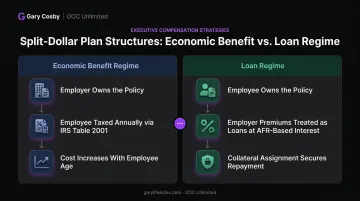
Here, the employer owns the policy and pays every premium. The employer then endorses a portion of the death benefit to the employee, who names their own beneficiary for that share.
The employee doesn't pay premiums directly. Instead, they pay tax each year on the value of the life insurance protection they receive, calculated using IRS Table 2001 factors based on age and death benefit amount. Because Table 2001 costs rise with age, this arrangement tends to get more expensive for the employee over time.
When the plan terminates, the employer usually keeps the policy or transfers it to the employee. If transferred, the employee owes tax on that value as compensation.
Loan Regime
Under this structure, the employee owns the policy from day one. The employer still pays the premiums, but documents each payment as a separate loan requiring adequate interest tied to the Applicable Federal Rate (AFR).
To secure repayment, the employee grants the employer a collateral assignment, a secured interest in the policy's cash value and death benefit until the loan balance is settled.
Here's the appeal: loan regime plans can lock in a favorable AFR at the time each premium loan is made, even if market rates climb afterward. That said, each premium payment is treated as its own separate loan for tax purposes, so a rate locked on one advance doesn't automatically carry over to future premiums. Repayment typically happens through policy cash value or the death benefit at termination.
How Split-Dollar Plans Are Terminated
Most agreements end one of three ways:
- Employee death — proceeds settle according to each party's contractual share
- A specified date — often retirement, triggering loan repayment or a policy transfer
- Early or voluntary termination — the parties unwind the arrangement per the agreement's terms
In every case, get clarity in writing on tax treatment before the fact. The employee generally owes tax on a policy transfer at termination as compensation, and that surprise bill is far easier to plan for than to absorb after the fact.
Key Benefits of Split-Dollar Life Insurance
Split-dollar arrangements offer a few distinct advantages worth weighing:
- **Corporate dollars fund a personal benefit**, which is especially valuable when the business sits in a lower tax bracket than the employee
- Below-market interest potential exists because loan regime plans can take advantage of a low AFR at the time of each premium advance
- Selective flexibility comes from falling outside ERISA's nondiscrimination rules, so employers can offer the benefit to one or two key people instead of the entire staff
That last point matters more than it might seem. A qualified plan like a 401(k) has to treat employees fairly across the board. A split-dollar plan doesn't. You decide who gets it.
Tax Rules and Legal Considerations You Should Know
Taxation hinges on who owns the policy, and the IRS recognizes two distinct approaches:
- Loan regime: The employee owes interest on employer-paid premiums and may face imputed income if that interest falls below the IRS-required rate.
- Economic benefit regime: The employee pays income tax annually on the calculated benefit value pulled from Table 2001.
There's also a securities-law wrinkle worth flagging. Sarbanes-Oxley Section 402 makes it unlawful for a publicly traded issuer to extend personal loans to directors and executive officers, with only narrow statutory exceptions. That restriction can directly limit loan regime split-dollar plans for public company executives, since employer premium advances function as loans to an insider.
Because these agreements touch insurance, tax, and legal rules simultaneously, don't try to structure one solo. Two professionals need to be involved:
- A licensed insurance professional — such as an OOC Unlimited agent — handles the policy design and funding.
- A CPA or estate attorney reviews the tax treatment and drafts the agreement itself.
Skipping either professional is how businesses end up with a plan that looks great on paper and creates a tax headache five years later.
Is Split-Dollar Life Insurance Right for Your Business?
Before committing, weigh a few practical questions:
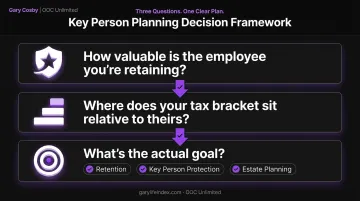
- How valuable is the employee you're trying to retain? Split-dollar plans make the most sense for executives or partners whose departure would genuinely hurt the business.
- Where does your tax bracket sit relative to theirs? The cost-sharing math works best when there's a meaningful gap.
- What's the actual goal? Executive retention, key person protection, and estate or wealth-transfer planning each point toward slightly different plan designs.
Because split-dollar arrangements sit at the intersection of insurance funding, tax law, and legal documentation, a team approach works best. A licensed agent structures the policy funding side. Your CPA and attorney handle tax treatment and drafting.
For example, Gary Cosby of OOC Unlimited, licensed in all 50 states, works with business owners exploring insurance-funding options like split-dollar arrangements for key employee retention. He handles the insurance design and funding piece, then coordinates with the business's CPA and attorney so the agreement is properly documented from the start rather than patched together after the fact.
Frequently Asked Questions
What is split-dollar life insurance?
It's a written agreement, typically between an employer and employee, that structures how they share the premium cost, cash value, and death benefit of a permanent life insurance policy. The term describes this funding structure rather than a specific type of policy.
Who owns a split-dollar life insurance policy?
Ownership depends on the arrangement. Under the economic benefit regime, the employer owns the policy. Under the loan regime, the employee owns it while the employer's premium payments are documented as loans.
What are the two types of split-dollar plans?
The economic benefit (endorsement) regime and the loan regime. The main difference is ownership: the employer owns the policy in the first, the employee owns it in the second.
Who pays the premiums in a split-dollar plan?
The employer typically pays premiums under both structures. Under the loan regime, though, the employee must eventually repay that amount as a loan, usually from cash value or death proceeds.
How are split-dollar life insurance plans taxed?
Economic benefit participants pay annual income tax on a calculated benefit value using IRS Table 2001. Loan regime participants owe interest tied to the Applicable Federal Rate, with potential imputed income if interest is below that rate.
Can split-dollar life insurance be used for estate planning?
Yes. Private or intergenerational split-dollar arrangements can help high-net-worth families transfer wealth and manage estate tax exposure. These plans are often paired with an irrevocable life insurance trust and should be structured correctly with an estate attorney.