This scenario plays out more often than most owners realize. A 2016 Nationwide survey found that roughly 60% of small business owners had no succession plan at all, and that number includes businesses with multiple partners who assumed "we'll figure it out later" was a strategy (Nationwide, 2017).
Business continuation insurance turns a paper agreement into guaranteed cash the moment it's needed. This article covers what it covers, what it costs, the main plan structures, and how to set one up the right way.
Key Takeaways
- Business continuation insurance funds a buy-sell or succession plan when an owner or key employee dies or is disabled
- Unlike business interruption insurance, which covers lost income after property damage, this policy covers the loss of a person
- Entity-purchase and cross-purchase are the two main funding structures, each with different tax outcomes
- Premiums hinge on the insured's age, health, coverage amount, and whether life, disability, or both apply
- Setup takes a team: a licensed insurance agent, a CPA, and an attorney working together
What Is a Business Continuation Insurance Plan?
A business continuation insurance plan is an insurance-funded arrangement that keeps a company operating and transfers ownership smoothly when an owner or key person dies or becomes disabled. Instead of scrambling for cash mid-crisis, the business (or its surviving owners) receives a policy payout designed specifically to cover the transition.
That instant liquidity matters. Without it, surviving owners often face forced asset sales, high-interest loans, or a fire-sale price just to buy out a departing partner's stake. Insurance proceeds eliminate that scramble.
This funding mechanism goes by several names. You'll hear it called "business succession insurance," "key person insurance," or simply "buy-sell funding." These terms overlap, but they're not identical to business interruption insurance, which is a completely different product.
How It Differs from Business Interruption Insurance
Business interruption insurance is property coverage. It reimburses lost income and operating expenses after physical damage from a covered peril, like a fire or storm shutting down your building, according to Investopedia.
Business continuation insurance addresses something else entirely: the loss of a person. It funds ownership transfer and succession, not property-related income loss. Confusing the two is a common and costly mistake for owners shopping for coverage.
Why Every Business With Multiple Owners or Key Employees Needs One
That confusion carries real stakes. Without funding in place, surviving partners often end up co-owning the business with an inexperienced heir, or selling under pressure at a steep discount.
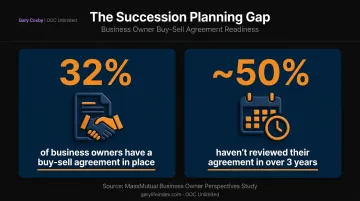
The gap is wider than most owners assume. A 2022 MassMutual study of 800 business owners found only 32% had a buy-sell agreement in place at all. Among those who did have one, nearly half hadn't reviewed it in over three years, meaning the funding amount likely no longer matches the business's actual value.
What Does a Business Continuation Insurance Plan Cover?
In short: it covers costs tied to the death or disability of an owner or key person, including buyout funding, replacement recruiting and training, lost expertise, and continued overhead.
Funding a Buy-Sell Agreement
The buy-sell agreement directs death benefit proceeds to purchase the deceased or disabled owner's share. This prevents messy negotiations with grieving heirs who may have no interest in running the business, according to Prudential's buy-sell agreement funding guide.
Policies can be structured for a partial or full buyout depending on current business valuation. As the company grows, coverage should be revisited, since underfunding defeats the purpose.
Key Person Insurance Protection
Proceeds here cover different ground:
- Recruiting and training costs for a replacement
- Lost revenue tied to that person's client relationships or specialized expertise
- Repayment on loans where the key person served as guarantor
Sizing this coverage typically follows one of two methods. The salary-multiple method recommends coverage of 8 to 10 times the person's salary, according to Investopedia's key person insurance guide. The replacement-cost method instead totals recruiting fees, training expenses, and projected productivity loss during the transition.
Business Overhead Expense (BOE) Coverage
BOE coverage reimburses fixed operating costs, such as rent, utilities, and staff payroll, when an owner becomes disabled and can't generate revenue. It typically excludes the disabled owner's own salary, new equipment, or property improvements, and benefits commonly run for up to two years.
This disability-based protection is usually layered alongside a life-insurance-funded buyout plan. Death and disability both threaten the business; a complete plan addresses both triggers, not just one.
Types of Business Continuation Insurance Plans
Two legal structures dominate buy-sell funding, and each carries different tax and administrative consequences.
Entity-Purchase (Stock Redemption) Plans
Here, the business itself owns the policy, pays the premiums, and is named beneficiary. When an owner dies or becomes disabled, the business uses the proceeds to redeem that owner's shares directly.
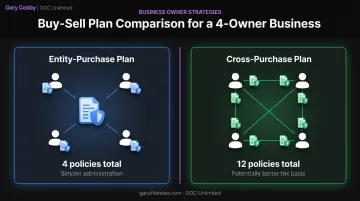
This structure is simpler to administer when there are several owners, since it requires only one policy per owner rather than a policy for every possible pairing.
Cross-Purchase Plans
In a cross-purchase arrangement, individual owners buy policies on each other's lives. Proceeds go directly to the surviving owners, who then personally purchase the departing owner's interest.
This can offer purchasing owners a better tax basis. The tradeoff: administration gets complicated fast. According to Prudential's 2026 buy-sell funding guide, four owners require 12 separate policies under a cross-purchase design, compared to just four under an entity-purchase plan. Beyond three or four owners, most businesses shift to entity-purchase for that reason alone.
Combining Life and Disability Insurance
Many continuation plans layer disability coverage on top of life insurance, since incapacity threatens a business just as much as death, sometimes more, given the ongoing costs of a long-term disability.
Non-owner key employees can also be insured without any buy-sell agreement in place. Losing an operations manager with irreplaceable vendor relationships, for example, could seriously disrupt the business. In cases like this, coverage makes sense on its own.
How Much Does a Business Continuation Insurance Plan Cost?
There's no flat rate here. Premiums are individually underwritten based on:
- Age and health/underwriting class of the insured person
- Coverage amount, tied directly to current business valuation
- Policy type, since disability coverage prices differently than life insurance, and combining both raises total cost
Beyond these underwriting factors, business size, industry risk, and the number of owners requiring coverage also affect the price. Plan structure matters too: a cross-purchase plan with five owners costs more to administer than an entity-purchase plan covering the same group, simply because more individual policies are involved.
Get a formal business valuation before shopping for coverage. Underinsuring is common, and it undermines the entire plan just when it's needed most.
Working with a licensed agent who understands how to translate a valuation into the right coverage amount matters more than chasing the lowest premium.
How to Set Up a Business Continuation Insurance Plan for Your Business
Setting this up correctly follows a fairly predictable sequence:
- Get a business valuation so the buyout price reflects reality, not a guess made five years ago
- Draft or update the buy-sell agreement with an attorney, specifying triggers, valuation method, and structure
- Determine the funding amount needed for a full or partial buyout
- Secure the appropriate policies, whether life, disability, or both, matched to the agreement's terms
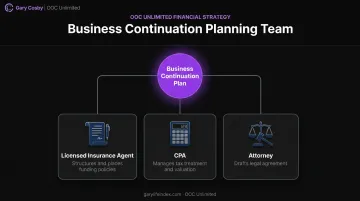
This is a team effort. No single professional should handle it alone.
- A licensed life insurance agent structures and places the funding policies
- A CPA manages tax treatment, entity structure, and valuation input
- An attorney drafts the legal agreement and consent documentation
Gary Cosby Jr. of GFI × Team OOC works this way with business owners. Licensed in all 50 states, he focuses on the insurance-funding piece, exploring key person disability and business overhead expense options.
He coordinates alongside a business owner's existing CPA and attorney rather than trying to replace them. Gary handles policy design and carrier selection; tax and legal decisions stay with the advisors already familiar with the business.
Frequently Asked Questions
What does business continuation insurance cover?
It covers costs tied to an owner or key person's death or disability, including buyout funding, replacement recruiting and training, and overhead reimbursement during disability.
How much does a business continuation plan cost?
Cost depends on the insured's age, health, coverage amount, and whether the policy includes life insurance, disability insurance, or both. There's no fixed rate since every plan is individually underwritten.
Is business continuation insurance the same as key person insurance?
Not exactly. Key person insurance is often one piece of a broader continuation plan, which may also fund a buy-sell agreement to handle full ownership transfer.
How is business continuation insurance different from business interruption insurance?
Business interruption insurance covers lost income after property damage, like a fire or flood. Business continuation insurance instead addresses the financial fallout from losing an owner or key person.
Do I need a buy-sell agreement before getting this insurance?
Most insurers want a buy-sell agreement in place, or at least being drafted alongside the policy application. The agreement and the insurance funding are typically set up together.
Can a business continuation plan cover more than one owner?
Yes. Multiple owners can be covered through an entity-purchase plan or through several cross-purchase policies. Either way, coverage should be revisited whenever ownership or valuation changes.