This scenario plays out more often than most owners realize. Every closely held business with two or more owners eventually faces the same question: what happens to an owner's share when they die, retire, become disabled, or simply decide they want out?
Without a written plan, the risks pile up fast:
- Ownership disputes between remaining partners and the departing owner's heirs
- Unwanted third-party owners, like an ex-spouse or estranged relative, gaining a seat at the table
- IRS challenges to the business's valuation during an estate tax audit, at the worst possible time
This guide breaks down buy-sell and stock redemption agreements: what they are, how they differ, the events that trigger them, how to set a fair price, and how owners typically fund the buyout.
Key Takeaways
- Buy-sell agreements control how ownership interests transfer among owners
- In a stock redemption agreement, the company buys back a departing owner's shares
- Common triggering events include death, disability, retirement, divorce, and exit
- Life insurance typically funds death-triggered buyouts with cash exactly when needed
- An attorney, CPA, and insurance professional should structure these agreements together
What Is a Buy-Sell Agreement (and How Does a Stock Redemption Agreement Fit In)?
A buy-sell agreement is a legally binding contract among business owners that spells out when and to whom an ownership interest can be sold after a triggering event. It's often written directly into a shareholder, operating, or partnership agreement rather than standing alone.
Closely held businesses need this structure for a simple reason: there's no public market for their shares. A minority stake in a family manufacturing company or a two-partner medical practice can't be sold on an exchange overnight. Without a plan, owners lose control over who ends up holding equity in their business.
The core purpose comes down to three things:
- Business continuity when an owner exits unexpectedly
- An orderly transfer of ownership instead of a scramble
- Protection against IRS valuation challenges during an estate settlement
Despite the stakes, most owners haven't addressed this. A Wilmington Trust survey of more than 200 privately held-company owners found that 58% lacked a transition plan for their business. That's a majority of owners leaving their partners, employees, and families exposed to exactly the kind of conflict a buy-sell agreement is designed to prevent.
Stock Redemption Agreements Explained
A stock redemption agreement is a specific type of buy-sell structure. Instead of the co-owners buying a departing owner's shares, the company itself redeems them using company funds.
A stock redemption agreement falls under the buy-sell umbrella; it's simply one way to structure the transaction.
Here's what happens mechanically:
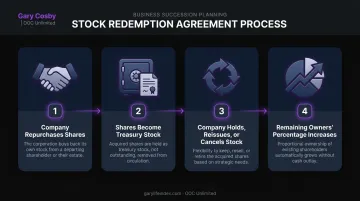
- The company repurchases the departing owner's shares
- Those shares become treasury stock — issued but no longer outstanding
- The company can hold, reissue, or cancel that treasury stock later
- Because there are now fewer outstanding shares, each remaining owner's percentage of the company increases automatically
That last point matters, but don't confuse it with a tax benefit. The remaining owners' percentage goes up; their cost basis in their existing shares generally does not.
Types of Buy-Sell Agreements: Redemption, Cross-Purchase, and Hybrid Structures
The three main buy-sell structures differ based on one question: who is obligated to buy the departing owner's interest?
Stock Redemption Agreement
The company buys back the shares. This structure works well when there are three or more owners because it centralizes everything into one set of policies and one purchasing party.
Advantages:
- Simplified administration: one buyer, one set of insurance policies
- The company absorbs age-related premium cost differences across owners
Disadvantages:
- No step-up in basis for remaining owners' existing shares
- Redemption proceeds can sometimes receive dividend tax treatment rather than capital gains treatment
Cross-Purchase Agreement
Here, co-owners buy each other's shares directly. Each owner typically holds a life insurance policy on every other owner, then uses the payout to buy that owner's interest if they die.
The upside: surviving owners get a basis step-up in the shares they acquire, which can reduce capital gains tax if they later sell.
The downside is administrative math: with two owners, you need two policies, but with five owners, you need 20 policies, since each owner needs a policy on every other owner. That math gets expensive and hard to track fast.
Hybrid Agreement
A hybrid (sometimes called "wait-and-see") structure combines both approaches. Shares are typically offered first to the company, and if the company passes, co-owners get the option to buy.
This flexibility helps in specific situations:
- One owner is uninsurable due to health issues
- The ownership group is growing and a rigid structure no longer fits
- Owners want to defer the redemption-versus-cross-purchase decision until a triggering event actually happens
Quick comparison:
| Structure | Who Buys | Basis Impact | Administrative Complexity |
|---|---|---|---|
| Redemption | The company | Generally no step-up | Low (one policyholder) |
| Cross-purchase | Co-owners | Purchase-price step-up | High with 3+ owners |
| Hybrid | Company first, then co-owners | Depends on final buyer | Moderate, flexible |
Common Triggering Events That Activate a Buy-Sell Agreement
Owners have to decide in advance which life events actually put the agreement into motion. Standard triggering events include:
- Death: Nearly always a mandatory trigger
- Disability: Often mandatory, sometimes with a waiting period
- Retirement: Frequently optional or negotiated
- Divorce: Protects against an ex-spouse becoming an owner
- Bankruptcy or creditor attachment: Prevents outside creditors from seizing an ownership stake
- Voluntary exit: An owner simply wants out
For each trigger, owners must decide whether the purchase obligation is mandatory (the company or co-owners must buy, and the departing owner must sell) or optional (either side has a choice). Mixing these designations across different triggers is common and often smart.
| Trigger | Common Classification |
|---|---|
| Death | Mandatory |
| Disability | Mandatory |
| Retirement | Optional |
| Divorce | Optional |
| Bankruptcy or creditor attachment | Mandatory |
| Voluntary exit | Optional |
Death and disability are typically the mandatory triggers, and for good reason: they're unpredictable, urgent, and most commonly funded through insurance. That funding piece is where things get technical, and it's covered next.
Setting the Purchase Price: Valuation Methods That Work
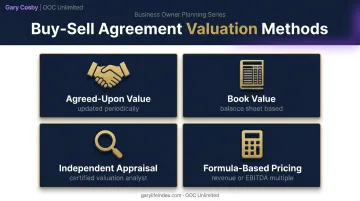
A buy-sell agreement without a clear pricing mechanism is a lawsuit waiting to happen. Owners choose from four common valuation methods:
- Agreed-upon value, updated periodically (annually or biennially) by the owners themselves
- Book value or adjusted book value, based on the company's balance sheet
- Independent appraisal by a certified valuation analyst at the time of the triggering event
- Formula-based pricing, such as a multiple of revenue or EBITDA
Payment terms matter just as much as the price itself. Owners need to specify either a lump sum payment at closing or multi-year installment payments with a stated interest rate.
Nailing down both value and payment terms upfront prevents the kind of dispute that ends up in court years later, when memories differ and stakes are higher.
There's also a tax angle that gets overlooked. The IRS doesn't automatically accept whatever price an agreement states. Rev. Rul. 59-60 established that fair market value for closely held stock depends on a hypothetical willing buyer and willing seller, weighing factors like earning capacity, book value, and comparable company data. There's no single formula the IRS will accept blindly.
A stale, outdated price or one that looks like a device to transfer wealth below fair value can invite exactly the scrutiny owners are trying to avoid. Valuation clauses need professional drafting, not a number pulled out of thin air during the initial partnership conversation.
Funding Your Agreement with Life Insurance
A buy-sell agreement is only as good as the cash behind it. This is where life insurance does the heavy lifting.
Here's the core problem it solves: when an owner dies, the business or the surviving owners suddenly need a large sum of cash, immediately, to complete the buyout. Pulling that from operating funds can cripple the business at the worst possible time. Life insurance delivers the cash exactly when it's needed, without draining the company.
Funding works differently depending on the structure:
- Cross-purchase agreements — each owner holds a policy on every other owner and uses the death benefit to buy the deceased owner's shares directly
- Redemption agreements — the company owns a policy on each owner and uses the death benefit to redeem shares itself
When a redemption structure is funded this way, it's often called an insured stock redemption agreement. Death benefit proceeds are generally received income-tax-free when the policy is properly structured, though exceptions exist for transfer-for-value situations and certain employer-owned policy rules.
One caveat matters: the Supreme Court's 2024 Connelly decision confirmed that corporate-owned life insurance proceeds count as a company asset for valuation purposes. A redemption obligation doesn't automatically cancel that value out. This makes correct structuring, and professional guidance, essential.
Funding gets complicated fast with multiple owners:
- Redemption structures face age-based premium disparities across owners
- Cross-purchase structures face a multiplying policy count as the ownership group grows
Working With a Licensed Insurance Professional
Choosing the right funding vehicle isn't a one-size-fits-all decision. Whether the business needs key person disability coverage, business overhead expense protection, or life insurance for a redemption or cross-purchase agreement, that decision benefits from someone who works this territory daily.
Gary Cosby, licensed in all 50 states and part of the OOC Unlimited team at Global Financial Impact, specializes in identifying and structuring the insurance funding component of a buy-sell agreement. Gary's role stays focused there.

Legal drafting stays with the business's attorney; valuation and tax structuring stay with the business's CPA. That division keeps each professional working in their own lane, which is how these agreements should be built.
Frequently Asked Questions
What is a stock redemption agreement and is it the same as a buy-sell agreement?
A stock redemption agreement is a specific type of buy-sell agreement where the company redeems a departing owner's shares. "Buy-sell agreement" is the broader term that also covers cross-purchase and hybrid structures.
What is the difference between a stock redemption agreement and a stock purchase agreement?
A redemption agreement governs the company buying back its own stock under specific triggering events, like death or retirement. A stock purchase agreement is broader and typically used in M&A deals or a full business sale.
What happens if a business doesn't have a buy-sell agreement in place?
Without one, businesses face ownership disputes and unwanted heirs inheriting shares. IRS valuation challenges during estate settlement can follow, and in some cases, owners who can't agree on next steps end up forcing dissolution.
What's the difference between a cross-purchase agreement and a stock redemption agreement?
In a cross-purchase, co-owners buy the departing owner's shares directly and receive a basis step-up. In a redemption, the company buys the shares, and remaining owners generally don't get that basis increase.
Can life insurance really fund a buy-sell agreement?
Yes. It's the most common funding method because it delivers tax-free cash exactly at the point of death, when the business needs it most. Disability insurance sometimes covers lifetime triggers like a disabling illness.
When should a business set up a buy-sell or stock redemption agreement?
Ideally at company formation. Owners should review it regularly as the business's value and ownership structure change, and it always needs to be in place before a triggering event, not after.