
Introduction
Most business owners spend 20 to 30 years building their company. Few spend more than an afternoon planning how they'll leave it.
That gap costs real money.
The Exit Planning Institute's 2025 State of Owner Readiness research found that only 13% of business owners currently have a formal, written exit plan, and just 15% of Baby Boomer owners have one on paper.
The stakes go beyond dollars. An unplanned exit, triggered by death, disability, burnout, or a sudden market shift, can erase decades of built-up value overnight.
Without a plan, your family, your employees, and your legacy are exposed to whatever happens next.
This guide covers what exit planning actually means and the main strategy options available to owners. You'll also get a step-by-step framework for building your own plan, plus the often-overlooked role life insurance plays in funding a smooth transition.
Key Takeaways
- Just 13% of business owners have a documented exit plan, risking a forced, undervalued sale.
- Nearly half of all ownership transitions are involuntary, triggered by death, disability, divorce, distress, or disagreement.
- Six exit routes exist: family succession, management buyout, ESOP, third-party sale, merger, or liquidation.
- Starting three to five years early preserves options and improves valuation outcomes.
- Life insurance funds buy-sell agreements, keeping a triggering event from draining business cash flow.
What Is Business Exit Planning?
Business exit planning is the ongoing process of preparing you, your business, and your finances for the day ownership changes hands, whether that's next year or fifteen years from now. It isn't a single event or a document you sign once and file away.
Exit Plan vs. Exit Strategy
These two terms get used interchangeably, but they mean different things:
- Exit plan: The overarching roadmap, covering your timeline, financial goals, advisory team, and the sequence of steps that get you from today to a successful transition.
- Exit strategy: The specific method you choose, such as a management buyout, an ESOP, or a sale to a third-party buyer.
Think of the plan as the "how and when," and the strategy as the "to whom."
It's Not Just for Owners Nearing Retirement
Exit planning isn't reserved for owners counting down to retirement. Illness, injury, and death don't check a calendar first. The Exit Planning Institute estimates that roughly 50% of business ownership changes happen involuntarily, driven by what the industry calls the "5 Ds": death, disability, divorce, distress, or disagreement among partners.
If you own a business, at any age or stage, you already have an exit ahead of you. You can shape that transition on your own terms now, or leave the outcome to chance later.
Why Exit Planning Matters (And Why Owners Delay It)
For many owners, the business isn't just an asset. It's an identity. You've poured nights, weekends, and personal savings into it, so planning for a future where you're not in charge can feel like planning your own disappearance.
That emotional resistance is the number one reason exit planning gets pushed to "someday." But someday has a cost.
The Documentation Gap Is Real
Recent survey data on small-business owners shows just over half have any kind of formal succession plan in place. That means close to half are running their business without a documented path forward. Older owners, the ones closest to a transition, aren't necessarily any more prepared than younger ones.
Delay Costs You Leverage
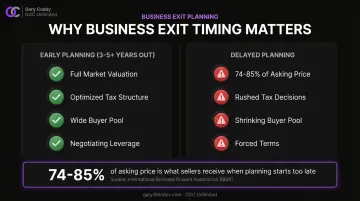
Waiting until you're "ready to leave" to start planning doesn't just delay the process. It shrinks your options.
- Valuation suffers: rushed sales rarely command full market value.
- Tax treatment gets locked in: asset sale versus stock sale decisions made under pressure can cost far more in taxes.
- Buyer pool shrinks: strategies like an ESOP or management buyout stop being realistic the closer you get to needing an immediate exit.
The numbers back this up. IBBA's Market Pulse survey found that completed business sales in early 2024 closed at 74% to 85% of the original asking price, depending on deal size. That's just among businesses that actually sold.
Types of Business Exit Strategies
Family Succession
Passing the business to a child or relative preserves legacy and continuity. It's a common choice for family-owned businesses, but the odds are tough. Family Business Institute research shows roughly 30% of family firms survive into the second generation, and only 10-15% make it to the third. Success depends on preparing the next generation early, not just naming a successor on paper.
Sale to Key Employees or Management Buyout
Selling to people who already know the business (often financed through an installment sale or a leveraged buyout) keeps culture intact and rewards loyal staff. The tradeoff: most management teams can't pay cash upfront, so owners typically carry seller financing and get paid out over several years.
Employee Stock Ownership Plan (ESOP)
An ESOP transfers ownership into a trust held for employees. Sellers of qualifying C-corporation stock can defer capital gains tax under IRC Section 1042 if two conditions are met:
- The ESOP acquires at least 30% of the company
- Proceeds go into qualified replacement property
According to the National Center for Employee Ownership, more than 6,600 ESOP plans now operate across roughly 6,400 U.S. companies, most of them privately held. The structure suits owners who want to reward the workforce and preserve independence.
Sale to a Private Equity Firm or Strategic Buyer
Third-party sales typically deliver the highest payout and the fastest close. Strategic buyers often pay a premium for synergies: shared customers, technology, or distribution. Financial buyers (private equity) focus on standalone returns and may keep more of your team and culture intact than a strategic competitor would. Either way, expect to give up control.
Merger or Acquisition
M&A makes sense when your business has something a larger company wants but doesn't have: proprietary technology, a loyal customer base, or a unique market position. A merger combines two companies into one; an acquisition means one company takes a controlling stake in the other.
Liquidation: The Last Resort
Liquidation means closing the doors and selling assets individually. It's typically the lowest-return option because it captures only asset value, not goodwill, customer relationships, or brand reputation. Most owners treat it as a fallback, not a plan.
How to Build Your Exit Plan: A Step-by-Step Framework
Exit planning follows a logical sequence. Skip a step, and you'll likely pay for it later, whether in taxes, in valuation, or in stress.
Start early. Industry benchmarks recommend beginning three to five years before your target exit date, with three years considered the bare minimum. Early planning gives you time to fix operational weaknesses, reduce owner dependence, and negotiate from strength instead of urgency.
Assemble your advisory team. You'll need a financial advisor, an attorney, a CPA, a valuation expert, and an insurance specialist working together, not in silos. Coordination between them, especially between your insurance specialist and CPA on buy-sell or key person funding, is what prevents costly missteps.
Get a professional business valuation. A real valuation looks past your financial statements to your brand, client relationships, and intellectual property. It's also your leverage: walking into negotiations with a credible, third-party number changes the conversation.
Identify and close value gaps. Compare what your business is worth today against what you need for life after the sale. If there's a gap, you have three options:
- Grow the business's value through operational improvements
- Extend your timeline to allow more preparation
- Adjust your retirement expectations to match reality
Choose your exit strategy and structure the deal. This is where the strategy options above come into play. Structuring decisions, like asset sale versus stock sale, directly affect how much of the purchase price you actually keep after taxes. If a buy-sell agreement is involved, confirm it's funded with life insurance so the deal actually closes when triggered.
Formalize, communicate, and execute. Draft the buy-sell or succession agreements, communicate the plan to employees and stakeholders at the right time, then set an annual review, since circumstances change.
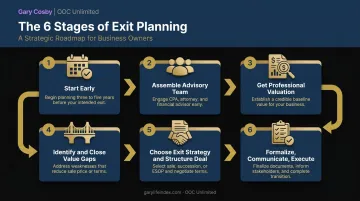
Treat this framework as an ongoing cycle you revisit every year, right up until the day you actually exit.
The Role of Life Insurance in Funding Your Exit Strategy
Even the best-structured exit plan is just paperwork until it's funded. This is where life insurance does its quiet, essential work.
Buy-Sell Agreements Need Real Money Behind Them
A buy-sell agreement is only as strong as its funding. These agreements typically need to cover several triggering events, including:
- Death of an owner or partner
- Disability preventing continued work
- Retirement or voluntary departure
- Other transitions defined in the agreement itself
If a partner dies or becomes disabled, the surviving owners or the business need cash immediately to buy out that share. Without funding in place, the business either drains its working capital or the departing owner's family ends up as an unwilling co-owner. A life insurance policy placed on each owner solves this by providing liquidity the moment it's needed.
Key Person Coverage Protects What the Business Can't Replace Overnight
Key person insurance works differently, protecting the business itself rather than an ownership transition. The business owns the policy, pays the premiums, and is the named beneficiary.
If a founder or critical operator suddenly can't work, the payout helps cover lost revenue, recruiting costs, and the disruption of training a replacement. For a company built around one key salesperson or technical lead, that cushion often determines whether the business retains its top clients during the transition.
Where GFI × Team OOC Fits In
Structuring these arrangements takes more than picking a policy. Gary Cosby Jr. and the licensed agents at GFI × Team OOC focus specifically on the insurance-funding piece: choosing the right policy type, coverage amount, and carrier from a network of 25+ A-rated insurers.
They coordinate directly with the business owner's CPA and attorney, who handle tax structuring and legal drafting, so the funding mechanism actually lines up with the buy-sell agreement already in place.
A legal agreement without funding is a promise with no way to keep it.
Common Exit Planning Mistakes to Avoid
Even owners who know they need a plan trip over the same pitfalls:
- Waiting until you're "ready to leave." By the time you're mentally done, your options have already narrowed, usually meaning a discounted price and fewer strategy choices.
- Skipping the professional valuation. Guessing at your business's worth based on a multiple you heard somewhere sets you up for a rude awakening when real buyers arrive with real numbers.
- Leaving insurance and buy-sell funding out of the plan. A legally sound agreement means little without cash to execute it. Without funding in place, both the business and family stay financially exposed if a triggering event hits before a sale closes.
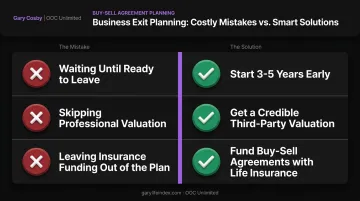
Building a complete advisory team from the start covers CPA, attorney, valuation, and insurance expertise. This is what separates a plan that works from one that just sits in a drawer.
Frequently Asked Questions
How do you plan a business exit strategy?
Start three to five years before your target date, get a professional valuation, build a full advisory team, choose the strategy that fits your goals, and formalize everything in writing.
What are some effective exit strategies for a business?
Family succession, ESOPs, management buyouts, third-party sales, and mergers are the main routes. The right fit depends on your timeline, your successor options, and how much control you're willing to give up.
What is an exit plan in a business plan?
It's the documented roadmap covering how and when ownership will transition, separate from the specific exit strategy (like an ESOP or third-party sale) you ultimately choose.
When should you start exit planning?
Three to five years before your intended exit. Earlier is better since it preserves more strategy options and improves valuation outcomes.
What is the most common exit strategy for small businesses?
Family succession and sales to key employees remain the most common paths, though ESOPs have grown steadily in popularity among owners prioritizing legacy and workforce loyalty.
How does life insurance factor into a business exit plan?
It funds buy-sell agreements so partners can execute a buyout immediately after death, disability, or another triggering event, without draining business cash flow or forcing a rushed sale. A licensed agent typically coordinates this funding alongside your CPA and attorney.