
Introduction
Every business owner leaves their business eventually. By choice, by health, or by circumstance beyond their control. Yet most owners push succession planning to "someday," treating it like a will they'll never get around to.
That delay is expensive. Fewer than one in three business owners has a formal succession plan, according to the Exit Planning Institute's State of Owner Readiness study. For most owners, the business represents the majority of their net worth—an unplanned exit can wipe out retirement savings, strain family relationships, and leave employees scrambling.
This guide walks through the exit strategy options available, a step-by-step planning framework, and how proper funding, including life and disability insurance, protects the plan you build.
Key Takeaways
- A written, funded succession plan protects your business value, your family, and your employees
- Multiple exit paths exist, including family transfer, management buyout, ESOP, and third-party sale
- Only 34% of US family businesses have a documented, communicated succession plan, per PwC's 2019 Family Business Survey
- Life and disability insurance often fund buy-sell agreements, without which even a strong plan can collapse financially
Why Business Succession Planning Can't Wait
The 5 D's That Force Unplanned Exits
Not every exit happens on the owner's timeline. The Exit Planning Institute describes five triggers, known as the 5 D's, that force owners out unexpectedly:
- Death: sudden loss with no transition plan in place
- Disability: a health event that ends an owner's ability to work
- Divorce: ownership disputes tied to marital dissolution
- Disagreement: irreconcilable conflict among partners or family
- Distress: financial hardship forcing a rushed sale
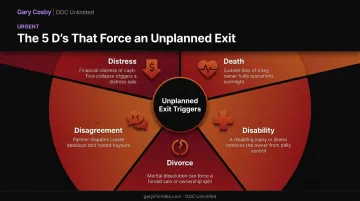
The Exit Planning Institute estimates roughly 50% of owner exits are involuntary, driven by one of these five events rather than a planned departure.
That's commentary from exit planning practitioners, not a formally measured national statistic. But it lines up with what advisors see constantly: owners who assumed they had years to plan, and didn't.
Why Starting Early Matters More Than People Think
Here's the part owners underestimate: planning early preserves optionality. An owner with five years of runway can groom a successor, clean up financials, and choose between multiple exit paths. An owner with six months has one option, usually the fastest buyer willing to write a check, not necessarily the best one.
Waiting doesn't just risk a worse outcome. It often means:
- Less time to strengthen the financials buyers actually pay for
- Fewer viable successors, since grooming a leader takes years, not weeks
- Reduced negotiating leverage when a sale feels urgent instead of strategic
Businesses that start planning years ahead have more paths available when the moment finally comes.
How to Create a Business Succession Plan: A Step-by-Step Framework
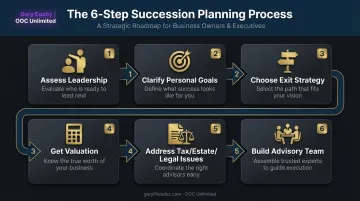
Succession planning unfolds in stages, not as a single decision. Skip a step, and the whole plan gets shakier.
Step 1: Assess Leadership Honestly
Start by asking a hard question: is there someone inside the business capable of running it? Evaluate family members and key employees against real leadership criteria, not loyalty or tenure. If no internal candidate exists, the plan simply points toward an outside buyer instead, a common and valid outcome rather than a shortfall in leadership.
Step 2: Clarify Your Personal and Financial Goals
Before choosing an exit path, define what life after the business looks like:
- How much income do you need post-exit?
- Do you want to stay involved in an advisory capacity, or walk away completely?
- Is preserving the company's culture and legacy a priority, or is maximizing payout the goal?
These answers shape every decision that follows.
Step 3: Choose Your Exit Strategy
With goals defined, select the path that fits: generational transfer, management buyout, ESOP, or third-party sale. Each option carries different tax, timeline, and control trade-offs. (We break down each option in detail below.)
Step 4: Get a Professional Business Valuation
Accurate, current financials and a third-party appraisal do two things: they set realistic price expectations and they strengthen your negotiating position. Buyers and family members alike respect a number backed by professional analysis, not guesswork.
Step 5: Address Tax, Estate, and Legal Implications
Work with a CPA and estate attorney to understand tax exposure and structure the transfer properly. Tools like buy-sell agreements and trusts often minimize tax burden while formalizing how the transition legally occurs. Buy-sell agreements are frequently funded through life insurance, giving the business the liquidity to complete a buyout without disrupting operations.
Step 6: Build a Formal Advisory Team
Put together a CPA, an attorney, and a financial or insurance advisor. Then write the plan down, including the timeline and contingencies for disability or death. A plan that exists only in your head remains an intention until it's written down.
Types of Business Exit Strategies: Which One Fits Your Goals
There's no universal "best" exit strategy. The right one depends on what the business owner is optimizing for: maximum payout, legacy preservation, continued involvement, or speed.
Family Succession or Generational Transfer
Passing the business to children or relatives preserves legacy and company culture. Bank of America identifies this as one of the most common exit paths owners consider. It typically requires:
- Years of grooming a family successor before handoff
- A formal buy-sell or gifting structure to prevent disputes among siblings or relatives
- Clear communication about roles, timelines, and expectations
Management or Employee Buyout
Selling to existing managers, or transitioning ownership through an ESOP trust, preserves operational continuity. The business keeps its institutional knowledge intact. These deals are usually financed through company earnings or ESOP debt, unfolding as a glide-path transition over several years rather than a single closing date.
Third-Party Sale to a Strategic or Financial Buyer
Selling to a competitor, strategic acquirer, or private equity firm often yields the highest valuation, particularly when a strategic buyer sees synergy value in the acquisition. The tradeoff: limited ongoing involvement for the owner and potential workforce changes post-sale.
Partner Buy-Sell Arrangement
Co-owned businesses commonly rely on a cross-purchase or entity-purchase buy-sell agreement. Either structure lets remaining partners buy out a departing, disabled, or deceased owner's share without scrambling for cash. This works because the agreement is funded in advance, typically through life insurance, so liquidity exists exactly when it's needed.
IPO or Liquidation
An IPO only suits large-scale, high-growth companies with significant revenue, making it an unrealistic path for most privately held businesses. Liquidation is the fallback when no viable transfer path exists: assets get converted to cash, creditors and shareholders are paid, and operations end.
Valuing and Preparing Your Business for Transition
A credible exit starts with clean numbers. Buyers, family successors, and even the IRS all scrutinize financial statements before any transition moves forward.
What strengthens a valuation:
- Accurate, updated financial statements spanning multiple years
- Documented intangible assets like brand equity, customer relationships, and intellectual property
- Clear evidence of recurring revenue and manageable owner dependency
Beyond the numbers, document your operational processes. New leadership, whether that's a family member, a management team, or an outside buyer, needs to understand how the business actually runs day to day.
What to document:
- Key client and vendor relationships
- Standard operating procedures for daily operations
- Institutional knowledge that currently lives only in your head
One risk owners consistently underestimate: employee retention during transition. Uncertainty about ownership changes can push top talent out the door right when you need them most.
Key person insurance and buy-sell agreement funding help offset this risk, giving successors the capital to retain critical staff and keep the business running smoothly without you.
Funding Your Succession Plan: Why Insurance Is the Backbone
A well-designed succession plan can still fail. Not because the strategy was wrong, but because the money wasn't there when the triggering event happened. This is where insurance stops being an afterthought and becomes the financial engine that makes the plan work.
Life insurance is one of the most common tools used to fund buy-sell agreements between partners. When a co-owner dies, the policy proceeds give remaining partners or the business entity immediate cash to buy out that owner's share, no loans or liquidated assets required.
Key person insurance works similarly but protects the business itself. If an owner or a critical employee dies or becomes disabled unexpectedly, this coverage compensates the company for:
- Lost revenue tied directly to that individual
- Recruiting and training costs for a successor
- Reassurance to lenders or investors that the business remains stable
Business overhead expense insurance addresses a different gap. If an owner becomes disabled and can't work, this coverage keeps fixed costs like rent, payroll, and utilities covered. That keeps the company out of a forced sale simply because the owner couldn't work for six months.
Structuring this correctly takes coordination. Gary Cosby Jr. of OOC Unlimited/GFI, licensed in all 50 states, works with business owners to explore insurance-funding options for key person, disability, and buy-sell needs.
His role sits alongside the owner's CPA and attorney, not in place of them. Each professional handles a distinct piece:
- The attorney drafts the buy-sell agreement
- The valuation professional sets the buyout number
- The insurance component ensures the money is there when a "5 D" event hits
Access to 25+ A+ rated carriers matters here too. It means comparing funding structures across multiple insurers instead of accepting whatever one company offers. You get coverage tailored to your specific succession timeline, not a generic template. If you're ready to map out how insurance fits into your exit plan, booking a consultation is a reasonable next step before you finalize any agreement.

Frequently Asked Questions
How do you create a succession plan for a business?
Assess whether an internal successor exists, clarify your personal financial goals, choose an exit strategy, get a professional valuation, and formalize everything with legal documents and insurance funding.
What is an example of a business exit strategy?
A family business owner might transfer ownership to a child gradually over five years through a structured gifting plan. Alternatively, an owner might sell to their management team through a financed buyout funded by future company earnings.
What are the 5 D's of succession planning?
Death, disability, divorce, disagreement, and distress. The Exit Planning Institute identifies these as the triggers behind roughly half of all unplanned business exits.
When should a business owner start succession planning?
Some advisors suggest starting at business formation, ideally years before an anticipated exit. Early planning preserves options, strengthens financials, and gives you time to groom the right successor instead of settling for the fastest one.
What role does life insurance play in a succession plan?
Life and disability insurance fund buy-sell agreements and key person protection, ensuring cash is available the moment a death or disability triggers an ownership transition. Without this funding, plans often stall for lack of liquidity.
Who should be on my succession planning team?
A CPA, an estate attorney, and a financial or insurance advisor form the core team. Each handles a distinct piece: tax structuring, legal documentation, and funding, working together rather than in isolation.