Introduction
Your VP of Sales just got a call from a competitor. Better title, bigger equity package, and a check that clears in thirty days.
You have no counteroffer ready. By Friday, ten years of client relationships and institutional knowledge walk out the door with her.
This scenario plays out in businesses every day. Employee turnover costs businesses more than $36,000 per departure on average, according to InvestmentNews research on workforce trends.
For a key executive, the real cost runs far higher once you factor in lost clients, disrupted deals, and rebuilding trust with a team.
A Restricted Executive Bonus Arrangement (REBA) is one answer. It's a Section 162 strategy that rewards your best people with tax-advantaged life insurance while building in golden handcuffs that make staying more attractive than leaving.
This guide breaks down how REBAs work, how the IRS taxes them, what to watch heading into 2026, and whether this strategy fits your business.
Key Takeaways
- A REBA combines a Section 162 bonus, restrictive endorsement, and employment agreement into one retention plan
- Employers get a full tax deduction with no ERISA filings or nondiscrimination testing required
- Executives own the policy immediately, but cash-value access waits until vesting
- The strategy fits highly compensated employees who've maxed out qualified plan contributions
What Is a Restricted Executive Bonus Arrangement (REBA)?
A REBA is an IRC Section 162 executive bonus plan funded through a personally owned life insurance policy, with one critical addition: a restrictive endorsement filed directly with the insurance carrier that limits the executive's early access to cash value.
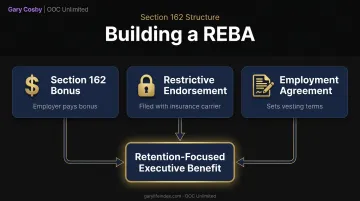
Three pieces have to work together for a REBA to function:
- The Section 162 bonus: the employer pays a bonus, which the executive uses to fund premiums on a policy they own
- The restrictive endorsement: a document filed with the insurer that legally restricts loans, withdrawals, surrenders, and beneficiary changes until vesting conditions are satisfied
- The employment agreement: the contract that spells out the vesting schedule, triggering events, and what happens if the executive leaves early
How This Differs From a Standard Executive Bonus Plan
In a standard Section 162 executive bonus plan, the employee owns the policy outright from day one with zero restrictions. That's simple, but it offers no retention value: the executive could cash out or walk away tomorrow, and the employer never sees a dime of that investment come back.
The restrictive endorsement changes that math entirely. It's what turns a nice perk into a genuine retention strategy.
Another advantage: REBAs aren't subject to ERISA filing requirements or nondiscrimination testing. That means you can offer this benefit selectively, such as to your top three executives, without extending it to your entire workforce or filing extra government paperwork.
How a REBA Works: Step-by-Step Mechanics
A REBA involves distinct responsibilities on both sides of the arrangement, plus a few structural decisions that shape how the benefit actually functions.
Employer and Executive Responsibilities
The employer handles the setup work:
- Identifying which key employees qualify for the arrangement
- Setting the premium or bonus amount for each participant
- Choosing a vesting schedule that aligns with retention goals
- Filing the restrictive endorsement directly with the insurance carrier
The executive, meanwhile, takes on the ownership side:
- Applying for and owning the life insurance policy personally
- Naming personal beneficiaries (subject to the endorsement's restrictions)
- Reporting the bonus as taxable income each year on their W-2
Single Bonus vs. Double Bonus
Employers structure REBA bonuses one of two ways, and the choice affects who absorbs the tax hit.
| Structure | How It Works | Who Pays the Tax |
|---|---|---|
| Single bonus | Employer pays the premium amount as a bonus | Executive covers income tax out of pocket |
| Double bonus (gross-up) | Employer adds extra cash to cover the tax bill too | Employer absorbs the tax cost, making it neutral to the employee |
According to Prudential's advanced planning guidance, both structures still count as reportable compensation subject to standard payroll withholding. Most companies looking to maximize the retention effect lean toward the double bonus. It removes any excuse for the executive not to participate.
Vesting Schedules and the Restrictive Endorsement
This is where the "golden handcuffs" actually get built. Two common approaches:
- Cliff vesting: zero access to cash value until a specific date arrives, then full access unlocks all at once
- Graded vesting: access phases in gradually, say 20% per year over five years
Vesting typically ties to reaching a specified age, hitting a service milestone, or reaching retirement. The endorsement itself sits with the insurance carrier, enforcing the restriction regardless of what either party might informally agree to later.
Tax Treatment and REBA Rules
Tax treatment is where REBAs earn their appeal, and where the details matter most.
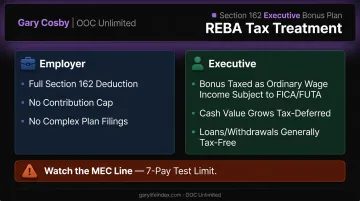
For the employer: Bonus payments are fully deductible under Section 162 as reasonable compensation for services rendered. There's no contribution cap like you'd find with a qualified retirement plan, and no complex plan filings to maintain.
For the executive: The bonus counts as ordinary wage income, subject to FICA and FUTA taxes in the year it's paid. Inside the policy, though, cash value grows tax-deferred, and policy loans or withdrawals generally come out tax-free, provided the contract avoids Modified Endowment Contract (MEC) status.
Watch the MEC line. Under IRC Section 7702A, a policy becomes a MEC if premiums paid in the first seven years exceed limits set by the "7-pay test." Cross that line, and withdrawals get taxed less favorably, with a possible 10% penalty on gains withdrawn before age 59½.
The Employer Control Problem
Here's a risk that catches business owners off guard: if the employer retains too much control over the policy, the IRS can challenge the deduction entirely. IRC Section 264(a)(1) denies a premium deduction whenever the employer holds a direct or indirect beneficial interest in the policy.
Bottom line: the executive's ownership has to be real, not just on paper. The restrictive endorsement limits access. It doesn't hand the employer a financial stake in the contract.
On early access: withdrawing cash value before the restriction lifts typically requires employer consent, and the employment agreement may require repayment of bonuses already paid if the executive tries to jump the vesting timeline.
2026 Considerations
The IRS released Notice 2025-67 with updated 2026 qualified plan figures: a $24,500 elective deferral limit, $72,000 in defined-contribution annual additions, and a $160,000 highly compensated employee threshold. None of these figures directly govern REBAs, since REBAs sit outside qualified plan rules entirely.
Still, they matter indirectly. Once an executive maxes out those qualified limits, a REBA becomes a natural next step for additional tax-advantaged savings.
No structural changes to Section 162, 264, or 7702A have surfaced for 2026 in current guidance. That said, tax rules shift, and a licensed tax professional should confirm current treatment before you finalize any arrangement.
REBA vs. Other Executive Benefit Strategies
Business owners often compare REBAs against three alternatives. Here's how they stack up:
| Strategy | Employer Control | Executive Ownership | Retention Leverage |
|---|---|---|---|
| Standard 162 bonus | None after payment | Full, immediate | None |
| REBA | Limited (endorsement only) | Full, but restricted | Strong |
| Split-dollar life insurance | Significant financial interest | Shared/limited | Moderate |
| NQDC | Deferred amounts exposed to creditors | None until paid out | Strong, but risky |
Standard Section 162 bonus plans are the simplest option, but they offer nothing to keep an executive around. The moment the bonus lands, the money and the policy belong to the employee, no strings attached.
Split-dollar life insurance flips the ownership model. The employer retains a financial interest in the policy, and tax treatment follows either the economic benefit regime or a loan regime, depending on structure.
This approach is more complex to administer. It typically suits situations where the employer wants to eventually recover premium costs.
Nonqualified deferred compensation (NQDC) defers the executive's tax bill, which sounds appealing on paper. The catch: deferred amounts remain exposed to the employer's general creditors, and the employer doesn't get a deduction until the executive actually receives the money.
If the business hits financial trouble, that deferred compensation is just as vulnerable as any other unsecured debt.
A REBA lands in a practical middle ground: the employer keeps a current deduction, the executive gets real ownership, and the endorsement still delivers genuine retention leverage.
Is a REBA Right for Your Business?
REBAs aren't a fit for every company or every employee. They work best under specific conditions.
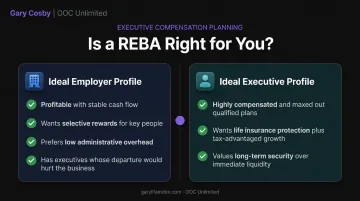
The ideal employer profile:
- Profitable business with predictable, stable cash flow
- Wants a selective way to reward specific key people (not the whole staff)
- Prefers low administrative overhead over complex qualified plan rules
- Has one or more executives whose departure would genuinely hurt the business
The ideal executive profile:
- Highly compensated, and has already maxed out 401(k) and other qualified plan contributions
- Wants both life insurance protection for their family and tax-advantaged savings growth
- Values long-term security enough to accept a vesting timeline
Structuring a REBA correctly takes coordination across three professional lanes: the insurance component, the legal drafting of the restrictive endorsement, and the tax treatment of the bonus itself. Getting any one piece wrong can undermine the whole arrangement.
That's where working with a licensed insurance professional matters. Gary Cosby Jr., licensed in all 50 states, helps business owners explore insurance-funding options for key employee and executive benefit strategies like REBAs.
Gary's role focuses on the insurance side: selecting the policy and structuring the funding mechanism. He coordinates closely with the business owner's existing CPA and attorney on the tax and legal components, since neither Gary nor any GFI team member provides tax or legal advice directly.
Frequently Asked Questions
What is a restricted executive bonus arrangement (REBA)?
A REBA is a Section 162 bonus plan combined with a restrictive endorsement that limits an executive's access to policy cash value until vesting conditions are met. The executive owns the policy, but with strings attached.
Who pays the premiums on a restricted executive bonus arrangement?
The employer pays a bonus to the executive, who then uses that bonus to fund premiums on a policy they personally own. The bonus counts as taxable income to the executive.
What are the rules for restricted executive bonus arrangements in 2026?
REBAs still operate under Section 162, with no confirmed structural changes for 2026 as of this writing. Confirm current bonus deductibility, MEC (Modified Endowment Contract) limits, and qualified plan thresholds with a licensed tax advisor before finalizing your arrangement.
Can I withdraw a reversionary bonus under a restricted executive bonus arrangement?
Generally, no. Cash value tied to a restricted bonus can't be withdrawn without employer consent until the restriction period specified in the endorsement lifts.
What happens if the executive leaves before the vesting period ends?
Early departure typically triggers repayment obligations for bonuses already paid, as outlined in the employment agreement. This repayment is often satisfied using the policy's available surrender value.
Is a REBA subject to ERISA?
Properly structured REBAs generally avoid pension-plan status under ERISA since the executive owns the policy outright. Many advisors recommend structuring them conservatively as a top-hat welfare plan to minimize compliance risk.