What actually moves the price? The insured's age and health, the coverage amount, and whether you choose term or permanent coverage. Younger, healthier employees cost less to insure. Larger death benefits cost more. Permanent policies cost several times more than term.
This article breaks down 2026 pricing tiers, the factors that swing your quote up or down, term versus permanent tradeoffs, and how to calculate the coverage amount your business actually needs.
Key Takeaways
- Monthly premiums typically run $50 to $500 per $1M of coverage, depending on age, health, and policy type.
- Permanent policies cost 2 to 5 times more than term coverage of the same face amount.
- Coverage needs should be based on salary multiples, replacement cost, or revenue contribution — not a flat industry rate.
- Waiting until a health issue arises can sharply raise premiums or trigger a denial.
How Much Does Key Person Insurance Cost in 2026? (Pricing Overview)
There's no flat industry rate for key person insurance. Every quote is built around the individual being insured and the coverage amount your business selects, not a published price list.
A common budgeting mistake is assuming one number applies across the board. Business owners often underestimate how much coverage they actually need, or forget that permanent policies carry a much bigger price tag than term. Both mistakes throw off the entire budget before the first quote even comes in.
Typical Monthly Cost Ranges (2026)
Based on current broker cost guides, here's how premiums generally break down per $1M–$5M of coverage. These figures include the death benefit and standard underwriting — they exclude riders, cash-value loads, or additional policy fees.
| Coverage Level | Example Profile | Monthly Premium |
|---|---|---|
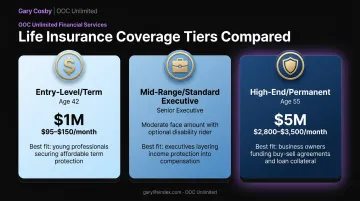
| Entry-level term | Age 42, good health, $1M, 10-year term | $95–$150 |
| Lower mid-range | Age 35, excellent health, $2M, 20-year term | $180–$240 |
| Upper mid-range | Age 48, good health, $3M, 10-year term | $420–$580 |
| High-end permanent | Age 55, standard health, $5M, permanent | $2,800–$3,500 |
These are 2026 broker premium illustrations, not guaranteed rates. Actual quotes depend on your carrier, underwriting class, and rider selections.
Entry-Level / Term Coverage (Younger, Healthy Insured)
This tier typically includes a basic term death benefit with standard underwriting (no bells and whistles). It's the right fit for startups and small businesses insuring a younger founder or key employee where budget matters more than long-term cash accumulation. Underwriting is usually straightforward, often requiring just basic health questions and no medical exam.
Mid-Range / Standard Executive Coverage
Here you're looking at term coverage with moderate face amounts, sometimes paired with a disability rider. This tier suits established small-to-mid-sized businesses insuring a senior executive or partner whose loss would meaningfully disrupt operations.
High-End / Permanent or Large Face-Value Coverage
Permanent or whole life policies, or large term policies with cash value accumulation, fall into this bracket. These are best for businesses funding buy-sell agreements or securing loan collateral for older, highly compensated key persons, where the policy also needs to double as a long-term financial asset. Underwriting at this level typically takes longer, since carriers weigh both health history and the size of the financial exposure.
Key Factors That Affect the Cost of Key Person Insurance
Pricing comes down to two things: the insured person's risk profile and the choices your business makes about coverage structure.
Age and Health of the Key Person
Younger, healthier insureds get significantly lower rates. Most insurers require a medical exam before issuing a policy.
According to Guardian Life, buying coverage at a later age produces meaningfully higher premiums, and health issues can make someone uninsurable altogether. A 35-year-old in excellent health might pay $180–$240/month for $2M in 20-year term coverage. A 48-year-old could pay $420–$580/month for $3M in the same product. Age and health class do the heavy lifting.
Coverage Amount and Policy Type
Premiums scale directly with face value. A $5M policy costs proportionally more than a $1M policy for the same person, health class, and product type, since coverage amount acts as a straight multiplier with no volume discount.
Policy type matters just as much. Permanent policies cost multiple times more than term because of cash-value accumulation, a factor we'll break down fully in the next section as one of the biggest cost drivers in your quote.
Occupation, Revenue Impact, and Optional Riders
Key persons in high-risk occupations may face added underwriting scrutiny. Top revenue generators, such as a sales leader responsible for a large share of company income, often need much larger coverage amounts to reflect their true financial impact. That larger face value raises the total premium even if the health rating stays the same.
Adding a disability rider broadens protection beyond the death benefit and increases the base premium. Carrier-specific salary replacement formulas vary, so get a quote that spells out the rider's actual terms rather than assuming a standard percentage applies.
Term vs. Permanent Key Person Insurance: Which Costs More?
Both structures protect the business, but they solve different problems at very different price points.
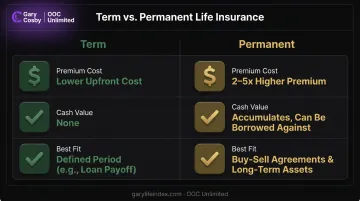
Premium Cost:
- Term: Lower upfront cost, coverage locked to a fixed period (typically 10, 20, or 30 years)
- Permanent: Two to five times higher cost than term for the same face amount, but the policy builds cash value over time
For example, term premiums on a $1 million policy for a healthy 45-year-old key employee often run $1,000 to $2,500 per year, while permanent coverage on the same employee can cost $8,000 to $15,000 or more annually.
Cash Value & Long-Term Use:
- Term: No cash value. Coverage expires at the end of the term with nothing to show for it.
- Permanent: Cash value accumulates and can be borrowed against as a business asset, which can improve certain balance sheet ratios over time.
Best Fit:
- Term: Works well for businesses insuring an employee for a defined period, such as until retirement or until a business loan is paid off.
- Permanent: Fits businesses funding buy-sell agreements or wanting a long-term financial asset layered on top of the protection itself.
If your primary goal is protecting against a specific, time-limited risk, term is almost always the more cost-efficient choice. Permanent coverage earns its higher price tag when the policy needs to do double duty as a financial asset.
How Much Coverage Do You Need? Estimating Your Budget
The right cost starts with the right coverage amount, not with shopping premiums first. Three methods are commonly used to land on a number.
- Multiple of Compensation: Multiply the key person's total compensation (salary, bonus, and stock) by 5x to 10x. For example, $360,000 in total pay produces a range of $1.8M to $3.6M, according to Policygenius.
- Cost to Replace: Add up recruitment fees, training costs, and lost productivity during the transition period to build a full replacement estimate.
- Revenue/Economic Contribution: Estimate the lost revenue or profit the business would forgo over the years it would realistically take to replace that person.
Beyond these formulas, businesses should also factor in whether the policy needs to coordinate with a buy-sell agreement or serve as loan collateral. These requirements can push the needed coverage amount higher than any single formula suggests.
Common Mistakes That Distort Key Person Insurance Costs
A few recurring errors throw off both the coverage amount and the total cost:
- Underinsuring based on salary alone: Ignoring lost revenue, client relationships, or the true replacement cost skews the number too low.
- Assuming premiums are tax-deductible: They generally aren't, and failing to budget for this can create a surprise in year-end planning.
- Delaying coverage until after a health issue appears: This can sharply increase premiums or trigger an outright denial. Underwriting early remains one of the cheapest moves a business can make.
Tax Implications and How to Get Properly Covered
Key person insurance carries specific tax rules worth understanding before you buy:
- Premiums are typically not tax-deductible when the business is the policy's beneficiary.
- Death benefits are usually received tax-free, but only if IRS notice and consent requirements under Section 101(j) are met before the policy is issued.
- Permanent policy cash value grows tax-deferred and can often be borrowed against without triggering a taxable event.
- Loans that cause a policy to lapse, or that convert it into a modified endowment contract, can create unexpected tax consequences.
Because pricing and structuring depend on individual underwriting, working with a licensed professional who can shop multiple A-rated carriers matters more than chasing a generic price range.
Gary Cosby Jr., a licensed life insurance agent with OOC Unlimited who is licensed in all 50 states, helps business owners explore key person disability and business overhead expense funding options. He also coordinates with the business's CPA or attorney when tax treatment, ownership structure, or buy-sell agreement details need outside expertise.
Frequently Asked Questions
How much does a $1,000,000 insurance policy cost?
A $1M key person term policy for a 42-year-old executive in good health typically runs $95–$150 per month for a 10-year term. Actual cost depends heavily on age, health class, and the carrier chosen.
What is key employee insurance coverage?
It's a business-owned policy where the company pays the premiums and receives the death benefit (not the employee's family) if a critical team member dies or becomes disabled. The payout helps the business recover financially.
Is key person insurance worth it?
For most businesses, yes. A modest monthly premium is a small price against the real financial cost of losing a founder, top executive, or major revenue driver. The right cost balances affordability with adequate protection.
How much key person insurance coverage do I need?
Use one of three approaches: a 5x–10x multiple of compensation, a full replacement cost estimate (recruiting, training, lost productivity), or a revenue contribution calculation. Many businesses blend all three.
Is key person insurance tax deductible?
Generally, no: premiums aren't deductible when the business is the beneficiary. The business typically receives death benefits tax-free, provided it properly documents notice and consent requirements.
Who qualifies as a "key person" for this type of coverage?
Founders, top revenue generators, specialized technical experts, and partners holding major client relationships all typically qualify. The common thread: their absence would create a real financial gap for the business.