
Introduction
Every business changes hands eventually. The only question is whether that transition happens on your terms, or in the chaos of an emergency.
Business owners face this reality constantly. Consider the scenarios that force the issue:
- A partner suffers a stroke with no warning
- A founder decides to retire at 65
- Siblings disagree over who inherits the family shop
- The one employee who knows how everything works quits without notice
Without a plan, any of these events can unravel decades of hard-won value in a matter of months.
This guide walks through the core succession strategies available to you and a practical, step-by-step process for building your plan. It also covers the funding piece most owners overlook, the part that determines whether a plan on paper actually survives contact with reality.
Key Takeaways
- Succession planning is ongoing, not a document you file away and forget
- Three paths exist: grow internal talent, sell to an outsider, or transition to family
- A plan without funding behind it can still collapse when a transition hits
- Annual reviews with legal, tax, and insurance advisors keep plans usable
What Is Succession Planning and Why Business Owners Can't Afford to Skip It
Succession planning is the deliberate process of deciding who will lead, own, or run key parts of your business once you step away. That's different from replacement planning, which is a reactive scramble to fill a seat after someone's already gone.
Good succession planning covers two separate tracks:
- Leadership continuity — who actually runs day-to-day operations
- Ownership transfer — who legally owns the business or its shares
For privately held and family businesses, these two tracks often involve different people entirely. A trusted manager might run the company while ownership passes to heirs who have no interest in daily operations.
Here's the uncomfortable part: most owners haven't done this work. Only 54% of U.S. small-business owners have created a succession plan, according to U.S. Bank's 2025 small-business survey, meaning close to half have nothing in place.
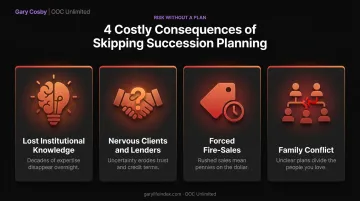
Skipping this step carries real consequences:
- Institutional knowledge walks out the door with no one to catch it
- Clients and lenders get nervous when leadership changes suddenly
- Forced fire-sales happen when there's no buyer lined up and cash is needed fast
- Family conflict over ownership can outlast the business itself
Succession planning should start years before you intend to exit. Waiting for a health scare or an unexpected resignation to force the issue is how businesses lose the most value.
Succession Planning Strategies: Choosing the Right Path for Your Business
There isn't one correct succession strategy. The right path depends on who's available, what your business needs, and how much runway you have.
Strategy 1: Develop and Promote Internal Talent
Grooming an existing employee or family member to take over preserves your culture, keeps client relationships intact, and lowers transition risk since the person already knows the business.
The evidence backs this up. A Harvard Business Review analysis covering 1,800 CEO successions found that company performance was significantly better when insiders took the top job compared to outside hires. That study wasn't limited to small businesses, but the direction is clear: familiarity with the business matters.
Building this pipeline takes time. Start identifying and mentoring candidates years, not months, before you need them ready.
Strategy 2: Bring in an Outside Buyer or Leader
Sometimes there's no viable internal or family successor. Or the business needs fresh capital, new expertise, or a clean break that only an outside buyer can provide.
This path comes with trade-offs. Research on family-owned business CEO transitions found that nonfamily leadership changes created value in 39% of cases, compared with 29% for family transitions, though successful family transitions produced a bigger average upside when they worked.
Culture fit, not competence alone, determines whether an outside hire succeeds. Top-performing companies invest heavily in onboarding new leaders into the company's history and values instead of assuming skill will translate automatically.
Strategy 3: Transition Ownership to Family or Co-Owners
Family succession brings its own dynamics. Fairness among heirs doesn't always mean equal ownership, especially when only some of the kids work in the business. Readiness matters more than birth order.
Structured agreements prevent disputes before they start:
- Establish buy-sell agreements between co-owners or family members
- Agree on clear valuation methods in advance
- Define triggers (death, disability, retirement) that activate the transfer
Many businesses blend approaches, developing internal or family talent while formalizing ownership through a buy-sell structure between partners. These agreements are typically funded through life insurance on each owner, ensuring cash is available the moment a trigger event occurs. That hybrid model tends to be the most resilient.
The Step-by-Step Succession Planning Process
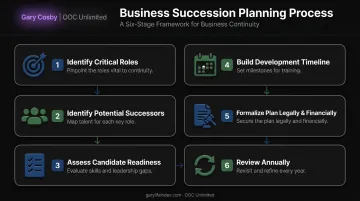
A succession plan unfolds over years, built through a sequence of deliberate steps rather than a single meeting.
- Identify critical roles and ownership stakes. Prioritize positions where a sudden vacancy would hurt operations or client relationships most. Not every role needs a succession plan, but the ones that keep the lights on absolutely do.
- Identify potential successors. Use objective criteria, such as skills, track record, and financial readiness, rather than assumptions about who "should" be next.
- Assess each candidate's readiness. Compare their current capabilities and financial capacity against what the role or ownership stake will actually require.
- Build a development and transition timeline. Include mentoring, a gradual handoff of responsibilities, and a realistic target date. Rushing this step is one of the most common reasons transitions fail.
- Formalize the plan legally and financially. Update ownership agreements and put a funding mechanism in place so the transfer can actually happen when it's triggered.
- Review and adjust annually. Business priorities shift, family circumstances change, and successor readiness evolves.
This process takes longer than most owners expect, and starting early makes the difference between a smooth handoff and a rushed one.
For family businesses specifically, McKinsey's research on family-owned business succession describes the full journey as an 8- to 15-year process, with 5 to 10 years spent identifying and preparing candidates and another 3 to 5 years equipping the chosen successor.
Funding Your Succession Plan So It Actually Works
A documented plan can still fail if there's no money behind it. If a partner dies or becomes disabled, the business often needs to buy out their share, fast, and without draining cash reserves or taking on new debt.
This is where insurance-backed funding earns its place in a real succession strategy.
| Mechanism | What It Does | When It Applies |
|---|---|---|
| Buy-sell agreement (insurance-funded) | Provides cash for remaining owners or the entity to purchase a departing owner's interest | Death, disability, retirement, or another defined trigger |
| Key person insurance | Protects the business's revenue while a replacement is found and trained | Loss of a critical employee, not necessarily an owner |
| Business overhead expense coverage | Helps pay rent, payroll, and fixed costs during an owner's disability | Owner becomes disabled but the business must keep running |
These three tools solve different problems. A buy-sell policy transfers ownership. Key person coverage protects operations. Overhead expense coverage keeps the lights on during disability. Treating them as interchangeable is a mistake.
Who does what:
- Attorneys draft the buy-sell agreement itself
- CPAs and valuation professionals determine what the business is actually worth
- A licensed insurance agent structures the policy that funds the eventual buyout
Gary Cosby and his team at OOC Unlimited work in that last lane, coordinating the insurance-funding piece alongside a business owner's existing CPA and attorney rather than trying to replace either one.
Ownership transition is only part of the picture, though. For owners who also want to retain key executives long-term, structures like Section 162 executive bonus plans or split-dollar arrangements can run alongside a buy-sell policy, since these are related but separate goals.
If you're weighing which mix of coverage fits your ownership structure, booking a consultation is a reasonable next step before you commit to a specific policy design.
Common Succession Planning Mistakes to Avoid
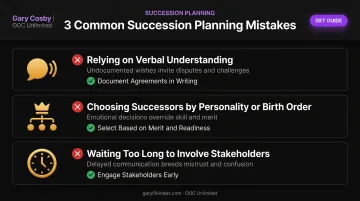
Even owners who intend to plan well fall into a few predictable traps.
- Relying on a verbal understanding. "Everyone knows who's next" isn't a plan; it's a guess that falls apart the moment someone disagrees or forgets what was said.
- Choosing successors on personality or birth order alone. Being well-liked or being the oldest child doesn't guarantee someone can run the business or afford to buy into it. Skills, financial readiness, and long-term commitment matter more.
- Waiting too long to involve stakeholders. Co-owners, senior staff, and outside advisors often spot gaps in a plan long before they become crises, and looping them in early costs little while preventing a lot.
None of these mistakes are exotic. They're just easy to make when planning feels like something to deal with "later."
Frequently Asked Questions
What are the 5 steps of succession planning?
The core steps are identifying critical roles, selecting potential successors, assessing their readiness, building a development timeline, and formalizing the plan legally and financially. Ongoing review keeps it current.
What are succession planning strategies?
The main strategies are developing internal talent, bringing in an outside buyer or leader, and transitioning ownership to family or co-owners. Many businesses combine these into a hybrid approach.
What is the difference between succession planning and replacement planning?
Replacement planning is a short-term backup for unexpected vacancies. Succession planning is a long-term strategy that develops and prepares successors well before a transition happens.
How often should a business succession plan be reviewed?
At minimum, annually. Also revisit it whenever ownership, family circumstances, or key personnel change significantly.
Why is life insurance important in business succession planning?
Life insurance can fund a buy-sell agreement, providing immediate cash to complete an ownership transfer if an owner dies or becomes disabled. This lets the business avoid selling assets or taking on debt to cover the transition.
Who should be involved in creating a succession plan?
An effective plan typically involves the owner, key successors, and three advisors: an attorney for legal drafting, a CPA for valuation and tax questions, and a licensed insurance agent to structure the funding.