Introduction
A buy-sell agreement is only as good as the cash sitting behind it. You can draft the perfect legal document, name every trigger, and agree on a fair price — none of it matters if the money isn't there when a partner dies.
Life insurance is how most business owners solve that problem. But "just buy a policy" oversimplifies things. Results depend heavily on your agreement's structure, valuation method, coverage amount, and policy type.
This article covers exactly how to fund a buy-sell agreement with life insurance. You'll find the structures to choose from, the variables that determine whether the payout actually covers the buyout, and the mistakes that create family disputes or surprise tax bills.
Key Takeaways
- Life insurance delivers tax-free cash exactly when a buy-sell agreement needs it, at death
- Three funding structures exist: cross-purchase, entity redemption, and hybrid, with different tax outcomes
- Coverage must track a current, defensible valuation, reviewed every 2-3 years
- Outdated valuations and mismatched structures cause most funding failures
- An attorney, CPA, and licensed insurance agent should coordinate the agreement and its funding
How to Fund a Buy-Sell Agreement With Life Insurance
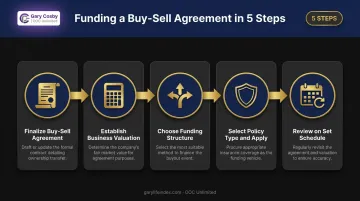
Funding a buy-sell agreement isn't a single purchase decision. It's a five-step process that starts with legal paperwork and ends with a recurring calendar reminder.
Step 1: Finalize the Buy-Sell Agreement Before Buying Insurance
The agreement has to exist first. It needs to name the triggering events, death, disability, retirement, divorce, and identify who buys a departing owner's interest.
A business attorney should draft or review this document before anyone applies for coverage. Buying a policy first, then fitting the agreement around it, tends to leave gaps between what the contract requires and what the insurance actually pays.
Step 2: Establish a Business Valuation to Set Coverage Amounts
Three valuation methods show up most often:
- Fixed price - owners agree on a set number, but it goes stale fast and rarely holds up for tax purposes
- Formula-based - a multiple of earnings or book value, more durable when built with an outside appraiser
- Professional appraisal - an independent valuation, generally the most defensible option
Once you have a value, calculating coverage is straightforward: multiply total business value by each owner's ownership percentage. A 30% owner in a $4 million company needs roughly $1.2 million in death benefit backing their share of the buyout.
Step 3: Choose a Funding Structure Based on Ownership and Tax Goals
This decision determines who owns each policy, who's named beneficiary, and how the tax burden lands on departing versus surviving owners. We'll break down the three main structures in the next section.
One thing worth flagging now: a traditional cross-purchase agreement requires n × (n-1) total policies, where n is the number of owners, according to Prudential's buy-sell funding research. Two owners need two policies. Five owners need 20. That math alone pushes many larger ownership groups toward a different structure.
Step 4: Select the Right Policy Type and Apply for Coverage
Term life insurance costs less upfront, but it expires. If the term runs out before a triggering event, and the owner has since become uninsurable, the agreement loses its funding source at the worst possible time.
Permanent life insurance costs more but stays in force for life, matching an obligation that doesn't expire either.
This is where a licensed life insurance agent working alongside the CPA and attorney matters most. Gary Cosby Jr. and the team at OOC Unlimited focus specifically on the insurance side of buy-sell funding, comparing carriers, underwriting requirements, and policy structures against what the agreement calls for, while leaving legal drafting and valuation work to the attorney and appraiser.
If you want to talk through carrier options for your specific ownership structure, you can book a consultation directly.
Step 5: Review the Agreement and Coverage on a Set Schedule
Plan to revisit the agreement and its coverage every 2-3 years, or sooner if the business grows significantly, a new owner joins, or tax law changes. This is the cadence J.P. Morgan Private Bank recommends, and for good reason: a policy sized for a $2 million company doesn't do much good if that company is worth $6 million five years later.
Cross-Purchase vs. Entity Redemption vs. Hybrid: Choosing the Right Funding Structure
Each structure changes who owns the policy, who receives the payout, and how taxes land on everyone involved.
Cross-Purchase Agreements
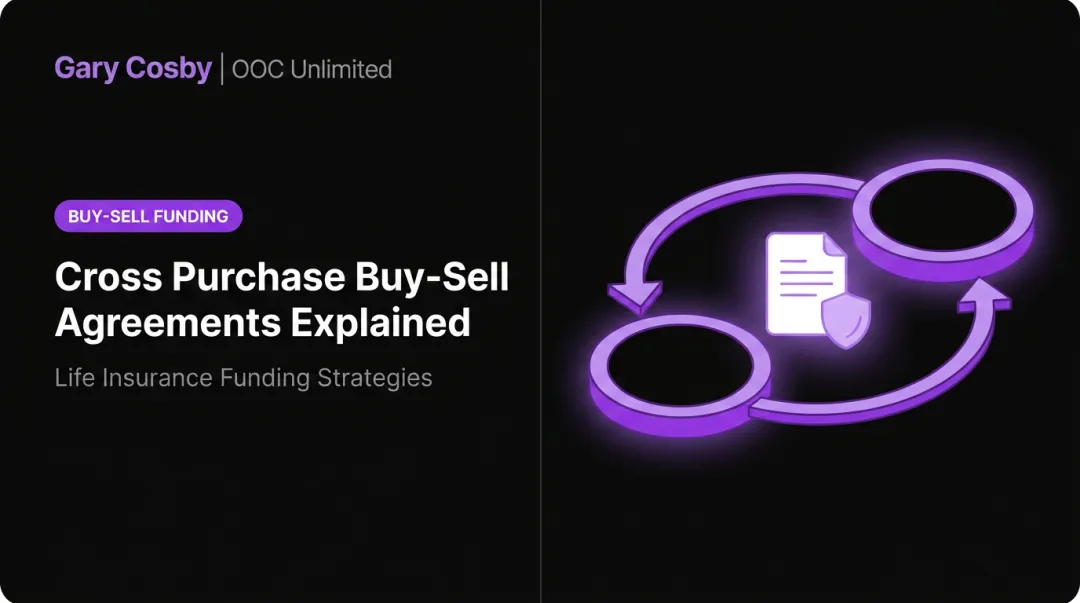
Under a cross-purchase agreement, each owner personally buys and owns a policy on every other owner. When one owner dies, the survivors use their policy payouts to buy the deceased owner's shares directly.
The upside: surviving owners get a step-up in cost basis equal to what they paid, which reduces capital gains tax when they eventually sell.
The drawback is math. Policy count multiplies quickly as owner count grows. That's manageable with two or three owners. It gets unwieldy with five or more, since every owner needs a separate policy on every co-owner, each with different ages, health ratings, and premiums.
Entity Redemption Agreements
Here, the business itself owns the policies and buys back a departing owner's shares. One policy per owner, paid by the company. Administration is far simpler for larger ownership groups.
But there's a catch confirmed by the Supreme Court's 2024 decision in Connelly v. United States. The Court ruled that a company's life insurance proceeds count toward its value for estate tax purposes, even when that money is earmarked for a redemption.
In that case, a $3 million death benefit inflated the deceased owner's estate value, adding nearly $890,000 in additional estate tax.
Translation: redemption-funded buyouts can raise the surviving estate's tax exposure, not just the departing owner's.
Hybrid (Wait-and-See) Agreements
A hybrid, or wait-and-see, structure gives the company first option to buy a departing owner's interest, then gives remaining owners a second option, with the company obligated to buy anything left over.
This flexibility suits growing businesses that don't yet know how many owners they'll have or what their tax situation will look like down the road. It defers the structural decision until the triggering event actually happens.
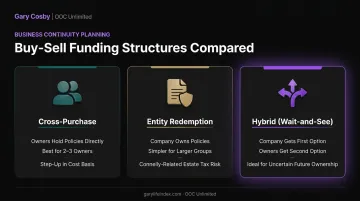
Quick comparison:
- Cross-purchase: Owners hold policies directly; works best with two or three owners
- Entity redemption: Company owns policies; simpler for larger groups but carries Connelly-related estate tax risk
- Hybrid: Company gets first option, owners get second; ideal when future ownership is uncertain
Key Factors That Affect Your Buy-Sell Insurance Strategy
Five variables decide whether your funding actually works when the time comes.
- Coverage amount versus current valuation. Undervalued coverage leaves a funding gap, forcing loans or fire-sale asset moves exactly when the business can least afford it.
- Policy ownership and beneficiary designation. Naming the wrong owner or beneficiary can invoke the IRC Section 101(a)(2) transfer-for-value rule, turning a tax-free death benefit into taxable income.
- Term versus permanent policy selection. Term policies risk lapsing or leaving an aging owner uninsurable before a trigger occurs. Permanent policies cost more but guarantee the coverage stays in force.
- Number of business owners. More owners make cross-purchase agreements administratively heavy, often pushing larger companies toward redemption or hybrid structures instead.
- Estate tax exposure of surviving owners. As the Supreme Court's 2024 ruling in Connelly v. United States showed, redemption-funded buyouts can increase a surviving owner's taxable estate. High-net-worth owners often need a cross-purchase structure instead.
These five factors don't operate independently: change one, and the others shift too. More owners often means moving away from cross-purchase, which then changes who holds the policies and how surviving owners get taxed later. Review all five together, not one at a time.
Common Mistakes to Avoid When Funding a Buy-Sell Agreement
Most funding failures trace back to one of four errors:
- Letting valuations go stale. A number set five years ago rarely reflects what the business is worth today, especially after a strong growth period.
- Choosing a structure without checking the tax impact. Cross-purchase and entity redemption produce different results for departing and surviving owners, so run the numbers on both before committing.
- Letting owners buy their own coverage without oversight. When each owner shops independently, policies end up inconsistent, different carriers, different amounts, sometimes missing entirely.
- Misnaming the policy owner or beneficiary. This is the fastest way to trigger the transfer-for-value trap or pull proceeds into an estate that was never supposed to include them.
Any one of these mistakes can undo years of careful planning. Catching them requires someone reviewing the insurance side and the legal side together, not in separate silos.
Alternatives to Funding a Buy-Sell Agreement With Life Insurance
Life insurance isn't the only way to fund a buyout. It's just the most common option, because it's the only one that guarantees the money shows up exactly when needed.
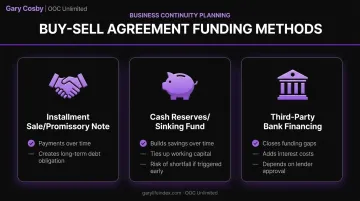
Installment Sale or Promissory Note
This works when an owner's age or health makes life insurance too costly or unavailable. The buyer pays the departing owner, or their estate, over time instead of in one lump sum.
The trade-off: it creates a long-term payment obligation. If the business hits a rough patch, that debt still has to be paid, adding financial risk right when the company can least handle it.
Cash Reserves or Sinking Fund
Businesses with strong, stable cash flow sometimes set aside profits over time to fund a future buyout, avoiding ongoing insurance premiums entirely.
The catch: it ties up working capital, and a triggering event can happen before the fund is fully built. A death in year three of a ten-year savings plan leaves a shortfall no one budgeted for.
Third-Party Bank Financing
When insurance proceeds or reserves alone can't cover the full buyout, some businesses turn to a bank loan to close the gap.
This adds interest costs and depends on lender approval, which can slow things down during an already sensitive time. Lenders may also hesitate to finance a business that just lost a key owner.
Frequently Asked Questions
What is buy-sell planning?
Buy-sell planning creates a legal agreement and funding mechanism that governs ownership transfers when an owner exits due to death, disability, retirement, or another trigger. It protects both the business and the departing owner's family.
How do I structure a buy-sell agreement?
Structuring involves defining triggering events, choosing a valuation method, and selecting a cross-purchase, redemption, or hybrid format. It's best handled with an attorney, CPA, and licensed insurance agent working together.
How much life insurance do I need to fund a buy-sell agreement?
Coverage should match each owner's proportional share of the current business valuation. A licensed agent can help calculate the exact amount based on your ownership percentage and appraisal.
Is life insurance used to fund a buy-sell agreement tax-free?
You'll generally receive death benefit proceeds income tax-free. Premiums aren't deductible, though, and improper policy ownership can trigger transfer-for-value taxation on part of the payout.
What happens if a buy-sell agreement isn't properly funded?
An underfunded agreement can force surviving owners into loans, asset sales, or disputes with the deceased owner's heirs over how to come up with the buyout price.
Can I convert my term life policy to permanent coverage for a buy-sell agreement?
Many term policies include conversion riders that allow a switch to permanent coverage without new medical underwriting. Review this option as the agreement matures and coverage needs change.