

Introduction
Search "7702A plan" and you'll find people looking for something to buy: a product, a strategy, a specific type of policy. That's the common mix-up. Section 7702A isn't a plan at all. It's a section of the IRS tax code, 26 U.S.C. §7702A, that determines how your life insurance policy gets taxed.
Congress added this rule in 1988 to work alongside Section 7702, which already defined what counts as life insurance for tax purposes. Together, the two sections stop life insurance from becoming a disguised investment account instead of the death benefit protection it's meant to be.
Many policyholders never think about 7702A until they overfund a policy or bump up a death benefit and get a surprise letter from their carrier.
This article breaks down what 7702A means, how the 7-pay test works, and what happens if a policy fails it. You'll also learn how to keep your funding plan on the right side of the line.
Key Takeaways
- Uses the "7-pay test" to determine if a policy becomes a Modified Endowment Contract (MEC)
- Congress enacted it in 1988 (TAMRA) to stop overfunded policies from earning tax-free growth and FIFO withdrawals
- MEC status permanently changes how loans and withdrawals get taxed, though death benefits stay income tax-free
- 7702A is a compliance test that carriers apply automatically to whole life, universal life, and IUL policies, rather than a standalone product
What Is Section 7702A?
Section 7702A (26 U.S.C. §7702A) is the part of the tax code that decides whether a permanent life insurance contract gets reclassified as a Modified Endowment Contract, or MEC. It doesn't define life insurance. Section 7702 already does that. Instead, 7702A asks a narrower question: was this policy funded too fast?
Congress created the rule through the Technical and Miscellaneous Revenue Act (TAMRA) of 1988, and it applies to contracts entered into on or after June 21, 1988, according to the U.S. Code text of Section 7702A.
Before this rule existed, insurers had already faced Section 7702 back in 1984. That alone didn't stop a wave of single-premium life policies marketed almost purely as tax shelters.
People would deposit a large lump sum, let it grow tax-deferred, then pull out gains through loans and withdrawals taxed first-in-first-out. Cost basis came out before any gain did.
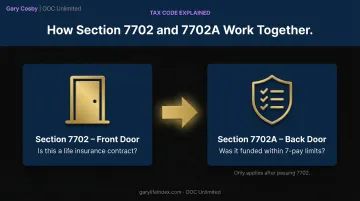
7702A closed that loophole. It only applies to contracts that have already passed the 7702 test and qualify as life insurance in the first place:
| Section | What It Asks |
|---|---|
| 7702 | Is this a life insurance contract at all? |
| 7702A | Was it funded within IRS limits during the first seven years? |
The rule preserves the tax advantages of genuine life insurance, tax-deferred cash value growth and an income-tax-free death benefit, for policies actually used as insurance rather than fast-funded investment vehicles.
Clearing Up the "7702A Plan" Misconception
You can't buy a "7702A plan" from an insurance carrier or a financial advisor. There's no application form for it. Instead, 7702A is a compliance test that carriers run automatically:
- When a policy is first issued
- Any time a "material change" happens, such as a death benefit increase
- Behind the scenes, without the policyholder needing to request it
Whole life, universal life, and indexed universal life (IUL) policies all get tested this way. If a policy fails, the carrier is required to notify the policyholder, so it doesn't go unnoticed.
How the 7-Pay Test Works and What Happens If a Policy Fails It
The 7-pay test is a cumulative math check, not a single annual premium cap. Here's how it works:
- When a policy is issued, the insurer calculates what the total premium would be if the contract were paid up in exactly seven level annual payments.
- That number becomes the "7-pay limit."
- If cumulative premiums paid during any of the first seven contract years exceed that limit at any point, the policy fails.
Once a policy fails, the contract becomes a MEC permanently. Even if you stop paying extra premium the following year, the classification doesn't reverse. The test measures what's already been paid into the contract, not future plans.
One wrinkle matters here: material changes reset the clock. Increasing the death benefit, or adding certain riders, generally restarts the 7-pay test as if the contract were brand new, with a fresh seven-year window. This is exactly why a small policy tweak years into a contract can unexpectedly trigger MEC status nobody saw coming.
What Happens If a Policy Becomes a MEC
MEC status doesn't touch the death benefit. Beneficiaries still receive it income-tax-free. The consequences only show up if the policyholder takes money out while there's gain in the contract:
- Taxation flips from FIFO to LIFO. Instead of withdrawing cost basis first, gains come out first and get taxed as ordinary income.
- A 10% additional federal tax applies to the taxable portion of distributions taken before age 59½, similar to an early retirement account penalty, per 26 U.S.C. §72.
- Loans count as distributions. Borrowing against a MEC is treated as an amount received under the contract, not a tax-free loan.
If a MEC classification happens by accident, say, a processing error or an unintentional premium overpayment, the IRS has historically allowed insurers to request relief through a closing agreement process under Rev. Proc. 2008-39. That relief route is initiated by the issuing carrier, not the policyholder, and only covers inadvertent, non-egregious failures.
Section 7702 vs. Section 7702A: What's the Difference
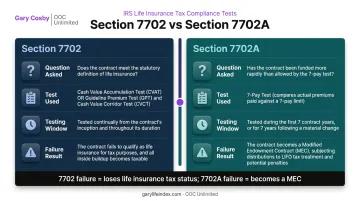
These two sections work together, but they test different things at different times.
Section 7702 is the front door. It decides whether a contract qualifies as life insurance for federal tax purposes at all, using one of two methods:
- Cash Value Accumulation Test (CVAT): cash surrender value can't exceed the net single premium at any time
- Guideline Premium Test (GPT): cumulative premiums can't exceed a guideline limit, while maintaining a minimum death benefit corridor
Section 7702A is the back door. It assumes a contract already passed 7702, then asks whether it was overfunded too quickly using the 7-pay test.
| Feature | Section 7702 | Section 7702A |
|---|---|---|
| Question asked | Is this life insurance at all? | Was it overfunded in the first 7 years? |
| Test used | CVAT or GPT | 7-pay test |
| Testing window | Ongoing, for the life of the contract | First 7 contract years (resets after material change) |
| Failure result | Loses life insurance tax status entirely | Becomes a MEC, still life insurance, different distribution tax treatment |
Failing 7702 is far more serious than failing 7702A. A 7702 failure means the contract stops being treated as life insurance for tax purposes altogether. A 7702A failure, becoming a MEC, just changes how loans and withdrawals get taxed. The death benefit remains intact either way.
Recent Changes: The 2021 Interest Rate Update
For over three decades, the interest rate assumptions baked into both 7702 and 7702A calculations sat frozen at 1980s levels: a 4% accumulation test rate and a 6% guideline premium rate. That changed with the Consolidated Appropriations Act, 2021, signed into law on December 27, 2020, under Public Law 116-260.
Instead of fixed percentages, the law introduced a formula tied to actual market rates, an "applicable accumulation test minimum rate" that adjusts periodically. For contracts issued shortly after the change took effect, this worked out to roughly a 2% accumulation test rate and a 4% guideline premium rate, well below the old fixed assumptions.
Why does this matter for 7702A specifically? Lower assumed interest rates change the math behind the 7-pay limit too:
- Raises the premium ceiling policyholders can pay without failing the 7-pay test
- Gives policyholders more room to fund a policy aggressively in the early years without triggering MEC status
- Ties rate changes to "adjustment years," which can shift again if the underlying valuation interest rate for insurers changes
If you're comparing an older policy against a newly issued one, don't assume the funding limits are identical. The rate environment your contract was issued under directly shapes how much premium fits inside the 7-pay window.
Working with a Licensed Professional to Avoid Accidental MEC Status
The math behind 7702 and 7702A isn't something most policyholders calculate themselves, and that's exactly how accidental MEC status happens. A few common triggers:
- Adding a lump-sum premium deposit beyond what the original illustration planned for
- Increasing a death benefit without checking how it affects the 7-pay limit
- Adding a rider or benefit that counts as a material change
None of these mistakes are obvious from the policyholder's side. The carrier runs the compliance test, but the decision to add money or change coverage usually starts with a conversation between the policyholder and their agent.
This is where a licensed life insurance agent matters. A good agent understands the funding side of a policy well enough to flag a potential MEC issue before a large premium payment goes in, not after.
At OOC Unlimited, agents handle the insurance-funding side of these decisions. They coordinate with the client's own CPA or tax attorney whenever tax treatment or ownership structuring is involved.
This division keeps each professional in their lane: the agent manages policy design and funding, while the CPA or attorney handles the tax and legal specifics of the client's broader financial picture.

Before making a large premium payment or a funding change to an existing policy, ask one question: will this affect my 7-pay test?
Frequently Asked Questions
What is Section 7702A of the IRS code?
Section 7702A is the part of the tax code that uses the 7-pay test to decide whether a life insurance policy is classified as a Modified Endowment Contract (MEC). It applies only to contracts that already qualify as life insurance under Section 7702.
What is the difference between Section 7702 and 7702A?
Section 7702 defines whether a contract qualifies as life insurance for tax purposes at all. Section 7702A tests whether that same contract was overfunded within its first seven years.
What is the Section 7702 strategy?
The "7702 strategy" refers to using cash-value life insurance for tax-advantaged growth and access to funds through policy loans. It only works as intended if funding stays within 7702 and 7702A limits, avoiding MEC status.
What happens if my life insurance policy becomes a MEC?
Withdrawals and loans get taxed on a gains-first basis instead of return-of-basis first, and a 10% penalty may apply before age 59½. The death benefit itself stays income-tax-free.
Can a policy return to non-MEC status once it fails the 7-pay test?
Generally no. MEC status is permanent once triggered. Historical IRS relief procedures, like Rev. Proc. 2008-39, have occasionally allowed insurers to correct inadvertent, non-egregious failures.
Do I need to worry about Section 7702A if I already have a life insurance policy?
Most policyholders never run into problems unless they make a large premium payment or increase their death benefit. Reviewing any funding change with a licensed agent first helps avoid an unwanted surprise.