Key man life insurance exists for exactly this moment. It's designed to hand the business a lump sum when it needs cash most.
Here's the direct answer upfront: premiums are generally not tax deductible in 2026 under IRC Section 264(a)(1). The death benefit, however, is usually received income tax-free, provided the business follows specific compliance rules.
This guide breaks down the core IRS rule, the compliance steps required under the Pension Protection Act, what's changed heading into 2026, and the myths that trip up business owners every year.
Key Takeaways
- Key man policy premiums are not deductible under IRC Section 264(a)(1).
- Death benefits stay tax-free only with proper notice, consent, and Form 8925 filing.
- Post-2006 policies must meet IRC Section 101(j) to keep that tax-free status.
- The 2026 highly compensated threshold remains $160,000, same as 2025.
- Pair a licensed agent with your CPA — insurance and tax filing are separate jobs.
What Is Key Man Insurance and Why Does It Matter?
Key man insurance (also called key person insurance) is a life insurance policy a business purchases on a critical employee, owner, or executive. The company pays the premiums, owns the policy, and names itself as the beneficiary.
Who qualifies as "key"? Usually one of these:
- The founder or majority owner whose relationships drive revenue
- A top salesperson responsible for a disproportionate share of closed deals
- A specialized technical lead whose expertise can't be replaced quickly
- A partner whose personal guarantee secures business financing
Most businesses are more exposed here than they realize. According to Nationwide's research on key person risk, 71% of small businesses report that their organization's success depends on just one or two individuals. That level of concentrated risk is exactly why so many companies turn to key man coverage as a safety net.
Why Businesses Buy This Coverage
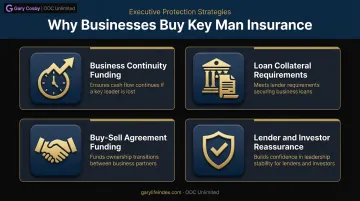
Companies use key man proceeds for four main purposes:
- Business continuity funding: covering lost revenue while the company recruits and trains a replacement
- Loan collateral requirements: many lenders require key person coverage before extending credit to a small business
- Buy-sell agreement funding: providing liquidity so remaining owners can buy out a deceased partner's share
- Lender and investor reassurance: showing financial stakeholders the business has a plan if something happens to leadership
Is Key Man Life Insurance Tax Deductible in 2026? The Core IRS Rule
Under IRC Section 264(a)(1), no deduction is allowed for premiums paid on a life insurance policy when the taxpayer is directly or indirectly a beneficiary. A business owning a key man policy on its founder or top earner fits this description exactly.
The logic behind this rule is straightforward. The IRS won't grant a double tax benefit. Since the death benefit is generally excluded from taxable income under Section 101(a), the government won't also let the business deduct the premiums that funded it. One tax break per transaction, not two.
This means key man premiums get treated as a non-deductible capital expenditure, an investment in business continuity, rather than an ordinary operating expense under Section 162.
Why Key Man Insurance Differs From Other Business Coverage
General liability, commercial property, and standard business auto policies are typically deductible because their payouts restore a loss. Key man insurance is different: the payout creates a net financial gain for the business rather than simply replacing something that was lost.
Here's how the tax treatment compares across common coverage types:
| Insurance Type | Premium Deductible? | Payout Taxable? |
|---|---|---|
| Key Person (Key Man) Insurance | No (IRC 264(a)(1)) | Generally no, if 101(j) compliance met |
| General Liability | Yes | Follows rules for the covered loss |
| Commercial Property | Yes | Not a life insurance benefit |
| Group Term Life (employee benefit) | Yes | First $50,000 excluded to employee under IRC 79 |
This has been the federal standard for decades under IRC 264(a)(1), and nothing in current 2026 tax legislation changes it.
Compliance Requirements: Staying Tax-Free Under the Pension Protection Act
Getting the premium non-deductibility right is only half the equation. The bigger risk for most business owners is losing the tax-free death benefit entirely by skipping a compliance step.
IRC Section 101(j), introduced by the Pension Protection Act of 2006, governs all employer-owned life insurance (EOLI) contracts issued after August 17, 2006, including key man policies. Miss the requirements, and the death benefit becomes taxable income instead of a tax-free windfall.
Notice and Consent, Before the Ink Dries
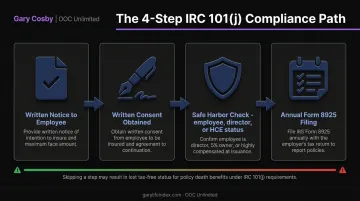
Before the policy is issued, the employer must provide written notice to the insured employee stating:
- The company intends to insure them
- The maximum face amount at issuance
- The business will be a beneficiary
The employee must then provide written consent to being insured, including consent for coverage to continue after employment ends. This has to happen before issuance. Retroactive consent doesn't satisfy the IRS. There's no do-over once the policy is in force.
Safe Harbors and the 2026 HCE Threshold
These notice and consent rules aren't absolute, though. Section 101(j)(2) carves out safe harbor exceptions that preserve tax-free treatment even without meeting every general rule, including:
- The insured was an employee at any point in the 12 months before death
- The insured was a director when the policy was issued
- The insured qualified as a highly compensated employee (HCE) under IRC 414(q) when the policy was issued
For 2026, the IRS confirmed in Notice 2025-67 that the compensation threshold defining an HCE stays at $160,000, unchanged from 2025.
The Annual Form 8925 Filing
Meeting notice, consent, or safe harbor requirements isn't the final step, either. Businesses holding covered EOLI contracts must file IRS Form 8925 every year the policy remains in force. The form reports:
- Total number of employees at year-end
- Number of employees insured under post-2006 contracts
- Total insurance amount in force
- Whether the employer obtained valid consent for each insured
Skip the notice, consent, or the annual Form 8925 filing, and an otherwise tax-free death benefit can convert into fully taxable income. Document every step, and have a licensed insurance professional coordinate with your CPA before the policy is issued, not after.
What's New for 2026: Tax Law Updates Business Owners Should Watch
The One Big Beautiful Bill Act (OBBBA), signed into law in July 2025, made sweeping changes to bonus depreciation and business expensing. It did not directly amend IRC 264 or 101(j). Key man insurance's core tax treatment remains exactly what it's been for years.
That said, two areas deserve attention this year:
- 2026 HCE threshold: Holds steady at $160,000, which matters if you're using the highly compensated employee safe harbor for a newer policy.
- Corporate Alternative Minimum Tax (AMT): Still applies to certain large C-corporations, with a wrinkle worth understanding for high-scale operations.
Here's the wrinkle: even though the death benefit is excluded from regular taxable income, a portion of that gain can show up in Adjusted Financial Statement Income (AFSI), the base used to calculate CAMT liability.
The exclusion under IRC 101 doesn't automatically erase the book-income gain your financial statements record when the payout exceeds the policy's carrying value.
This mainly affects applicable large corporations, generally those averaging over $1 billion in AFSI. Most small and midsize businesses won't hit this threshold.
Still, if your company is structured as a C-corp with meaningful scale, it's worth a conversation with your tax advisor before assuming the death benefit is entirely off the tax radar.
Review your key man policy annually. Thresholds shift, corporate structures change, and a policy that made sense three years ago may need adjusting.
Common Myths and Special Tax Scenarios
A few misconceptions show up again and again in conversations with business owners. Here's where things actually stand.
The Loan Collateral Myth
Some business owners assume that assigning a key man policy as collateral for a loan changes its tax treatment, making premiums suddenly deductible. It doesn't. This confusion often stems from rules in other countries where loan-collateral assignment can affect deductibility. Under U.S. tax law, collateral assignment has no bearing on IRC 264(a)(1). The premiums stay non-deductible regardless of who else has a security interest in the policy.
Pass-Through Entities (S-Corps, LLCs, Partnerships)
S-corps, partnerships, and LLCs taxed as pass-throughs follow the same non-deductibility rule as C-corps, but the mechanics play out through owner basis instead of a straight deduction. Non-deductible premiums reduce the owner's basis in the business, while a tax-free death benefit increases it when received.
This affects future capital gains calculations if the owner sells their interest, so tracking premiums and proceeds separately matters more here than in a standard C-corp structure.
Executive Bonus Arrangements
A Section 162 executive bonus plan flips the standard key man structure entirely. Instead of the business owning the policy, the employer pays the executive a bonus specifically to fund a policy the employee owns. The employer deducts the bonus as compensation; the employee owns the policy, names the beneficiary, and keeps it even after leaving the company.
The difference comes down to ownership. Business-owned equals non-deductible under 264. Employee-owned equals deductible compensation under 162.
Is Key Man Insurance Worth It for Your Business?
The non-deductible premium is a real cost, but it's worth weighing against what the coverage actually protects: revenue continuity, loan eligibility, and the confidence lenders and investors need to keep backing your business.
Insurers typically calculate coverage amounts using one of a few standard methods:
- Multiple of salary — often 5 to 10 times the key person's annual compensation
- Contribution to profits — salary plus their direct financial contribution to the bottom line, multiplied by at least five
- Cost to replace — recruiting, training, lost productivity, and the time it takes a new hire to reach comparable output
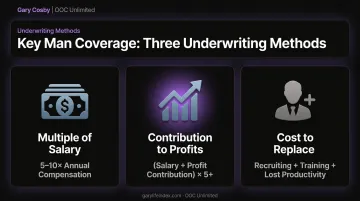
None of these are tax-law requirements. They're underwriting benchmarks that help gauge whether your coverage matches your actual risk exposure.
Structuring this correctly means separating two jobs: the insurance piece and the tax/legal piece. A licensed agent, like Gary Cosby Jr. and the OOC Unlimited team, can help determine appropriate coverage amounts and structure the policy itself.
Your CPA and attorney handle the tax filing and legal agreements. Keeping these roles separate is what typically holds up if the IRS or a lender reviews your policy structure.
Frequently Asked Questions
What insurance expenses are tax-deductible?
Most ordinary business insurance, including general liability, commercial property, business auto, and workers' comp, is deductible under Section 162. Key man life insurance premiums are a notable exception under Section 264.
Is key man insurance worth it?
It depends on how critical the insured person is to revenue and operations. Weigh the non-deductible premium cost against the tax-free death benefit and the continuity protection it provides during a leadership loss.
Is the death benefit from key man insurance taxable?
Generally no, if you provided notice, obtained consent, and filed Form 8925 before the insurer issued the policy. Miss any of those steps, and the benefit can become fully taxable.
What happens if I don't get employee consent before buying the policy?
The entire death benefit can become taxable income, with no way to fix it retroactively. You must provide written notice and consent before the insurer issues the policy, not after.
Can S-corps and LLCs deduct key man insurance premiums?
No. Pass-through entities follow the same non-deductibility rule as C-corps. Premiums reduce the owner's basis in the business instead of flowing through as a deduction.
What is IRS Form 8925 and do I need to file it every year?
Form 8925 reports employer-owned life insurance contracts, including insured employee counts and total coverage in force. You must file it annually with your tax return for as long as the policy remains active.