
Most life insurance forces a choice: protect your family after you're gone, or build cash value while you're alive. Rarely does one policy do both and pay out while you're still breathing, if a qualifying illness hits.
This article breaks down how Indexed Universal Life (IUL) insurance with living benefits actually works, which riders matter most, who it fits, and what it realistically costs.
Key Takeaways
- IUL combines permanent death benefit protection with index-linked cash value growth, avoiding direct market risk.
- Living benefit riders let you tap your death benefit early for a qualifying chronic, critical, or terminal illness.
- Monthly costs vary widely based on age, health class, coverage amount, and rider selection.
- Buyers seeking the cheapest possible term coverage should look elsewhere.
- Comparing multiple A-rated carriers with a licensed advisor matches the right rider structure to your goals.
What Is Indexed Universal Life Insurance with Living Benefits?
IUL is permanent life insurance. Unlike term policies that expire after 10, 20, or 30 years, IUL is designed to last your entire life as long as it's funded properly. Premiums are flexible, and cash value grows based on the performance of a market index, without your money being invested in the market itself.
"Living benefits" refers to accelerated death benefit riders. These let you tap a portion of your death benefit while you're still alive, provided you meet specific health-related conditions defined in the contract.
Here's the variance that trips people up: carrier practices on rider costs differ significantly.
- Carriers like F&G include chronic, critical, and terminal illness riders at no additional premium
- Other carriers charge extra upfront, or apply a discount charge only when you actually use the rider
This distinction changes the real cost of a policy, so confirm directly with each carrier before comparing quotes.
Compare that to term life insurance, which typically builds no cash value and offers limited or no living benefits at all. That's why permanent coverage is usually required if living benefits matter to you.
IUL isn't the only permanent option, either. Whole life, standard universal life, and variable universal life can all carry similar riders. What sets IUL apart is its cap-and-floor structure, which balances growth potential against downside protection in a way whole life's fixed returns and VUL's full market exposure don't.
Why Living Benefits Matter Now
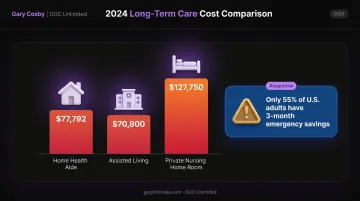
Long-term care costs have climbed sharply. In 2024, the national median annual cost for a home health aide reached $77,792, up 3% year over year. Assisted living hit $70,800, while a private nursing home room climbed to $127,750, according to Genworth and CareScout's 2024 Cost of Care Survey.
Meanwhile, most households aren't prepared for a health-related financial shock. Only 55% of U.S. adults had savings to cover three months of expenses in 2024, according to the Federal Reserve's 2025 report on household economic well-being.
A critical illness diagnosis doesn't just threaten your life. It threatens your savings, your income, and your family's stability, all while you're still around to feel the impact.
How Does an IUL with Living Benefits Policy Work?
Cash Value Growth Mechanics
Each premium payment covers two things: the cost of insurance and policy fees, plus whatever remains flows into your cash value account. That remainder earns interest based on index performance, subject to three key mechanics:
- Cap rate – the maximum interest rate your cash value can earn in a given period, regardless of how high the index climbs
- Participation rate – the percentage of index gains your account actually receives
- Floor – the minimum guaranteed rate, often 0%, protecting you from market losses
Real carrier illustrations show how the cap limits credited interest, even in strong index years:
| Carrier | Index Return | Cap Rate | Credited Rate |
|---|---|---|---|
| F&G | 14.70% | 11% | 11% |
| Mutual of Omaha | 21.82% | 9.25% | 9.25% |
In both cases, the cap kept the credited rate well below the index's actual performance.
Most carriers let you split cash value between one or more index-linked strategies and a fixed-interest account, so you're not locked into a single approach.
How Living Benefits Riders Activate
Living benefit riders trigger under three general categories:
- Chronic illness – inability to perform at least two of six activities of daily living (eating, toileting, transferring, bathing, dressing, continence) for 90 consecutive days, or severe cognitive impairment
- Critical illness – conditions like heart attack, stroke, invasive cancer, major organ transplant, or ALS
- Terminal illness – physician-certified life expectancy typically under 12 to 24 months, depending on the carrier
Accessing the benefit permanently reduces the remaining death benefit paid to beneficiaries. Mutual of Omaha, for instance, charges a flat $100 administrative fee per acceleration request.
Some carriers bundle these riders into the base policy at no extra premium; others sell them as add-ons. Always confirm which structure applies when comparing policies.
Key Living Benefits Riders Explained
Rider terms vary meaningfully by carrier. Here's how three of the 25+ A-rated carriers we work with structure their core riders:
| Rider Type | F&G | Mutual of Omaha | Allianz |
|---|---|---|---|
| Terminal illness | Life expectancy under 24 months; up to 100% of death benefit ($1M max) | Life expectancy 12 months or less; percentage varies | Life expectancy 12 months or less; up to $1M |
| Chronic illness | Up to 25% of death benefit annually, $1M lifetime max | Up to 80% of face amount per request | Up to 25% or $250,000 per election, $1M lifetime max |
| Critical illness | Up to 100% ($1M max); covers heart attack, stroke, ALS, organ transplant, invasive cancer | Covers ALS, kidney failure, cancer, heart attack, stroke, dementia, major burns | Not detailed in available product guides |
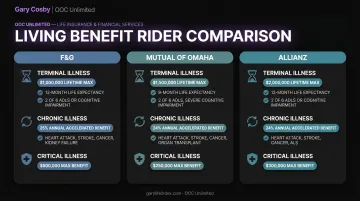
Beyond the payout percentages, qualification requirements determine whether a claim actually gets approved. Carriers typically require:
- Chronic illness qualification requires failing two of six Activities of Daily Living (ADLs) for 90 consecutive days, or documented severe cognitive impairment
- Critical illness payouts factor in age, condition severity, and life-expectancy impact
- Most critical illness claims include an administrative fee deducted from the payout
On taxes: accelerated benefits are generally excluded from gross income under IRC Section 101(g), as outlined in IRS guidance. Chronic illness payouts, however, face annual limits tied to qualified care costs. Since individual circumstances vary, run your specific situation past a tax professional before assuming a payout is fully tax-free.
Who Is an IUL with Living Benefits Right For (and Who Should Skip It)?
Good fits typically include:
- High earners who've already maxed out 401(k) and IRA contributions and want another tax-advantaged growth vehicle
- Business owners needing key-person coverage or buy-sell funding with added living-benefit flexibility
- Parents or breadwinners who want death protection plus a safety net if a serious illness strikes first
Reconsider if you:
- Need the maximum death benefit at the lowest possible monthly cost — term life almost always wins here
- Aren't interested in monitoring cap rates, funding levels, or policy performance over time
- Only need coverage for a defined period, like until a mortgage is paid off or kids finish school
Rider structures, caps, and fees vary widely from carrier to carrier. Comparing several A+ rated options with a licensed advisor is the best way to spot favorable terms.
OOC Unlimited's network works directly with 25+ A+ rated carriers, giving clients a way to line up rider terms side by side instead of settling for whatever one insurer offers.
Cost & Key Considerations of IUL with Living Benefits
Main cost drivers include:
- Age at issue and current health classification
- Total coverage amount requested
- Riders selected (chronic, critical, terminal illness)
- Carrier-specific pricing and index crediting structure
Because these variables interact differently across carriers, premiums for otherwise similar healthy applicants in their 30s and 40s can vary substantially. A personalized illustration is the only reliable way to see actual numbers for your age and health profile.
Beyond base premium, expect:
- Cost of insurance charges, which increase with age
- Premium load and expense charges
- Administrative fees, especially per rider acceleration
- Surrender charges if you cancel in early policy years
These ongoing charges are predictable. The bigger risks come from how the policy is structured, and three deserve attention before you sign:
- MEC status: Overfunding a policy beyond IRS 7-pay limits triggers Modified Endowment Contract treatment, changing how withdrawals are taxed
- Capped growth: Even a 20%+ index year won't fully credit to your cash value if your cap sits at 9-11%
- Reduced benefits: Using living benefit riders permanently lowers both your cash value and the death benefit your family eventually receives

Frequently Asked Questions
How much does an IUL with living benefits cost per month?
Cost depends heavily on your age, health class, and coverage amount, so no single number applies. Getting a personalized quote from a licensed advisor is the only reliable way to know your actual premium.
Who should not get an IUL with living benefits?
Anyone prioritizing the cheapest possible maximum death benefit is typically better served by term life. Those with only short-term coverage needs, like covering a specific loan or a set number of years, should also look elsewhere.
Can you access cash from an IUL with living benefits anytime?
Cash value withdrawals or loans usually require accumulated value, often available after the first policy year, and surrender charges may apply early on. Living benefit riders only trigger with a qualifying illness diagnosis, not on demand.
Why do wealthy people use IULs with living benefits?
They offer tax-deferred growth beyond retirement account contribution limits, along with generally tax-free death benefits and policy loans. Living benefits add protection against a health crisis draining other assets.
Is an IUL with living benefits worth it for the average person?
It depends on your financial goals and budget. If you want permanent protection plus optional health-crisis funding rather than simple, low-cost term coverage, it can be a strong fit.
What happens to my death benefit if I use the living benefits rider?
The accelerated payout permanently reduces the remaining death benefit your beneficiaries receive. Depending on the carrier and rider, administrative fees or interest charges may apply to the accessed amount.