Introduction
If you're the sole owner of your business, there's no partner waiting in the wings to buy you out if something happens to you. No co-owner means no automatic succession plan.
That gap is more common than most owners realize. Roughly three in five small business owners have no succession plan at all, according to a Harris Poll conducted for Nationwide. Without one, death, disability, or retirement can force a rushed sale or years of legal limbo for your family.
A unilateral buy-sell agreement solves this. It lets you pre-select a buyer and lock in a price, then fund the purchase with life insurance long before you need it.
This guide breaks down what a unilateral buy-sell agreement is and how it works, plus how insurance typically funds the deal.
Key Takeaways
- A unilateral buy-sell agreement obligates one buyer, often a key employee or LLC, to purchase your business interest.
- Without one, your business often defaults to a spouse or heir unprepared to run or sell it.
- The designated buyer owns life insurance that delivers cash exactly when it's needed.
- Attorneys draft the agreement; insurance professionals structure the funding.
What Is a Unilateral Buy-Sell Agreement?
A buy-sell agreement is a legal contract that governs what happens to your ownership interest when a specific event occurs, such as death, disability, or retirement. Think of it as instructions for a transaction that hasn't happened yet.
A unilateral (or one-way) buy-sell agreement is the version built for solo operators. Only one designated party, whether that's a key employee, family member, or an LLC, has both the right and the obligation to buy your interest. There's no back-and-forth negotiation between co-owners because there are no co-owners to negotiate with.
In practical terms, it functions like a will for your business. It tells employees, family, and stakeholders exactly how ownership transitions if you die, become disabled, or step away.
In a typical one-way structure, the designated buyer owns a life insurance policy on the sole owner and is named beneficiary. That buyer is contractually bound to use the death benefit to purchase the business from the estate, according to Securian Financial's overview of one-way buy-sell strategies.
The estate gets liquidity. The buyer gets the business. Nobody's left guessing.
This differs from cross-purchase agreements (where multiple co-owners buy each other out) or entity-purchase agreements (where the business itself redeems the departing owner's shares). Both require more than one existing owner. A sole proprietor simply doesn't have that option.
Who Should Consider a Unilateral Buy-Sell Agreement?
This structure fits a specific profile:
- Sole owners without a business partner who need a built-in exit plan
- Businesses with key employees capable of stepping into leadership
- Owners whose spouse or heirs have no interest in, or ability to, run the business
If any of these describe your situation, the absence of a plan is a risk sitting on your balance sheet.
Why Business Owners Need One
Without any agreement in place, your business interest typically passes to your spouse through your will. That sounds simple, but it rarely plays out that way.
Your spouse now faces three unappealing choices:
- Sell quickly at a discount because there's no ready buyer and no time pressure working in their favor
- Shut the doors and liquidate assets, often for pennies on the dollar
- Hire outside management to keep operations running, adding cost and risk to a business they may not understand
None of these options preserve value, and the damage doesn't stop at the ownership level. Warning signs appear fast:
- Employees start job hunting
- Vendors tighten payment terms
- Creditors get nervous
A business without a clear successor can lose customers and staff within weeks of a triggering event, well before any sale even closes.
Licensing adds another wrinkle. If you run a law practice, contracting company, or real estate brokerage, state rules often prevent an unlicensed spouse or heir from operating the business, even temporarily.
California's Contractors State License Board, for example, cancels a sole-owner license on death, with only a limited window for immediate family to apply for continuation. A unilateral buy-sell agreement sidesteps this entirely by naming a qualified buyer in advance.
How a Unilateral Buy-Sell Agreement Works
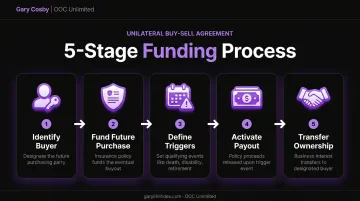
The mechanics are more straightforward than most owners expect. Here's the typical flow:
- Identify the buyer. You designate a specific person or entity as the buyer, often a key employee or a newly formed LLC with you holding a small controlling interest and employees holding the majority.
- Fund the future purchase. The designated buyer takes out a life insurance policy on your life, sized to match your business's agreed valuation.
- Define the triggers. The agreement spells out exactly which events—death, disability, or retirement—activate the mandatory purchase.
- Activate the payout. When a triggering event occurs, insurance proceeds go directly to the buyer, who is contractually required to use those funds to purchase the business from your estate.
- Transfer ownership. Your estate or spouse receives cash. The designated buyer takes full control. The business keeps running without interruption.
Consider a worked example. Say your business is valued at $2 million, and you form an LLC where you hold a 10% controlling interest while three key employees hold the remaining 90% as non-controlling members.
The example breaks down like this:
- Business valuation: $2 million
- Your ownership stake: 10%, controlling
- Employees' combined stake: 90%, non-controlling
- LLC-owned policy: $2 million death benefit, premiums paid by the LLC, LLC named beneficiary
If you pass away, the LLC collects the $2 million death benefit and uses it to buy your 10% stake and any remaining interest specified in the agreement. Your estate walks away with cash. Your employees walk into full ownership of a business that never had to close its doors or scramble for financing.
Key Elements to Include When Drafting the Agreement
A unilateral buy-sell agreement only works if it's specific. Vague language creates disputes exactly when your family can least afford one, so make sure the agreement addresses these four elements.
Triggering events. Spell out death, disability, retirement, and voluntary exit separately, since each may call for different terms and ambiguity here is one of the most common sources of later disagreement.
Valuation method. Choose one of three approaches:
- A fixed price, reviewed and updated on a set schedule
- A formula based on revenue, earnings, or a similar metric
- An independent appraisal at the time of the triggering event
Fixed prices that never get updated tend to become unreliable fast, so build in a review cadence rather than setting a number and forgetting it.
Right of first refusal. This clause prevents you from selling to an outside party during your lifetime without first offering the interest to your designated buyer, protecting the succession plan you've already built.
Funding requirement. The agreement should explicitly obligate the buyer to maintain the life insurance policy through ongoing premium payments. Without this, your entire plan depends on someone else's discretion.
Unilateral vs. Other Types of Buy-Sell Agreements
Not every business needs a one-way structure. Here's how it stacks up against the alternatives:
| Structure | Who buys | Best fit |
|---|---|---|
| Unilateral/one-way | A preselected employee, family member, or LLC | Sole owners or single-owner entities |
| Cross-purchase | Remaining co-owners buy the departing owner's share | Businesses with two or more active owners |
| Entity-purchase (redemption) | The business itself buys back the interest | Multi-owner entities, often with more owners than a cross-purchase can efficiently handle |
| Wait-and-see/hybrid | Entity decides first, then remaining owners, per the agreement terms | Multi-owner businesses wanting flexibility |
If you have business partners, cross-purchase or entity-purchase structures generally make more sense. They're built around multiple existing owners with competing interests to balance. A unilateral agreement, by contrast, is purpose-built for the owner who's flying solo, with one clear successor rather than a group negotiation. Funding matters as much as structure: life insurance often guarantees the buyout money is there when needed.
Funding a Unilateral Buy-Sell Agreement With Life Insurance
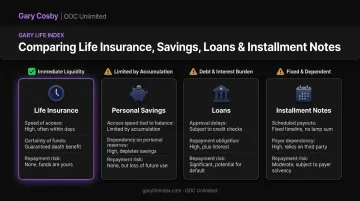
A buy-sell agreement without funding is just a promise. Life insurance is the preferred vehicle because it delivers cash exactly when it's needed, not months later after a loan application or a scramble for savings.
Under Section 101(a)(1) of the Internal Revenue Code, death benefits are generally excluded from gross income, according to Cornell Law School's Legal Information Institute. That said, exceptions apply, including transfer-for-value rules and employer-owned contract provisions, so tax-free treatment isn't automatic in every structure. Confirm your specific setup with a tax professional before finalizing the agreement.
Compare that to the alternatives:
- Personal savings require the buyer to have accumulated enough cash before an unpredictable event occurs
- Loans depend on credit availability and repayment capacity, introducing approval delays exactly when the business needs speed
- Installment notes stretch payments over years, leaving your estate dependent on the buyer's future performance
Typical Policy Structure
In most unilateral agreements, the designated buyer or LLC:
- Owns the policy on the owner's life
- Pays the premiums
- Is named the beneficiary, so proceeds flow directly toward the buyout
If disability is named as a triggering event, disability insurance can be layered in as a complementary funding source since life insurance alone won't cover that scenario.
Getting the coverage amount right, and finding carriers that price it competitively for your business's actual valuation, is where a licensed insurance professional matters.
Gary Cosby Jr., licensed in all 50 states, helps business owners evaluate insurance-funding options for buy-sell agreements, key person coverage, and business overhead needs. His role stays focused on the insurance component; he works alongside your CPA and attorney when tax treatment, ownership structure, or legal drafting requires their input.
That process draws on 25+ A+ rated carrier partners, comparing options to find coverage that matches your business's actual valuation rather than settling for whatever a single carrier offers.
Frequently Asked Questions
What is a unilateral contract with an example?
A unilateral contract involves one binding promise accepted through performance, like offering $100 to whoever finds a lost dog. A unilateral buy-sell agreement applies that same one-way structure, transferring ownership from a sole owner to a single designated buyer.
Is a unilateral buy-sell agreement legally binding?
Yes, when properly drafted and executed, it's a fully binding legal contract. An attorney should handle the drafting to make sure it meets your state's requirements for enforceability.
Can a unilateral buy-sell agreement be used by businesses with multiple owners?
Not typically. It's designed for sole owners or businesses with one dominant owner. Multi-owner businesses generally use cross-purchase or entity-purchase agreements instead.
How much life insurance is needed to fund a unilateral buy-sell agreement?
Coverage should match your business's agreed valuation, with room for growth over time. Periodic reviews help keep the policy amount aligned with the company's current worth.
What happens if the designated buyer can't keep up with life insurance premiums?
Most agreements require the buyer to maintain the policy, since a lapse can jeopardize the entire succession plan. Building a clear premium funding structure into the agreement upfront prevents this risk.
Do I need an attorney to draft a unilateral buy-sell agreement?
Yes, an estate planning or business attorney should handle the legal drafting. An insurance professional like Gary Cosby Jr. can then help structure the funding component alongside that legal work.