This scenario plays out more often than most owners realize. Many business partners assume they'll figure out ownership transitions "when the time comes." But death, disability, and retirement don't wait for convenient timing.
Without a buy-sell plan, surviving partners can face forced partnerships with an heir who has zero business experience, sudden cash-flow crises, or even liquidation just to settle an estate.
This guide breaks down what a buy-sell plan actually is, the main structures available, how they get funded, and what it takes to build one that actually works when you need it most.
Key Takeaways
- A buy-sell agreement is a legally binding contract dictating ownership transfer upon death, disability, or exit
- Cross-purchase, entity-purchase, and wait-and-see structures carry different tax and administrative trade-offs
- Life insurance remains the funding method most likely to deliver cash exactly when a triggering event occurs
- Outdated valuations inside an agreement can create disputes at the worst possible moment
- Nearly three in five small business owners have no succession plan in place at all
What Is a Buy-Sell Plan?
A buy-sell plan, sometimes called a buy-sell agreement, is a legally binding contract that spells out exactly what happens to a business owner's stake if they die, become disabled, retire, or otherwise leave the business. Cornell's Legal Information Institute defines it as a restriction on ownership rights in a closely held organization, requiring an exiting owner's interest to be sold back to the company or to the remaining owners.
Strip away the legal language, and the mechanics are straightforward:
- The agreement sets a predetermined price or valuation formula for the departing owner's share
- It names who has the right or obligation to buy that share
- It specifies how the purchase gets funded
These agreements show up most often in partnerships, closely-held corporations, and multi-member LLCs, where ownership isn't publicly traded and a sudden exit can throw daily operations into chaos.
The High Stakes of an Unplanned Exit
A buy-sell agreement without funding is just a promise. If the contract says the business must buy back a deceased owner's shares but there's no cash reserved for it, that obligation becomes a scramble. This is where life insurance typically enters the picture. It creates the cash the moment it's needed, rather than forcing survivors to find money during an already stressful period.
Worse than an unfunded agreement is no agreement at all. In that case, an owner's share can pass to a spouse or heir with no interest in or knowledge of the business, creating chaos when stability is needed most.
This isn't a rare oversight. A 2017 Nationwide survey of over 500 small business owners found that three in five small businesses lacked a formal succession plan of any kind.
Why Every Business With Multiple Owners Needs One
Any company with more than one owner is exposed to the same risk: an outside party suddenly becoming a co-owner with no warning and no vetting process.
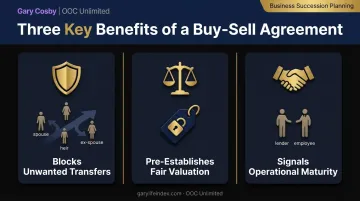
A well-drafted buy-sell plan closes that gap by:
- Blocking unwanted ownership transfers to a deceased partner's spouse, an unrelated heir, or a divorcing owner's ex-spouse
- Pre-establishing a fair valuation method so surviving owners and a departing owner's estate aren't negotiating price during a crisis
- Signaling operational maturity to lenders and key employees who view a documented succession strategy as a sign of a well-run company
Valuation disputes aren't hypothetical.
A Tenth Circuit case rejected a company's book-value pricing formula after the IRS revalued the shares for estate-tax purposes, triggering costly litigation.
The U.S. Supreme Court's Connelly v. United States decision went further: a corporation's obligation to redeem a deceased owner's shares didn't offset the life insurance proceeds used to value those shares. That ruling reshaped how entity-purchase agreements need to be structured going forward.
A poorly designed agreement can create the exact litigation it was meant to prevent.
Types of Buy-Sell Agreements
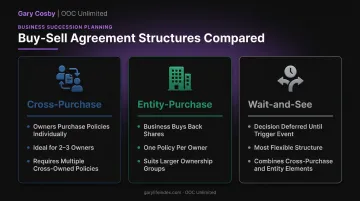
Two primary structures dominate the buy-sell landscape, along with a hybrid option that blends the two. Each comes with different tax and ownership consequences.
Cross-Purchase Agreement
In this structure, remaining owners individually purchase the departing owner's share. Funding typically comes from life insurance policies each partner holds on the others.
- Works best with two or three owners
- Surviving owners generally get a step-up in basis when the buyout occurs
- Becomes administratively heavy fast — a cross-purchase setup can require n × (n-1) policies, meaning a five-owner business would need 20 separate policies
Entity-Purchase (Redemption) Agreement
Here, the business itself buys back the departing owner's interest, usually funded by a policy the company owns on each owner.
- Simplifies administration since it only requires one policy per owner
- Better suited to businesses with several owners
- Following the 2024 Supreme Court ruling in Connelly v. United States, company-owned death proceeds can increase the business's value without an offsetting reduction for the redemption obligation, which affects how much coverage is actually needed
Wait-and-See Agreement
This hybrid approach delays the decision on whether the entity or the individual partners will buy the shares until the triggering event actually happens.
- Offers more flexibility to adapt to circumstances at the time of the trigger
- Requires more careful drafting up front to define how that decision gets made later
A mixed approach, blending partial cross-purchase and partial redemption, is also common depending on the owners' goals.
Four Ways to Fund a Buy-Sell Plan
Funding is the piece that gets overlooked most, and it's the piece that determines whether the whole agreement actually works.
| Funding Method | How It Works | Main Risk |
|---|---|---|
| Cash | Owners set aside money over time | Trigger event may happen before enough is saved |
| Installment | Purchase price paid from future income | Strains cash flow for years; depends on future performance |
| Loan | Business or owners borrow the purchase price | Adds interest cost and repayment risk |
| Insured | Life/disability insurance pays out at the trigger | Requires accurate valuation and proper policy design |
Cash Method
Owners build a reserve fund specifically for a future buyout. The problem: death and disability don't wait for the fund to reach an adequate level. A partner passing away in year two of a ten-year savings plan leaves the fund badly short.
Installment Method
The business pays the purchase price out of future income over several years. This can strain cash flow significantly, and it leaves the departing owner's family dependent on how well the company performs after they're gone.
Loan Method
The business or remaining owners borrow the purchase price. Future income then has to cover both principal and interest, which adds real financial risk on top of the loss of a partner.
Insured Method
Life insurance, and disability insurance for non-death triggers, is the only method that puts cash in hand the moment it's needed, assuming the underlying business valuation is accurate. There's no waiting on a savings goal, no borrowing, no dependence on future income.
This is why insurance is the default funding choice for most buy-sell agreements.
Gary Cosby, a licensed life insurance agent with GFI × Team OOC, works specifically on this piece of the puzzle. He helps business owners explore insurance-funding options for buy-sell agreements, key person coverage, and business overhead expense needs, drawing on access to 25+ A+ rated carriers.
Gary's role stays focused on the insurance side. He works alongside the owner's CPA and attorney, who handle the legal drafting and valuation work.
Essential Components of a Buy-Sell Agreement
Every agreement, regardless of structure, needs a handful of core elements to function as intended.
- Ownership details: a list of all owners and their exact equity stakes
- Valuation method: a current, agreed-upon way to determine business value, whether that's a fixed price, independent appraisal, or earnings-based formula
- Triggering events: defined circumstances that activate the agreement, such as death, disability, retirement, divorce, or bankruptcy
- Purchase mechanics: who has the right or obligation to buy, and the exact funding source, often a life insurance policy earmarked to cover the buyout
- Tax and estate considerations: how the transaction affects the departing owner's beneficiaries and the remaining owners' basis
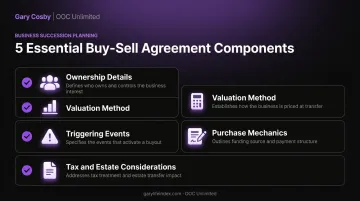
Skipping any one of these leaves room for disagreement precisely when emotions and financial stakes are highest.
Building Your Buy-Sell Plan the Right Way
A buy-sell plan isn't a do-it-yourself project. It requires three professionals working in coordination:
- An attorney to draft the legally binding contract
- A CPA or valuation professional to structure the tax treatment and determine business value
- A licensed life insurance agent to design and place the funding mechanism
That third role, the valuation and tax work, deserves special attention. Skipping this step, or letting the valuation go stale, creates real problems down the line.
The CPA Journal recommends obtaining annual valuation updates from a qualified appraiser. Fixed formulas can drift far from fair market value as growth prospects, profitability, and market conditions shift year to year. An outdated number in the agreement can undervalue, or overvalue, a partner's share at the exact moment it matters.
Gary Cosby and GFI × Team OOC focus specifically on the insurance-funding piece of this puzzle. With access to 25+ A+ rated carriers, they help business owners find coverage options so the plan stays properly capitalized as the business, and its valuation, change over time.
Frequently Asked Questions
What is a buy-sell plan?
A buy-sell plan is a legal contract that determines how an owner's business interest is sold or transferred upon death, disability, or retirement. It's typically funded through life insurance to guarantee cash is available when needed.
What triggers a buy-sell agreement?
Common triggers include death, permanent disability, retirement, divorce, and bankruptcy. An owner's voluntary decision to exit the business can also activate the agreement.
Who needs a buy-sell agreement?
Any business with two or more owners, including partnerships, LLCs, and closely-held corporations, benefits from having one in place. It protects both the business and each owner's family.
Is life insurance required to fund a buy-sell agreement?
No, but it's the most reliable way to guarantee funding. It guarantees cash is available exactly when a triggering event occurs, unlike savings or loans.
How much does it cost to set up a buy-sell agreement?
Costs vary based on attorney fees, business complexity, valuation expenses, and the insurance premiums tied to your chosen funding method. Owner age and health also affect insurance costs.
What happens if a business doesn't have a buy-sell plan?
Without one, businesses risk forced partnerships with an untrained heir or spouse, valuation disputes, potential litigation, and in worst-case scenarios, forced liquidation to settle an estate.