Gary Cosby Jr., founder of OOC Unlimited, knows this gap firsthand. His father passed away without life insurance, and Gary watched his family scramble to cover final expenses while grieving. That experience shaped his mission: make sure families, and the businesses they build, never get caught unprepared.
This guide walks through what business partner life insurance actually is, the main types available, how much coverage partners typically need, and how to structure it correctly with the right professionals at the table.
Key Takeaways
- Business partner life insurance funds a buyout or replaces lost income when a partner dies
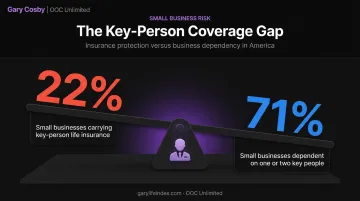
- Only 22% of small businesses carry key-person coverage, though 71% depend on one or two people
- Cross-purchase, entity-purchase, and key-person policies each solve a different problem
- Coverage amounts should match your buy-sell valuation, not a generic income multiple
- A licensed agent, CPA, and attorney each play a distinct role in getting this right
What Is Business Partner Life Insurance?
Business partner life insurance is a policy, or set of policies, designed to protect a company and its remaining owners financially when a partner dies. The death benefit gives survivors cash exactly when they need it most: to buy out a departed partner's share, cover lost income, or keep the doors open while the business adjusts.
There are two distinct ways this coverage gets structured, and confusing them causes real problems:
- Insuring the business itself — the company owns the policy, is the beneficiary, and uses proceeds to cover its own losses (this is key-person coverage)
- Insuring partners for each other's benefit — individual partners own policies on one another, with proceeds funding a direct buyout (this is cross-purchase coverage)
Neither of these replaces personal life insurance. A partner's individual policy protects their own spouse and kids. Business partner coverage protects the company and the people left running it. Smart partners typically carry both, since one doesn't do the other's job.
Why Do Business Partners Need Life Insurance?
When a partner dies, the business doesn't just lose a person. It loses institutional knowledge, client relationships, and often a signature that vendors and lenders trust. Revenue can dip immediately while remaining partners scramble to cover gaps.
Only 22% of small businesses carry key-person life insurance, despite 71% of them depending heavily on one or two key people, according to data cited by MassMutual and the Insurance Information Institute. That's a wide gap between exposure and protection.
The Forced Partnership Problem
Without a funded agreement in place, a deceased partner's ownership stake doesn't disappear. It typically passes to their spouse or heirs. Suddenly, the surviving partner is running a business with someone who never signed up for it, and who may have very different ideas about how things should work.
This creates real friction:
- Heirs may want quick cash rather than long-term involvement
- Surviving partners may not have liquid funds to buy them out
- Disagreements over business direction can stall decisions for months
Ownership disputes aren't the only threat to stability. Debt obligations create a second pressure point when a guarantor dies unexpectedly.
Debt and Cash Flow Pressure
Many partnership agreements involve loans personally guaranteed by one or more owners. When a guarantor dies, some lenders and creditors move to collect from the estate, adding pressure at the worst possible time.
Life insurance won't prevent these disputes or debt calls, but it creates the financial buffer surviving partners need. That cushion helps them avoid rushed asset sales or disadvantageous deals just to keep the business running.
Types of Life Insurance for Business Partners
Not every policy solves the same problem. Here's how the three main structures differ.
Individual (Cross-Purchase) Policies
In a cross-purchase arrangement, each partner buys a policy on the other partner (or partners), naming themselves as beneficiary. When one partner dies, the survivor receives the payout directly and uses it to purchase the deceased partner's ownership share, often from the estate or heirs.
Many partners also maintain a separate personal policy alongside this business coverage. One protects the partnership transition; the other protects their own family's finances independently. Neither should substitute for the other.
Key Person Life Insurance
Key person coverage works differently. Here, the business owns the policy and is the beneficiary, not the individual partners. If the insured partner or executive dies, the company receives the death benefit and uses it to cover lost revenue, recruit a replacement, or reassure nervous lenders and investors.
The distinction matters: key person insurance protects the company as an entity. Cross-purchase and buy-sell policies protect the ownership transition itself. Businesses often need both, especially when a partner is also the person driving most of the revenue.
Buy-Sell Agreements (Entity Purchase vs. Cross-Purchase)
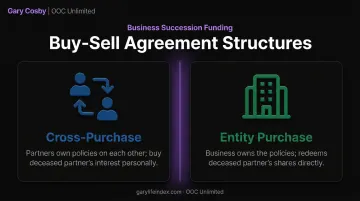
A buy-sell agreement is a contract obligating surviving partners to buy out a deceased partner's share at a predetermined price, funded by life insurance proceeds. There are two ways to structure it:
- Cross-purchase: Individual partners own policies on each other and buy the deceased partner's interest personally
- Entity purchase: The business itself owns the policies and redeems the deceased partner's shares directly into the company
Yes, a partnership can legally own a policy on one of its partners. The IRS addresses this directly in Notice 2009-48, which confirms partnership ownership doesn't disqualify a policy as employer-owned life insurance, provided proper written notice and consent are documented beforehand.
Example: A two-partner firm signs a buy-sell agreement valuing each partner's share at $1 million. Each partner (or the entity, depending on structure) carries a $1 million policy naming the appropriate beneficiary. When one partner dies, funds arrive almost immediately, no waiting on a sale, no liquidating equipment or real estate under pressure.
How Much Life Insurance Coverage Do Business Partners Need?
The right coverage amount depends entirely on what the policy needs to accomplish: protecting the partner's family, protecting the business, or both.
For personal/family protection, U.S. Bank recommends 8-10 times annual income as a starting benchmark, adjusted for income growth, dependents, and inflation over time.
For business-side coverage, partners need to account for costs that keep running whether or not a partner is there to manage them:
- Rent or mortgage payments on business property
- Payroll obligations for existing staff
- Outstanding loans or lines of credit
- Vendor and supplier commitments
- Inventory or equipment financing
The National Association of Insurance Commissioners outlines two common approaches for sizing buy-sell coverage:
- Salary multiple: A set multiple of the insured partner's salary
- Full buyout valuation: Coverage that matches the agreement's actual buyout terms
The second approach tends to be more precise, since it ties coverage directly to what the agreement requires rather than an estimate.
Coverage amounts aren't a "set it and forget it" decision. As a business grows in value, or as buyout terms shift, the policy amount needs to keep pace. A $500,000 buy-sell policy written five years ago might fall well short of today's business valuation.
Setting Up a Buy-Sell Agreement Funded by Life Insurance
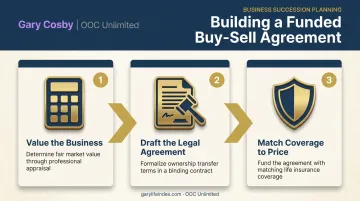
Getting a funded buy-sell agreement in place involves three coordinated steps:
- Value the business. A valuation professional determines what the company, and each partner's share, is actually worth today.
- Draft the legal agreement. An attorney puts the buyout terms in writing, specifying triggering events (death, disability, retirement) and the buyout price or formula.
- Match coverage to the price. Life insurance is purchased in an amount that lines up with the agreed valuation, so funds are available the moment they're needed. A licensed life insurance agent typically coordinates this step alongside the attorney and valuation professional.
Choosing How Future Value Gets Determined
The agreement should spell out how the business will be valued down the road, not just at signing. Common methods include:
- A fixed price, updated periodically
- A formula based on earnings or book value
- An independent appraisal at the time of the triggering event
Vague or outdated valuation language is one of the most common sources of disputes between surviving partners and a deceased partner's heirs.
When a Partner Is Uninsurable or Reluctant
Sometimes a partner can't get coverage due to health issues, or simply doesn't want to. Alternative funding options include:
- Installment buyouts from company cash flow
- Sinking funds
- Business loans
These options are slower and less certain than an insurance payout, which is why they're usually treated as a backup rather than the primary plan.
Choosing the Right Policy and Insurance Partner
Structuring this correctly isn't a one-person job. Tax treatment, ownership structure, and agreement language all intersect, which means it takes a licensed insurance agent working alongside your CPA and attorney, not one professional trying to cover all three roles.
This is where Gary Cosby Jr. and the OOC Unlimited team fit in. Licensed in all 50 states, they focus specifically on the insurance-funding side of key person, buy-sell, and business overhead expense planning.
They coordinate with the business's existing CPA and attorney rather than replacing them. The legal drafting and valuation work stay with the professionals already trained for it.
Term vs. Permanent Coverage
The right policy type depends on the timeline:
| Policy Type | Best Fit |
|---|---|
| Term life | Affordable, temporary protection for a loan, agreement period, or the partnership's active working years |
| Permanent life (whole life or IUL) | Lifelong coverage with cash value accumulation for succession planning or executive compensation strategies |
There's no universal right answer here. It depends on how long the coverage needs to last and whether building cash value matters to the broader financial plan.
Frequently Asked Questions
What is business partner insurance?
It's a policy, or set of policies, that protects a business or its surviving partners financially when one partner dies. It's most often used to fund a buyout under a buy-sell agreement.
Can a partnership own a life insurance policy?
Yes. A partnership or business entity can own and be the beneficiary of a policy on one of its partners, common in key-person coverage and entity-purchase buy-sell agreements. Proper notice and consent requirements must be met first.
How much is a $1,000,000 life insurance policy a month?
Monthly premiums vary widely based on age, health, and whether you choose term or permanent coverage. Northwestern Mutual notes that term is typically far less expensive than permanent insurance, but getting a personalized quote is the only way to know your actual number.
Is life insurance for business partners tax deductible?
Generally, no. Premiums aren't deductible when the business is the beneficiary, under IRC Section 264(a)(1). The upside is that death benefits are typically received income-tax-free.
Who should be the beneficiary on a buy-sell life insurance policy?
It depends on the structure. In a cross-purchase agreement, surviving partners are the beneficiaries. In an entity-purchase agreement, the business itself is named as beneficiary.
What happens if a business partner won't get life insurance for a buy-sell agreement?
The agreement becomes unfunded, risking forced asset liquidation or disputes with heirs down the road. Alternatives like installment buyouts or sinking funds can help, though they're generally less reliable than an insurance payout.