Introduction
If you're applying for a business loan and your bank mentions "collateral assignment of life insurance," common on SBA loans, you're not alone in feeling confused. In plain terms, it's a legal arrangement giving a bank a specified claim to your life insurance policy's death benefit if something happens to you before the loan is repaid.
Because this affects your policy's payout and beneficiaries, this guide is written for business owners, loan applicants, and lenders trying to make sense of bank underwriting requirements for commercial, SBA, or business loans.
Many borrowers don't understand the roles involved: who's the assignor, who's the assignee, how it affects your beneficiaries, and where the insurance company fits in. We'll walk through how the process works, why banks ask for it, what factors affect approval, and situations where it may not make sense at all.
Key Takeaways
- Banks recover only the loan balance from the death benefit, not the full payout.
- Unlike naming a bank as beneficiary, your family still receives what's left.
- Banks prefer permanent policies since cash value adds a repayment cushion.
- Both parties sign an insurer-specific form to finalize the assignment.
- Repayment triggers a release, restoring your family's full beneficiary rights.
What Is Collateral Assignment of Life Insurance for Banks?
How Collateral Assignment Works
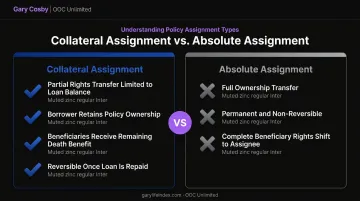
Collateral assignment is a contractual arrangement where a policy owner assigns rights to a portion of the death benefit to a bank as security for a loan. The insurer acknowledges this arrangement and keeps a record of it on file.
The intended outcome is straightforward: it guarantees the bank recovers the outstanding loan balance if the borrower dies before repayment. This means the bank doesn't have to rely solely on other hard collateral, like real estate or equipment.
This is not the same as absolute assignment. Collateral assignment only transfers rights up to the loan balance. Absolute assignment permanently transfers full ownership and beneficiary rights to the assignee, which is a much bigger commitment most borrowers don't need.
Why Banks Require Collateral Assignment for Loans
Banks lean on this tool most heavily for business, SBA, and commercial loans, especially when a business's success depends on one owner's continued involvement.
Under the SBA's current guidelines, life insurance is required to cover a collateral shortfall for Standard 7(a), EWCP, CAPLines, and International Trade loans when the business is a sole proprietorship, single-member LLC, or depends on one owner's active involvement.
For 504 loans, the CDC determines whether the business's viability hinges on a specific individual. If the loan isn't fully collateralized, insurance becomes part of the package.
Here's the risk banks are managing: without a collateral assignment, a lender may have to pursue a deceased borrower's estate through probate to recover funds. That process brings:
- Months of legal delays
- Added legal costs that eat into recovery
- A real chance of partial or total loss on the loan
Is this a legal mandate or a lender preference? Mostly the latter. SBA guidelines apply conditionally based on collateral shortfall and owner dependence, and many commercial lenders simply treat it as standard underwriting policy for loans above a certain threshold. There's no blanket dollar figure that triggers it across every loan type.
How Collateral Assignment of Life Insurance Works (Conceptual Flow)
At a high level, the process runs from loan application through policy assignment to disbursement of funds. The bank needs several pieces of information before moving forward:
- The requested loan amount
- The policy's death benefit and current cash value
- Borrower and policy owner details (sometimes these are different people)
- Lender information for the assignment paperwork
Once everything checks out, the insurer records the bank as collateral assignee up to a specified amount. The policy keeps functioning normally otherwise, meaning premiums still get paid and cash value still accumulates.
The assignment form itself controls how this plays out. It specifies whether the bank's claim is a fixed dollar amount or tied to the declining outstanding balance. Until the loan is satisfied, beneficiary payouts are subordinated to the bank's claim. After that, the assignment is released, and family beneficiaries regain full rights.
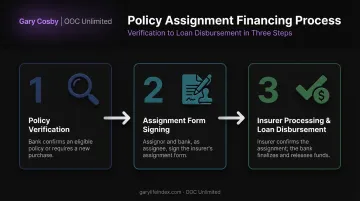
This process unfolds in three steps:
- The bank first checks whether the borrower already has an eligible policy or needs to purchase one, confirming the death benefit meets the loan's collateral requirement.
- As assignor, the policy owner completes an insurer-provided form naming the bank as assignee and specifying the loan terms. Both parties sign it, and some insurers, like Lincoln Financial, also require signatures from irrevocable beneficiaries.
- The insurer processes the assignment and sends confirmation. The bank then finalizes approval and disburses the loan, and the assignment stays active until the loan is fully repaid.
Where Banks Apply Collateral Assignment & Key Factors They Evaluate
Where It's Used in Bank Lending
Collateral assignment shows up most often in:
- Business loans, particularly for owner-dependent companies
- SBA 7(a), 504, CAPLines, and Export Working Capital loans
- Commercial real estate financing
- Key person or succession-related financing
It typically happens during underwriting and loan origination, before the funds are disbursed. Banks may also revisit it at renewal or refinancing.
What triggers the requirement? Insufficient hard collateral, succession risk tied to a key owner, or internal bank policy mandating it above a certain loan size.
Key Factors Banks Evaluate
Banks aren't indifferent to policy type or structure. Here's what they typically look at:
- Policy type: Permanent policies (whole or universal life) are generally preferred over term because cash value adds a layer of security if the borrower defaults, according to Progressive.
- Death benefit size: The benefit needs to meet or exceed the outstanding loan balance.
- Insurer financial strength: A weaker-rated carrier increases the bank's repayment risk if that insurer can't pay the claim.
- Ongoing premium payments: A lapsed policy is worthless as collateral, so banks monitor this throughout the loan term.
Some lenders still accept term coverage depending on loan size, so confirm acceptance before assuming a policy qualifies.
Working with a licensed life insurance professional early on can help you select a policy structure that satisfies these requirements from the start, rather than discovering a mismatch mid-application. Gary Cosby Jr. at OOC Unlimited, for instance, works specifically with business owners on structuring permanent policies for capital funding and collateral assignment purposes, coordinating with the client's CPA and attorney where tax treatment or legal documentation come into play.
Common Misconceptions and When Collateral Assignment May Not Be Appropriate
Common Misconceptions
Three mix-ups come up again and again:
- Assignee vs. beneficiary. These are different roles: a beneficiary designation gives the bank rights to the entire death benefit, while collateral assignment limits the claim to the loan balance.
- "Paid off" doesn't mean "released." Even after you've informally paid off the loan, the assignment stays on record until the insurer processes formal release documentation. Skipping this step leaves the bank's claim technically active.
- Not every policy qualifies automatically. Many banks reject term policies lacking cash value, so get pre-approval from the lender before committing to a policy structure.
When It May Not Be Appropriate
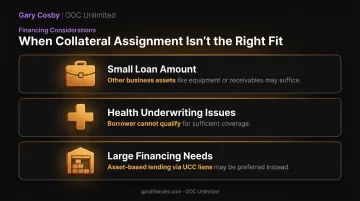
Collateral assignment isn't always the right fit. Consider skipping it when:
- The loan amount is small enough to be secured by other business assets, like equipment or receivables
- Health underwriting issues prevent the borrower from qualifying for sufficient coverage
- The financing need is large enough that banks prefer asset-based lending structures secured through UCC liens on receivables, inventory, or equipment instead
Conclusion
Collateral assignment gives a bank a secured claim to part of a life insurance death benefit, not ownership of the entire policy. It's a narrower, more targeted tool than most borrowers assume.
Understanding how it works helps business owners and lenders structure loans that protect both repayment and family financial security at the same time.
If you're navigating a bank's collateral assignment requirement, working with a licensed life insurance professional makes the process smoother. Gary Cosby Jr. and the team at OOC Unlimited specialize in insurance-funding strategies for business owners, including policy selection and structuring for collateral assignment purposes. They can help make sure the right policy is in place before your bank's underwriting deadline arrives.
Frequently Asked Questions
What does it mean if a life insurance policy is collaterally assigned?
It means a bank holds a legal right to a specified portion of the death benefit to cover an outstanding loan balance if the insured dies before the loan is repaid. Anything beyond that amount still goes to the named beneficiaries.
What is an example of collateral assignment?
A business owner assigns a whole life policy to a bank as security for a business loan. If the owner passes away with a remaining balance, the bank recovers only that amount; beneficiaries receive the rest.
What is the difference between assignment and collateral assignment?
Absolute assignment permanently transfers full ownership of the policy to the assignee. Collateral assignment only grants a limited claim up to the outstanding loan balance, leaving remaining rights with the policy owner.
Who is authorized to assign a life insurance policy as collateral?
Only the policy owner, who may or may not be the insured person, can execute the assignment. The insurer must also acknowledge and process the paperwork for it to take effect.
Is a collateral assignment of life insurance revocable?
It's typically irrevocable while the loan remains outstanding. Once the debt is fully repaid, the assignee signs a release and the insurer restores full beneficiary rights.
What type of life insurance do banks typically accept for collateral assignment?
Banks generally prefer permanent policies with cash value, such as whole or universal life. Some lenders accept term policies too, depending on loan size and their internal underwriting policy.