This is the exact scenario corporate-owned life insurance was built to address. Many business owners have heard the term but assume it's just another executive perk or a complicated tax shelter. In reality, COLI can function as both a real balance sheet asset and a financial safety net when a key person is suddenly gone.
This guide breaks down what COLI actually means, how the mechanics work, its tax treatment, the different policy types available, and who genuinely benefits from having one in place.
Key Takeaways
- The company owns the policy as applicant, payer, and beneficiary, not the family.
- Death benefits are usually income-tax-free with proper notice and consent documentation.
- COLI mainly funds key person protection, buy-sell agreements, and deferred compensation plans.
- Premiums are generally not tax-deductible, though the death benefit itself is tax-free.
- Federal law requires written employee consent before issuing a policy on their life.
What Is Corporate-Owned Life Insurance (COLI)?
Corporate-owned life insurance is a life insurance contract where the business itself is the applicant, owner, premium payer, and beneficiary. The insured person is typically a key executive, founder, partner, or highly valued employee, but that individual's family isn't who collects the payout. The company does.
This is the opposite of how most people think about life insurance. With individual or group coverage, an employee's spouse or estate is named beneficiary. With COLI, the business stands to receive the death benefit, because it's the business that stands to lose financially if that person dies.
Different Names, Same Structure
You'll encounter several terms describing this same ownership setup:
- Bank-owned life insurance (BOLI): the identical structure, used specifically when a bank is the policyholder
- Key man insurance: an older, narrower term for COLI used on top executives or hard-to-replace employees, as described in a Congressional Research Service report
- Employer-owned life insurance contract: the formal IRS terminology
Regardless of which term you use, the coverage typically applies to one of three scenarios:
- The employee dies while still actively working for the company
- The employee retires and dies years later while coverage continues
- The employee retires, and the accumulated cash value is tapped to help fund retiree benefit obligations
These scenarios only play out as intended if one legal requirement is met first: the Pension Protection Act of 2006 requires employers to give written notice and get written consent from the employee before the policy is purchased. Skip this step, and the tax advantages that make COLI attractive can disappear entirely. We'll cover exactly what that consent process looks like next.
How Does Corporate-Owned Life Insurance Work?
The process follows a fairly consistent sequence, regardless of which carrier or policy type a business chooses.
- Identify the insured: the company determines it has an insurable interest in a specific employee, meaning their loss would create a genuine financial hardship for the business.
- Secure written consent: the employee receives notice of the intent to insure, the maximum face amount, and confirmation that the company will be beneficiary. They must consent in writing before the policy is issued.
- Apply and pay premiums: the company submits the application and pays all ongoing premiums.
- Company is named beneficiary: proceeds go directly to the business, not the employee's estate.
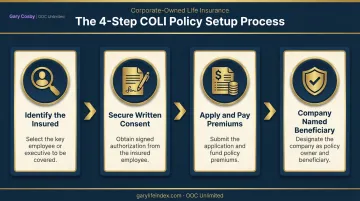
This consent process isn't optional paperwork. Under IRS Notice 2009-48, the contract generally must be issued within one year of that consent, or before the employee's employment ends, whichever comes first. Miss the window, and the exclusion for death benefits can be lost.
Guaranteed Issue and Cash Value
Group COLI policies covering multiple employees are frequently issued on a guaranteed issue basis, meaning no medical exam is required for eligible participants. This doesn't affect or replace any personal life insurance the employee carries on their own.
For permanent policies (whole or universal life), a cash value component builds over time. The company can access this value later through:
- Policy loans against the cash value
- Partial withdrawals
- Full surrender (though this may trigger charges)
When the insured employee dies, the company receives the death benefit. That money commonly offsets recruiting costs, executive search fees, lost revenue during the transition, or the general disruption of losing someone central to operations.
Insurable interest rules vary by state. A business must be able to demonstrate a legitimate financial stake in the insured's life or continued employment — check your state's specific requirements through the NAIC.
Common Business Uses of COLI
Three applications show up again and again in practice:
Key person protection. This is the most familiar use — the death benefit cushions the financial blow of losing a founder, top revenue producer, or irreplaceable technical expert. It's the closest thing to a shock absorber a business has for this kind of loss.
Funding buy-sell agreements. In an entity-redemption arrangement, the business owns a policy on each owner and uses the payout to buy the deceased owner's shares from their heirs. This keeps ownership intact without forcing a fire sale or a messy negotiation with grieving family members.
Informally funding deferred compensation. Companies that promise executives future non-qualified deferred compensation (NQDC) create a real liability on paper. COLI cash value can help offset that obligation, even though the policy and the deferred comp plan remain legally separate.
Pros and Cons of Corporate-Owned Life Insurance
Like most financial tools, COLI comes with real upside and real trade-offs. Neither side should be glossed over.
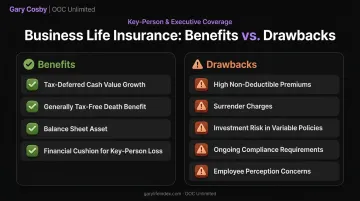
Benefits of COLI
- Tax-deferred cash value growth: permanent policies accumulate value without annual tax drag
- Generally tax-free death benefits, provided notice and consent requirements were properly satisfied at issuance
- Balance sheet asset: cash surrender value is recorded as a company asset, which can help offset unfunded liabilities like NQDC obligations
- The policy can also provide a financial cushion, helping absorb the real cost of replacing a critical employee, from search fees to lost client relationships
Drawbacks and Risks
COLI isn't free money, and it isn't simple. A few realities to weigh:
- Premiums are high, and unlike most business expenses, they're generally not tax-deductible
- Surrender charges can apply if a policy is canceled early, particularly in the first several years
- Investment risk exists in variable and indexed universal life policies, where cash value moves with market or index performance
- Compliance is ongoing: missing notice/consent steps or failing to file annual Form 8925 can jeopardize the tax-free treatment entirely
- Some employees simply don't like the idea that their employer, not their family, benefits from the policy
Types of COLI Policies
Not every COLI policy works the same way. The right structure depends on how long coverage is needed and whether cash value growth matters to the business.
| Policy Type | Cash Value? | Best For |
|---|---|---|
| Term life | No | Lower-cost, temporary key-person coverage over a defined period |
| Whole life | Yes, guaranteed | Long-term planning with predictable, fixed growth |
| Universal life (UL) | Yes, flexible | Adjustable premiums and death benefits over time |
| Variable universal life (VUL) | Yes, market-based | Higher growth potential, but the company bears investment risk |
| Indexed universal life (IUL) | Yes, index-linked | Growth tied to an index with floors that limit downside, though caps limit upside too |
Each type comes with its own trade-off:
- Term life stays inexpensive and simple, but coverage ends when the term does
- Whole life guarantees growth, at the cost of a higher premium
- Universal life trades some of that predictability for flexible premiums and benefits
- VUL and IUL can grow faster than fixed policies, but they can also underperform if the index or subaccounts don't cooperate
Is Corporate-Owned Life Insurance Taxable?
This is where a lot of confusion sets in, so let's separate the pieces clearly.
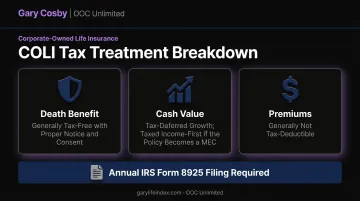
Death benefits generally stay tax-free for the company, but only if it met the notice-and-consent requirements under IRC Section 101(j) and an insured-status or permitted-beneficiary exception applies. Without that documentation, the IRS limits the exclusion to just the premiums paid, not the full payout.
Cash value grows tax-deferred inside permanent policies. The IRS typically treats withdrawals as a nontaxable recovery of basis first, and it generally doesn't tax policy loans as income either — unless the policy becomes a Modified Endowment Contract (MEC).
What Triggers MEC Status
A policy becomes a MEC when it fails the IRS's "7-pay test," meaning the owner paid too much premium in too short a window relative to the death benefit. Once a policy becomes a MEC:
- The IRS taxes distributions income-first, not basis-first
- Loans and withdrawals before age 59½ can trigger a 10% additional tax on the taxable portion
- MEC status remains permanent for the life of the contract, even if the owner later reduces premiums
Premiums, on the other hand, are generally not tax-deductible for the company, even though the death benefit and cash value receive favorable treatment. This trips up a lot of business owners who assume everything about the policy is tax-advantaged.
Finally, any business holding an employer-owned contract issued after August 17, 2006 must file IRS Form 8925 annually. This filing discloses the number of insured employees, total coverage in force, and whether valid consent exists for each one.
Who Should Consider a COLI Policy?
COLI tends to make the most sense for businesses that fit a specific profile, rather than companies in general.
Strong candidates typically include:
- Businesses genuinely dependent on one or two key people for revenue, client relationships, or operations
- Companies with highly compensated executives tied to deferred compensation arrangements
- Multi-owner businesses relying on a buy-sell agreement for succession planning
Cost is a real factor. As an illustrative benchmark, Guardian's published term rates show a healthy, nonsmoking 40-year-old paying roughly $73 a month for a woman and $92 a month for a man for $1 million of 20-year term coverage.
Permanent COLI policies cost considerably more than this retail benchmark, since they add cash value and lifelong coverage. Actual pricing depends heavily on group underwriting, the carrier, and the policy structure chosen.
Smaller businesses may find full COLI structures more complexity than they need. A simpler key person term policy often accomplishes the core goal, protecting against the loss of one critical person, without the administrative overhead of permanent policy management and annual compliance filings.
Structuring COLI, key person coverage, or deferred comp funding correctly isn't a solo project. It requires coordination between a licensed insurance professional and the business's CPA or attorney, since tax treatment, plan documentation, and policy structure all have to line up correctly.
This is exactly the lane Gary Cosby Jr. works in at OOC Unlimited. Licensed in all 50 states, Gary helps business owners explore insurance-funding options for key person coverage and related business needs, working alongside each client's existing tax and legal advisors rather than replacing them.
Frequently Asked Questions
What does company-owned life insurance mean?
COLI is a policy where the company is the applicant, owner, premium payer, and beneficiary on the life of an employee, typically a key executive, partner, or founder. The employee's family is not the beneficiary.
Is company-owned life insurance taxable?
Death benefits are generally tax-free and cash value grows tax-deferred, provided notice and consent rules are properly met. Premiums the company pays, however, are usually not tax-deductible.
Does company-owned life insurance have cash value?
Permanent COLI policies, including whole, universal, and variable universal life, build cash value over time. Term COLI policies do not accumulate any cash value.
How much does a $1,000,000 company-owned life insurance policy cost per month?
Cost depends heavily on the insured's age, health, and whether the policy is term or permanent. For example, a $1 million term policy for a healthy 45-year-old executive might cost $50 to $150 per month, while permanent coverage runs higher.
Do employees have to consent to being insured under a COLI policy?
Yes. Federal law requires the company to provide written notice and obtain written consent from the employee before purchasing a COLI policy on their life.
Is COLI the same thing as key person insurance?
Not exactly. Key person insurance is one common use of COLI, but COLI is the broader ownership structure that can also fund buy-sell agreements or deferred compensation plans.