Introduction
Maybe your business partner is ready to retire. Maybe a strategy disagreement has turned into deadlock. Maybe divorce, disability, or death has forced the question: how do you buy this person out?
Ownership changes like these aren't rare events reserved for large corporations. They happen constantly among small and mid-sized businesses, often with little warning.
Buying out a shareholder can look simple on paper: agree on a number, write a check, transfer the shares.
In practice, the outcome hinges on your valuation method, buy-sell agreement terms, financing structure, and tax treatment.
This guide covers when a buyout makes sense, the step-by-step process to execute one, the factors that swing price and terms, financing options like insurance-funded buy-sell agreements, and the mistakes that sink otherwise solid deals.
Key Takeaways
- A buyout can follow a cross-purchase, stock redemption, or hybrid structure, each with different tax effects
- Nailing down valuation and financing before negotiating prevents most disputes
- Retirement, death, disability, divorce, and irreconcilable conflict trigger most buyouts
- Financing ranges from personal savings and bank loans to seller notes and insurance-funded plans
- Skipping legal or tax advice and relying on stale valuations cause most failed buyouts
When Should You Buy Out a Shareholder?
A buyout isn't automatically the right move just because tension exists between owners. Timing matters as much as intent.
Common Triggers for a Shareholder Buyout
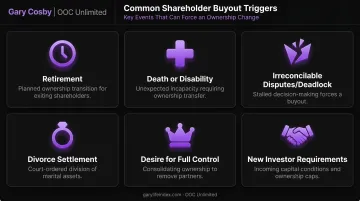
Most buyouts happen for one of these reasons:
- Retirement – an owner wants to step back and cash out their equity
- Death or disability – a triggering event under an existing buy-sell agreement
- Irreconcilable disputes or deadlock – partners can no longer agree on direction
- Divorce settlements – a spouse's claim on shared property forces a transfer or buyout
- Desire for full control – one owner wants to consolidate decision-making
- New investor requirements – incoming capital is conditioned on an existing shareholder's exit
Succession-related ownership changes are more common than most owners assume. PwC's 2025 US Family Business Survey found that succession planning affected 44% of surveyed US family firms in the prior year, noticeably higher than the 34% reported globally.
When to Hold Off
A full buyout can backfire if:
- The company doesn't have the cash flow to absorb it
- The parties haven't agreed on a valuation method
- Litigation is already underway between the parties
In these cases, mediation or a partial buyout often makes more sense than forcing the issue prematurely. A partial buyout means purchasing a portion of the shares now, with an option to buy the rest later.
How to Buy Out a Shareholder: Step-by-Step Process
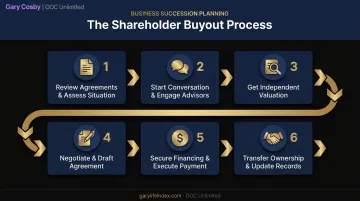
Step 1: Review Agreements and Assess the Situation
Before any conversation happens, pull out the buy-sell agreement, articles of association, or operating agreement. Check for:
- Pre-set valuation formulas
- Payment terms
- Triggering-event clauses that apply to your situation
Then identify why the buyout is happening. A retirement conversation moves differently than one triggered by a dispute or a death, and the underlying reason shapes tone, urgency, and who has more room to negotiate.
Step 2: Start the Conversation and Engage Advisors
Approach the departing shareholder directly, with documented expectations and a collaborative tone. This alone prevents a surprising number of disputes.
Both sides should retain independent legal counsel right away, and loop in a CPA or tax advisor before real numbers get discussed. Skipping this step to save a few thousand dollars upfront is one of the most common, and costliest, mistakes in these deals.
Step 3: Get an Independent Business Valuation
If the agreement doesn't specify a formula, commission a neutral valuation to set a fair starting point. Common methods include:
- Earnings multiple – applies a multiplier to normalized earnings
- Discounted cash flow (DCF) – projects future cash flows and discounts them to present value
- Net asset value – values assets net of liabilities
The valuation date and method chosen can shift the final price materially, especially after an unusually strong or weak year.
Step 4: Negotiate Price and Draft the Buyout Agreement
With attorneys involved, negotiate price and payment structure, staying open to reasonable compromise. The written agreement should spell out:
- Purchase price and payment method (lump sum, installments, or earn-out)
- Non-compete terms
- What happens if financing falls through before closing
Step 5: Secure Financing and Execute Payment
Finalize financing early. Apply for external funding well ahead of the closing date. Last-minute financing gaps are a leading cause of delayed or collapsed buyouts. If the buy-sell agreement was pre-funded with a life insurance policy on the departing shareholder, this risk is often already covered — policy proceeds can supply most or all of the purchase price the moment a triggering event like death, disability, or retirement occurs.
Before funds move, consult a tax advisor on how the payment will be treated: capital gain, ordinary income, or a deductible business expense. That choice directly affects what both parties keep after taxes.
Step 6: Transfer Ownership and Update Records
File the legal documents needed to transfer shares, then notify employees, customers, banks, and vendors of the ownership change. Update the shareholder agreement, insurance policies, and financial accounts to reflect the new structure.
Key Factors That Affect Buyout Valuation and Terms
A handful of variables determine whether a buyout goes smoothly or turns into a fight. Aligning on these early saves both time and money.
Valuation Method Used
A fixed formula, independent appraisal, or negotiated figure can each produce very different price outcomes for the same company. That rigidity becomes a problem during an atypical year, such as a downturn or the sudden loss of a major client, when a fixed formula can feel unfair to one side.
Buy-Sell Agreement Provisions
Clauses like drag-along, tag-along, and good leaver/bad leaver terms determine whether a buyout can even be enforced, and at what price. Without these provisions in place, resolving an ownership dispute typically requires slower, more expensive legal action. Many buy-sell agreements are funded with life insurance on each owner, so the cash needed to complete the purchase is already available when a triggering event occurs.
Tax Treatment of the Transaction
Whether payments are treated as capital gain, ordinary income, or goodwill changes the tax liability for both buyer and seller. Poor structuring can raise the buyer's effective cost or shrink what the seller actually keeps, which is why most parties involve a CPA before finalizing the deal structure.
Payment Structure and Cash Flow Impact
A lump sum, installment plan, or earn-out changes how much financial strain the deal places on ongoing operations. An oversized upfront payment can drain the working capital a business needs to keep running, while a structured payout, such as one funded through key person life insurance, keeps operations funded through the transition.
Financing a Shareholder Buyout: Options and Alternatives
Financing determines whether a buyout is even feasible. The right choice protects the company's cash flow and the buyer's personal finances at the same time.
Personal Funds, Bank Loans, and Seller Financing
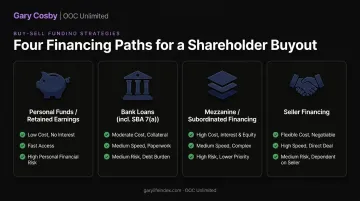
Several financing paths can bridge the gap between an agreed price and available cash:
- Personal funds or retained earnings: Works when the amount is modest and reserves are healthy, though it risks straining payroll, inventory, and growth capital.
- Bank loans: SBA 7(a) loans and similar options commonly fund ownership changes; compare equity requirements and repayment terms across lenders, since SBA policy shifts over time.
- Mezzanine or subordinated financing: Debt behind senior bank debt, sometimes with equity warrants, fills the gap when a loan doesn't cover the full price.
- Seller financing: An installment or vendor-loan arrangement spreads payments over time, easing the buyer's cash burden while giving the seller steady income.
Insurance-Funded Buyouts for Death or Disability Triggers
When the trigger is death or disability, cross-purchase and stock redemption agreements are commonly funded with life or disability insurance purchased well in advance. This guarantees the money is available the moment it's needed, rather than scrambled together during a crisis.
The Supreme Court's 2024 ruling in Connelly v. United States shows why this matters. A company held $3.5 million in life insurance on each of two owner-brothers and used the proceeds to redeem one owner's shares after his death.
The Court held that the insurance payout increased the company's value for estate tax purposes, rather than being offset by the redemption obligation. How a buyout is funded can change its tax outcome, not just whether it's affordable.
This is the kind of detail that gets missed without the right specialist involved. OOC Unlimited works alongside a business owner's CPA and attorney to structure life insurance funding for buy-sell agreements. Together, they determine the right policy type and coverage amount, so the money is in place before a triggering event happens, not after.
Common Mistakes to Avoid When Buying Out a Shareholder
Even well-intentioned buyouts go sideways when the basics get rushed. Watch for these three:
- Skipping legal and tax counsel to save money upfront – this almost always leads to costlier disputes or unfavorable tax treatment later
- Relying on an outdated or overly rigid valuation: commission a fresh, independent assessment instead of trusting a formula from years ago
- Underestimating financing needs – an oversized upfront payment can strain company cash flow for months or years after closing
Frequently Asked Questions
Can you buy out a shareholder?
Yes. A shareholder can be bought out through negotiation, an existing buy-sell agreement, or, in rare cases, a formal legal proceeding if no agreement exists.
Is a company buyout good for shareholders?
It depends on fair valuation and terms. A well-structured buyout can benefit both the departing and remaining shareholders, while a poorly negotiated one can hurt either side.
Can a company force a minority shareholder to sell their shares?
Only with pre-agreed exit clauses like drag-along or good leaver/bad leaver terms, or through a formal legal process such as a squeeze-out or expulsion proceeding.
How is the buyout price for a shareholder determined?
Common methods include an earnings multiple, independent appraisal, or net asset value. Many buy-sell agreements pre-define the formula so there's no dispute over methodology later.
What happens if the company can't afford to buy out a shareholder?
Alternatives include installment payments, seller financing, an insurance-funded buy-sell agreement, or a partial/phased buyout that spreads the purchase over time instead of all at once.
How long does a shareholder buyout typically take?
Amicable buyouts with an agreed valuation can close in a matter of weeks. Disputes or valuation disagreements can stretch the process to several months or longer.