
Here's the hard part: most owners never plan for either scenario. Your business is likely your largest financial asset, often worth more than your home, your retirement accounts, and your investments combined. Yet the majority of owners delay transition planning until circumstances force their hand, and by then, options narrow and value evaporates.
This guide breaks down the four core components of a solid transition plan, the paths available to you, and how to assemble the right advisory team — including the insurance-funding strategies that protect your plan from being derailed by the unexpected.
Key Takeaways
- Transition planning transfers ownership; succession planning transfers leadership. You need both.
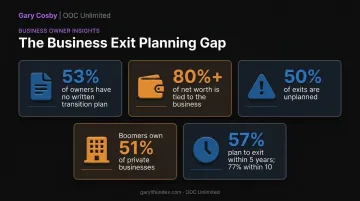
- 53% of business owners have no written, formal transition plan, according to a 2023 industry survey.
- A complete plan rests on four pillars: timeline, valuation, successor selection, and legal/risk structuring.
- Starting 3-5+ years before your intended exit preserves your leverage, your value, and your options.
What Is Business Transition Planning?
Business transition planning is the process of preparing to transfer ownership of your company to someone else: a buyer, a family member, your employees, or your management team. It's not the same thing as succession planning, which focuses on who runs the company day-to-day going forward.
The distinction comes down to two different questions:
| Question | Answered By |
|---|---|
| Who leads the company day-to-day? | Succession planning |
| Who owns it, and how does money and control change hands? | Transition planning |
| A business can have a strong succession plan and still fall apart financially if the ownership transfer isn't structured properly. |
Transitions happen two ways:
- Voluntary: retirement, launching a new venture, or simply wanting out
- Involuntary: the "5 D's" — death, disability, divorce, disagreement, and distress
Because a transition touches financial, legal, tax, and emotional territory all at once, it's rarely something one advisor can handle alone. That's why owners typically build a small team rather than lean on a single CPA or attorney.
Why Business Transition Planning Matters
The numbers here are sobering. A 2023 National State of Owner Readiness report surveyed over 1,100 business owners and found that 53% have no written, formal transition plan in place.
That same research found the business typically represents 80% or more of an owner's total net worth.
Put those two facts together, and the risk becomes obvious: most owners have the majority of their wealth tied up in an asset they haven't prepared to sell, transfer, or protect.
The Cost of Waiting
Unplanned exits aren't rare edge cases. The same research estimates that roughly 50% of U.S. business exits are triggered by unplanned events rather than a deliberate, timed decision.
When a transition happens on someone else's timeline instead of yours, you lose negotiating power. Buyers know when a seller is desperate, and valuations reflect that.
Planning ahead changes the equation:
- Higher valuations: clean records and a documented growth story command better offers
- Smoother continuity: employees, customers, and vendors experience less disruption
- Reduced tax exposure: proper structuring can preserve significantly more of the sale proceeds
- Stronger negotiating position: you're choosing a buyer, not settling for whoever shows up first
A Wave of Owners Is About to Exit
There's a demographic reality adding urgency here. Baby Boomers own an estimated 51% of privately held U.S. businesses, representing more than 3 million companies worth nearly $10 trillion.
Among those owners, 57% want to exit within five years, and 77% within ten, according to the same 2023 owner-readiness data. That's a massive wave of ownership change hitting the market at roughly the same time, which means competition for buyers, capital, and qualified successors will only intensify.
The Four Components of a Business Transition Plan
A complete transition plan combines four interconnected pieces that work together. Skip one, and the whole structure gets shaky.
Component 1: Vision, Goals & Timeline
Start with what you actually want. Financial outcome, legacy, impact on employees and community — these priorities shape every decision that follows. Then set a realistic timeline:
| Transition Type | Typical Timeline |
|---|---|
| Internal (family, employees, management) | 5-7 years |
| External sale | 1-3 years |
Rushing either one usually costs you money.
Component 2: Business Valuation & Financial Readiness
Owners consistently hold unrealistic ideas about what their company is worth, according to research from Wharton, which calls this mismatch one of the most common reasons deals collapse. Unlike public companies, private businesses have no market ticker to reference, so you have to build that valuation yardstick yourself.
That means:
- Getting an independent, buyer-perspective valuation, not a hopeful guess
- Cleaning up 3+ years of financial statements
- Fixing anything that would make a buyer nervous during diligence
Component 3: Successor or Buyer Identification & Development
Whether you're grooming a family member, promoting from within, or preparing marketing materials for outside buyers, this component is about readiness. Internal candidates need upskilling well before the transition date. Handing someone the keys without preparation is how good businesses stumble post-sale.
Component 4: Legal, Tax & Risk Management Structuring
This is where buy-sell agreements, tax-efficient deal structures, and risk protection tools come together. Key person insurance and business overhead expense coverage often fund these agreements, ensuring the plan survives even if an owner dies or becomes disabled before the transition completes.
A licensed insurance professional typically joins the team at this stage. Agents like Gary Cosby Jr. at OOC Unlimited focus specifically on the insurance-funding side, structuring key person coverage and buy-sell funding alongside a business owner's CPA and attorney. The attorney drafts the legal agreement, and the valuation expert sets the dollar figure the insurance needs to cover.
Exploring Your Business Transition Options
Once your goals and readiness are clear, you'll choose a path. Each one trades off differently between value, control, and speed.
| Path | Best For | Typical Timeline |
|---|---|---|
| External Sale | Maximizing immediate financial return | 12-24 months prep + 6-10 months to close |
| Family Succession | Preserving legacy and family involvement | 5-7 years |
| Employee Ownership (ESOP/EOT) | Protecting jobs and community ties | 6-12 months once the decision is made |
| Management Buyout | Smoothest operational continuity | Varies; often financed through seller notes |
Selling to an External Buyer
An outright sale usually delivers the biggest immediate payout, but it demands preparation. According to IBBA's Q4 2021 Market Pulse report, smaller deals under $500,000 closed in about 6 months, while mid-market transactions between $5 million and $50 million took a median of 10 months.
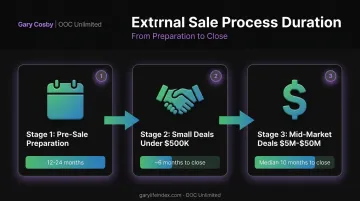
Add another 12-24 months of pre-sale prep, and you're looking at a multi-year process from decision to close.
Family Succession
Keeping the business in the family protects your legacy, but it demands an honest look at whether your successor is actually ready. The track record here is humbling: only about 40% of family businesses successfully transition to a second generation, roughly 13% reach a third, and just 3% survive to a fourth, per data cited by Businessweek. Readiness assessment isn't optional; it's the difference between "successfully transitioned" and becoming another statistic.
Employee Ownership (ESOP/EOT/Co-ops)
Employee stock ownership plans and employee ownership trusts let your team become owners while keeping the business rooted in its community. Most ESOP transactions take 6-12 months from the decision to sell until documents are signed, according to National Center for Employee Ownership data. EOTs are newer to the U.S. market (fewer than 100 currently exist), but interest is growing quickly.
Management Buyouts
Your existing leadership team often knows the business better than any outside buyer ever could, which makes for the smoothest operational handoff. The catch is financing: management teams rarely have the capital to pay cash upfront, so these deals typically rely on seller financing spread out over several years.
Building Your Transition Advisory Team & Timeline for Success
No owner should try to navigate this alone. A transition touches too many disciplines for one advisor to cover everything competently.
Your core team should include:
- CPA: Tax planning and financial strategy
- Attorney: Drafting buy-sell agreements and legal documents
- Valuation expert: Establishing what the business is actually worth
- Insurance professional: Structuring the funding mechanisms that protect the plan
That last piece matters more than most owners realize. Life insurance frequently funds buy-sell agreements, giving remaining owners the liquidity to buy out a departing partner without scrambling for cash.
Key person and disability coverage serve a similar purpose: protecting the business if an owner or essential employee dies or becomes unable to work before the transition is complete.
This is the specific lane firms like OOC Unlimited work in: they handle the insurance-funding piece while your attorney and CPA manage the legal and tax structuring around it.
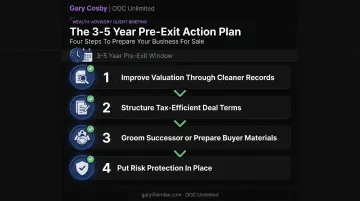
Start this conversation 3-5 years before your intended exit date. That window gives you time to:
- Improve your valuation through cleaner records and operational fixes
- Structure tax-efficient deal terms before you're under time pressure
- Groom a successor or prepare marketing materials for external buyers
- Put risk protection in place before you actually need it
One more thing worth saying plainly: letting go is harder than the paperwork. Many owners have built their identity around the business for decades, and an abrupt exit can feel like losing a part of yourself.
A phased reduction in involvement, stepping back from day-to-day decisions gradually rather than walking away overnight, tends to work better for both the owner and the business.
If you're weighing how key person coverage or buy-sell funding might fit your specific situation, a free consultation can walk through the options relevant to your business structure.
Frequently Asked Questions
What are the four components of a transition plan?
The four pillars are vision/goals and timeline, business valuation and financial readiness, successor or buyer identification, and legal/tax/risk structuring. Each one addresses a different piece of a successful ownership handoff.
What is the difference between business transition planning and succession planning?
Transition planning focuses on transferring ownership (who buys or receives the business), while succession planning focuses on leadership (who runs it day-to-day afterward). A complete strategy needs both.
How long does business transition planning typically take?
External sales generally take 1-3 years from prep to close. Internal transitions, such as family succession or management buyouts, often take 5-7 years to execute properly.
Why is a buy-sell agreement important in business transition planning?
A buy-sell agreement, often funded by life insurance, creates a pre-agreed plan for what happens if an owner dies, becomes disabled, or exits. It prevents disputes and provides the liquidity needed for a smooth ownership change.
What happens if a business owner doesn't have a transition plan?
Without a plan, owners risk a forced sale, a lower valuation, and significant family or financial stress. This is especially true if one of the "5 D's" (death, disability, divorce, disagreement, distress) triggers an unplanned exit.
When should a business owner start transition planning?
Most advisors recommend starting 3-5 years before your intended exit. That timeline preserves your options, protects your valuation, and keeps you in control of the process instead of reacting to circumstances.