That tension sits at the heart of every management buyout. Owners worry about legacy, loyal employees, and whether a new owner will gut the culture they built. Management teams want ownership and the upside that comes with it, but most have never financed a multimillion-dollar acquisition or structured a deal that protects everyone if something goes wrong mid-transaction.
This guide breaks down what an MBO actually is, how the process unfolds step-by-step, how these deals get financed (including the insurance protections lenders often require), the real trade-offs involved, and a well-known example that shows how far an MBO can go.
Key Takeaways
- An MBO lets existing leadership buy the business, preserving continuity for staff, customers, and suppliers.
- Deals typically close in 6 to 12 months, depending on financing complexity and size.
- Financing usually blends buyer equity, senior and mezzanine debt, seller notes, and sometimes private equity.
- Lenders often require key person life insurance to protect the loan if a new owner dies or becomes disabled.
- MBOs aren't always permanent—sometimes they're a strategic stepping stone toward a bigger sale or IPO down the road.
What Is a Management Buyout (MBO)?
A management buyout happens when a company's existing leadership team pools capital, debt, and outside financing to acquire a majority or full ownership stake in the business they already run. Instead of a stranger stepping in, the people who already know the operation, the customers, and the numbers become the new owners.
Three scenarios typically trigger an MBO:
- An owner is retiring with no family member ready or willing to take over.
- A large corporation wants to divest a non-core division that doesn't fit its strategic direction anymore.
- A struggling public company decides to go private to escape short-term market pressure.
Who Usually Leads the Deal
Sometimes it's one strong leader, a general manager, say, teaming up with one or two trusted executives. Other times it's a broader group: five or six department heads pooling resources and expertise. Whatever the structure, someone has to be designated as the lead voice in negotiations. Shared vision matters just as much as shared capital here.
Why Management Wants In
Management teams pursue buyouts for a few consistent reasons:
- They believe they can run the company better than it's currently being run.
- They want direct financial upside instead of a fixed salary.
- They want to protect continuity for employees, customers, and suppliers who depend on the business staying stable.
One defining trait of MBOs: due diligence tends to be lighter than in a typical outside acquisition. The buying team already knows the financials, the operational quirks, and where the hidden risks lie.
This familiarity often translates into better outcomes. Business advisors frequently observe that management-led buyouts close more smoothly than third-party sales, since fewer surprises mean fewer deals falling apart.
How Does a Management Buyout Work? (Step-by-Step Process)
An MBO unfolds as a sequence of moving parts that has to line up correctly. Here's how it typically works:
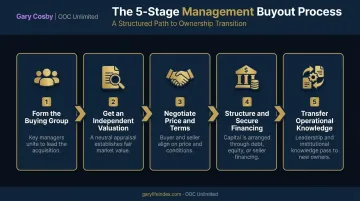
- Form the buying group. Identify who's in, designate a leader or president, and confirm everyone shares the same vision. Misaligned partners at this stage almost always resurface as bigger problems later.
- Get an independent valuation. This matters more than it sounds. When a longtime employer and a longtime employee negotiate price directly, emotional bias creeps in on both sides. An outside valuation keeps the number honest.
- Negotiate price and terms before financing. Buyers should start building lender relationships early, before formal terms are locked in, so financing doesn't become the bottleneck later.
- Structure and secure financing. This usually means combining debt, buyer equity, and sometimes seller financing (more on this below), often paired with an insurance-funded buy-sell agreement or key person policy that protects both sides through the transition.
- Transfer operational knowledge gradually. Relationships with clients, suppliers, and lenders often shift years before the legal ownership transfer actually closes. The paperwork is often the last thing to change.
Timeline: According to Sofer Advisors, most MBOs take 6 to 12 months from initial discussions to closing, with simpler deals wrapping up in as little as 6 months and complex ones stretching past a year. Financing structure and diligence scope are the biggest variables.
Advantages and Disadvantages of a Management Buyout
MBOs solve real problems, but they're not automatically the "safe" choice just because the buyers are familiar faces.
Advantages:
- Faster, smoother transitions since buyers already understand operations and culture.
- Greater continuity for employees, customers, and suppliers, with no adjustment period to a stranger's management style.
- Lower onboarding risk compared to an outside buyer learning the business from scratch.
Disadvantages:
- The psychological shift from employee to owner is harder than most people expect, since salaried thinking doesn't translate directly to ownership thinking.
- Sellers rarely walk away with the highest possible price, since there's no competitive bidding war driving the number up.
- Conflicts of interest can surface if management has an incentive to undervalue the business during negotiations, since they sit on both sides of the table.
There's a risk that often gets overlooked entirely: what happens if a key member of the incoming ownership team dies or becomes disabled mid-transition? Financing agreements can unravel fast if a lender's repayment assumption was built around a specific person staying healthy and involved. Insurance-based protections, covered in the next section, exist specifically to address this scenario.
How Are Management Buyouts Financed?
Financing is where most MBOs live or die. The right structure depends heavily on deal size.
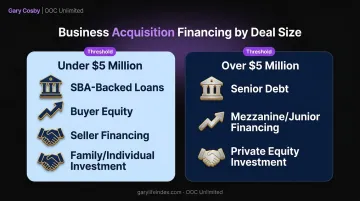
Small Transactions (Under $5 Million)
Smaller deals typically lean on:
- SBA-backed loans – the SBA's 7(a) program caps out at $5 million and can be used for full or partial ownership changes.
- Buyer equity contributed directly by the management group.
- Seller financing, where the outgoing owner effectively becomes a lender.
- Individual or family investment to fill remaining gaps.
Large Transactions (Over $5 Million)
Bigger deals usually require a more layered capital stack:
- Senior debt from banks, first in line for repayment.
- Mezzanine or junior financing, subordinated to senior debt but carrying higher return expectations.
- Private equity investment, which often comes with a significant or controlling equity stake in exchange for capital.
Seller Financing and Skin in the Game
Sellers frequently agree to spread payments over several years, sometimes tying part of the price to an earnout based on how the company performs post-sale. This bridges valuation gaps when buyer and seller can't quite agree on price upfront.
Lenders and private equity backers almost always expect management to personally invest real capital, not just sweat equity. It's proof of commitment, and it aligns incentives when things get tough.
The Insurance Piece Nobody Talks About Enough
Here's where a lot of MBOs get exposed. If a key incoming owner dies or becomes disabled before the deal is fully funded, the entire financing structure can be jeopardized. That's why lenders and buy-sell agreements frequently require key person life insurance and disability coverage on the new ownership team as a condition of closing.
This is squarely where GFI × Team OOC's Gary Cosby comes in. Gary works alongside a business owner's CPA and attorney, not in place of them, to structure the insurance-funding piece of these transitions.
His role focuses on making sure the capital is there if the unexpected happens. The attorney drafts the legal agreement, the valuation professional sets the number, and Gary structures the coverage that protects the deal itself.
With that protection secured, many new owners also lean on bank financing or accounts receivable factoring to keep operations funded while the dust settles from the transition.
Management Buyout vs. Leveraged Buyout vs. Management Buy-In
These three terms get mixed up constantly, but the distinction matters.
| Structure | Who leads the deal | Equity/debt approach |
|---|---|---|
| MBO | Existing management, already running the company | Managers invest personal equity; PE or bank debt fills the rest |
| Sponsor-led LBO | An outside private equity sponsor | Sponsor supplies equity and heavy acquisition debt; management may co-invest but isn't required to |
| MBI | A new external team replacing current leadership | Incoming managers invest, often alongside PE investors who initiate the deal |
An MBO is technically a subset of an LBO. The difference is who's driving: management leads and contributes rollover equity, rather than an outside sponsor calling the shots.
An MBI, on the other hand, exists to replace leadership, usually because the company looks undervalued or mismanaged. An MBO does the opposite: it keeps trusted, known leaders exactly where they are.
That familiarity shows up in the deal process itself:
- Lighter due diligence, since buyers already know the business inside out
- Smoother stakeholder transitions, since customers and employees see continuity, not upheaval
Real-World Example of a Management Buyout
Michael Dell's 2013 take-private deal remains one of the most cited management buyouts in modern corporate history. Dell teamed up with private equity firm Silver Lake to buy out public shareholders.
Deal specifics:
- Deal value: $24.9 billion, reportedly
- Shareholder payout: $13.75 per share plus a $0.13 special dividend
- Key partners: Michael Dell and Silver Lake Partners
The rationale was straightforward: Dell wanted room to transform the company strategically without quarterly earnings pressure, activist investors, or public reporting requirements breathing down his neck. Investor Carl Icahn pushed back hard during the process, arguing the price undervalued the company, but the deal closed anyway.

This example stands out for its outcome as much as its size. Dell returned to public markets in December 2018 through a Class V share exchange, proving an MBO doesn't have to be permanent. For some companies, going private is a temporary strategy rather than a permanent exit.
Frequently Asked Questions
How does a management buyout work?
Management pools personal capital along with debt, equity, and sometimes seller financing to purchase the company they already run. Ownership and operational responsibility then transfer gradually, often finishing before the legal paperwork is even signed.
Is a management buyout a good thing?
MBOs often deliver continuity and smoother transitions than an outside sale, but success hinges on accurate valuation, sound financing, and whether management is genuinely ready to think like owners instead of employees.
What is the difference between a management buyout (MBO) and a leveraged buyout (LBO)?
An MBO is a type of LBO where the existing management team leads the acquisition and contributes equity. A broader LBO can be led entirely by an outside financial sponsor with no management involvement in the buying group.
What is an example of a management buyout?
Michael Dell's 2013 buyout of Dell Inc. alongside private equity firm Silver Lake is one of the most well-known examples, taking the company private in a deal valued near $24.9 billion.
What is the difference between an MBO and a management buy-in (MBI)?
An MBO keeps the current management team in place as the new owners. An MBI brings in an entirely external team to replace existing leadership, often because the company is seen as undervalued or poorly managed.
How is a management buyout financed?
Financing typically blends buyer equity, senior and mezzanine debt, seller financing, and sometimes private equity. Lenders often also require key person and disability insurance on incoming owners to protect the deal against unexpected events.