Executive bonuses are structured tools, tied to performance, retention, and business strategy. Get the design wrong, and you risk losing the leaders you need most. Get it right, and you drive measurable results — Stanford research shows a median CEO receives roughly $12,000 in bonus for every $1M of net income, a far tighter link between pay and performance than most people assume.
This guide breaks down what counts as an executive bonus, what "normal" actually looks like, what a fair severance package includes, and a lesser-known strategy — life-insurance-funded Section 162 plans — that many privately held businesses overlook entirely.
Key Takeaways
- Executive bonuses are variable pay layered on base salary, never guaranteed
- No single "average" bonus exists — it varies by role, industry, and company size
- Severance and signing bonuses run on different logic than annual performance bonuses
- Section 162 plans reward key leaders using employer-paid life insurance premiums
What Are Executive Bonuses?
An executive bonus is discretionary or performance-tied compensation, paid in cash or equity, given to senior leaders on top of base salary. Unlike salary, it's never guaranteed. Executives must earn it, trigger it through a specific metric, or receive it at leadership's discretion.
The purpose is simple: align what an executive decides to do with what shareholders and the business actually need. A CEO whose pay depends heavily on profit growth thinks differently about a risky acquisition than one drawing a flat salary regardless of outcome.
Who typically qualifies:
- C-suite executives (CEO, CFO, COO)
- Vice presidents and senior leadership
- Any role deemed critical to executing company strategy
The Incentive Effect Is Bigger Than Most Assume
For years, researchers underestimated how sensitive cash bonuses really are to performance. A 2019 Stanford study by Guay, Kepler, and Tsui found that performance sensitivity in executive bonus plans runs roughly ten times higher than earlier estimates suggested.
What this means practically: bonus design isn't a minor lever. Small changes in how a bonus formula is structured can meaningfully shift executive behavior, for better or worse.
What counts as "reasonable" bonus design isn't fixed. It depends on:
- Company stage (startup vs. mature enterprise)
- Ownership structure (public vs. privately held)
- Industry norms and competitive pressure for talent
That variability is exactly why the next sections break bonuses down by type and benchmark.
Types of Executive Bonuses
Not all executive bonuses serve the same purpose. Some recruit talent. Others reward a single strong year. Others exist purely to keep someone from walking out the door. Here's how each type functions.
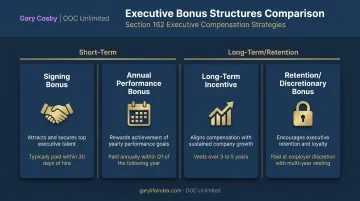
Signing (Sign-On) Bonuses
Companies offer signing bonuses to recruit executives from competitors or to offset compensation and equity the candidate forfeits by leaving their current employer. Structures typically fall into two camps:
- Lump sum: Paid upfront, sometimes with a clawback if the executive leaves within a set window
- Vesting schedule: Paid in installments tied to tenure milestones
Annual Performance Bonuses (Short-Term Incentives)
This is the most common bonus type. It's tied to yearly financial or operational metrics such as revenue, profit margin, or specific KPIs, and it's typically paid out once per year based on how those targets landed.
Long-Term Incentive Bonuses
Long-term incentives (LTIs) reward sustained performance over a multi-year window, usually two to three years, paid in cash, equity, or a mix of both. The goal is retention as much as reward. Nearly 88% of long-term incentive plans use a three-year performance period, according to Equilar's analysis of Fortune 500 pay practices.
Retention and Discretionary Bonuses
- Discretionary bonuses: No preset formula. Leadership decides after the fact, based on judgment rather than a locked metric. More flexible, but less transparent to the recipient.
- Non-discretionary bonuses: Goals are communicated upfront and tied to specific, measurable targets.
Many companies formalize a discretionary bonus for a single key executive through a Section 162 plan, funding the reward with a life insurance policy the executive owns while the company deducts the premium.
Beyond structuring a single bonus, many companies blend short-term and long-term incentives rather than picking one lane.
WTW's research on high-performing S&P 500 companies found that outperforming firms used higher short-term incentive maximums, 215% of target versus 200% for the broader market. These same firms also offered stronger long-term payout potential, 305% versus 220% at the 75th percentile.
The blend, not either piece alone, tracked with sustained outperformance.
How Much Do Executives Typically Earn in Bonuses?
There's no single number that answers "what's the average executive bonus." But benchmark data gives you a workable range.
WorldatWork's 2025 Incentive Pay Practices survey reports median annual-incentive targets as a percentage of base salary:
| Company Type | Role | Annual Incentive Target | LTI Target |
|---|---|---|---|
| Public | CEO | 100% | 300% |
| Public | Other executive/officer | 60% | 50% |
| Private | CEO | 100% | 100% |
| Private | Other executive/officer | 40% | 30% |
A few things jump out. CEOs at both public and private companies target bonuses equal to their full base salary. But long-term incentive targets diverge sharply — public-company CEOs target 300% of salary in LTI, while private-company CEOs target just 100%. Equity liquidity explains most of that gap.
Those percentages cover ongoing incentive pay, not the lump sum paid at hire. Signing bonuses don't follow a clean formula either. Equilar's tracking of new-hire equity awards among the Equilar 500 found CEO recipients jumped from 36 (2012-2017) to 49 (2018-2021), with a notable spike from 9 in 2019 to 14 in 2020. Size is driven by:
- The compensation or equity the candidate forfeits at their prior employer
- The scarcity of the candidate's skill set (a turnaround CEO commands more leverage than a routine hire)
- The candidate's negotiating position
Industry, company size, and public vs. private ownership all move the needle enough that a single headline "average" figure will mislead you. Benchmark against your specific peer group instead of chasing a generic number.
Executive Severance Packages: What's Reasonable?
Severance exists to cushion an involuntary departure while protecting the company. In exchange for pay and benefits, most agreements require the departing executive to sign a release of claims, and often a non-compete or non-disparagement clause.
Meridian Compensation Partners' 2024 study of non-change-in-control severance found that roughly 90% of companies calculate cash severance as a fixed multiple of pay rather than a weeks-per-year formula. The most common multiples:
- 2x annual pay for CEOs
- 1x annual pay for other named executive officers
Beyond cash, packages commonly include continued health benefits for a defined period and, in some cases, accelerated vesting of unvested equity. Many companies pre-fund these obligations through corporate-owned life insurance or key person policies, ensuring cash is available when a severance payment comes due.
Golden Parachutes and Added Scrutiny
When a severance package is triggered by a change in control (a merger or acquisition, for instance), it falls into "golden parachute" territory. If the total present value of payments reaches three times the executive's base amount, the IRS treats it as an excess parachute payment:
- The company loses its tax deduction on the excess portion
- The executive faces a 20% excise tax on top of ordinary income tax
Public companies face additional scrutiny here. SEC rules require detailed golden-parachute disclosure in merger proxy materials, plus a separate shareholder advisory vote unless the arrangement already went through a say-on-pay vote.
Section 162 Bonus Plans: Funding Executive Rewards with Life Insurance
Most of the strategies above work fine for large public companies with deep compensation committees. But privately held and family-owned businesses often need something simpler — a way to reward a key leader without diluting equity or building a formal deferred comp program. That's where a Section 162 executive bonus plan comes in.
How It Works
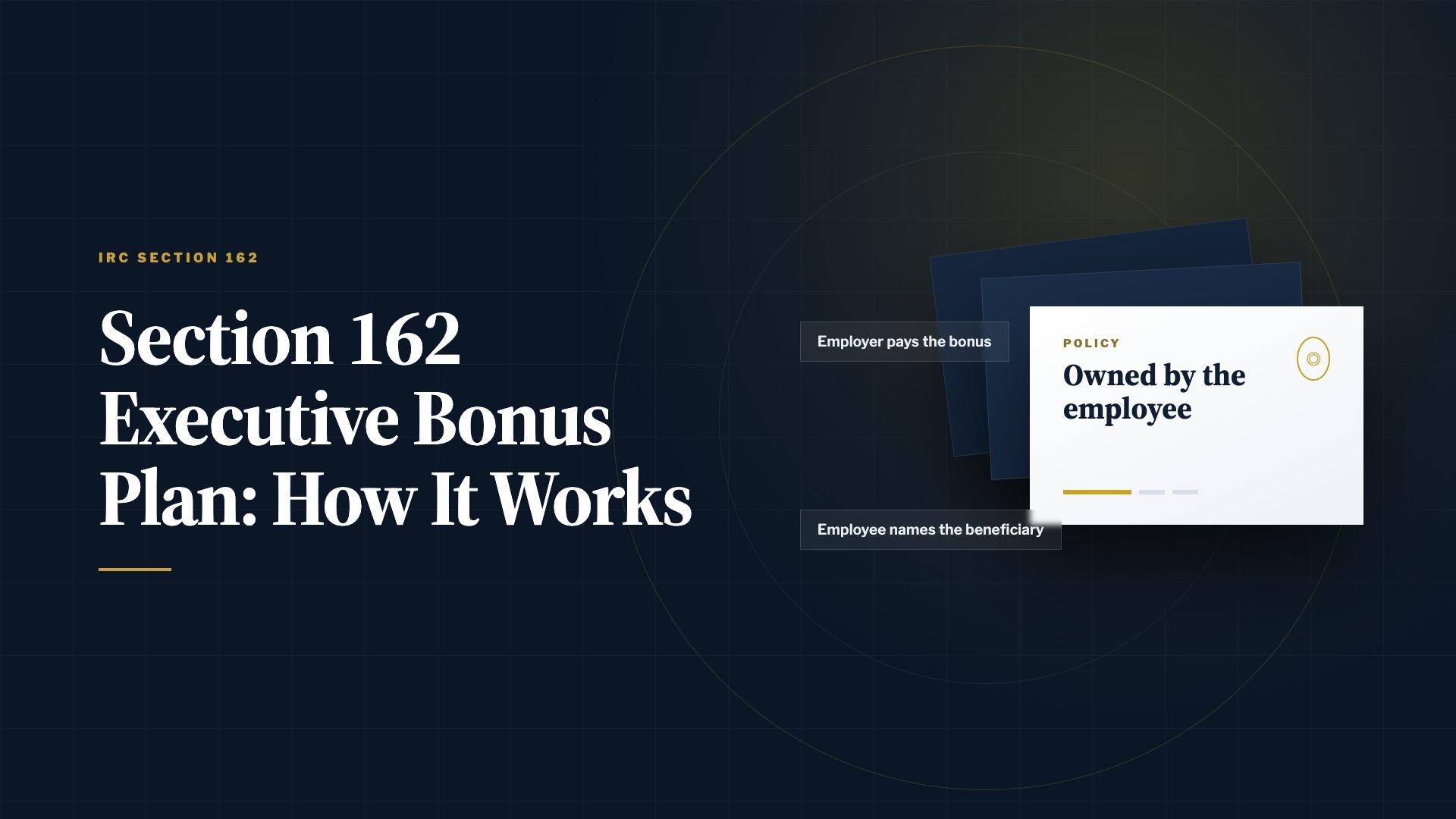
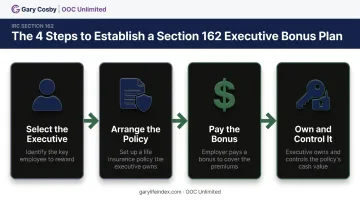
A Section 162 plan works simply: the employer pays a bonus to a key executive equal to the premium on a life insurance policy. The executive owns the policy outright and names the beneficiaries.
- Select the executive: the business chooses who participates, with no requirement to offer it company-wide
- Arrange the policy: typically a permanent policy like indexed universal life (IUL) or whole life
- Pay the bonus: the employer bonuses an amount equal to the premium, paid directly or through the executive
- Own and control it: the executive retains cash value access and names the beneficiaries
Some businesses add a "double bonus," a second, smaller bonus meant to offset the income tax the executive owes on the first one.
Why Employers Use It
- Bonus payments are typically tax-deductible as a compensation expense
- Plans can target one or two key people without triggering ERISA nondiscrimination testing or contribution limits
- No long-term liability once the premium bonus is paid, with no pension obligation lingering on the books
Why Executives Value It
- Tax-deferred growth on the policy's cash value
- A death benefit that's generally tax-free to beneficiaries
- Potential access to supplemental retirement income through policy loans or withdrawals down the road
For closely held and family-owned businesses, this structure answers a specific need: rewarding the leader driving the business without a formal deferred comp arrangement or added plan administration.
A restricted version, known as a REBA, adds vesting conditions so the executive gains full access only after certain tenure milestones. It functions much like restricted stock, but for a private company.
If you're a business owner weighing whether this fits your retention strategy, carrier selection matters. OOC Unlimited, operating under Global Financial Impact, represents 25+ A+ rated carriers, giving business owners access to competitive IUL and whole life options rather than a single provider's product line.
Plan design depends heavily on the executive's age, health, and the company's tax structure. Booking a direct consultation is the most reliable way to see what a Section 162 plan would look like for your business.
Frequently Asked Questions
What are executive bonuses?
Executive bonuses are performance- or role-linked pay layered on top of base salary for senior leaders. They're variable, not guaranteed, and can be paid in cash, equity, or both.
What is the average executive bonus?
There's no single average — bonus size varies widely by role, industry, and whether the company is public or private. Benchmarking against your specific peer group matters far more than a headline figure.
What is a typical executive signing bonus?
Signing bonuses are structured as either a lump sum (sometimes with clawback conditions) or a vesting schedule tied to tenure. Size depends on forfeited prior compensation, role scarcity, and negotiating leverage.
What is a reasonable severance package for an executive?
Most companies use a fixed multiple of pay: commonly 2x annual pay for CEOs and 1x for other senior executives, plus continued benefits. Change-in-control severance often runs higher and faces added tax scrutiny.
Are executive bonuses taxed differently than regular salary?
Most cash bonuses are taxed as ordinary income, same as salary. With Section 162 plans, the bonus itself is taxable, but the policy's cash value grows tax-deferred and the death benefit is typically tax-free.
Can small or privately held businesses offer executive bonus plans too?
Yes. Private companies commonly use simplified structures like Section 162 plans, which avoid the ERISA complexity and disclosure requirements public companies face while still rewarding key leaders effectively.