2026 makes this trickier than it used to be. Business valuations have climbed, bank lending has tightened in fits and starts throughout the year, and a huge wave of baby boomer co-owners is approaching retirement age with no real exit plan. More than half of U.S. employer businesses are now owned by someone 55 or older, according to Gallup's analysis of Census and owner survey data. That's a lot of buyouts waiting to happen.
This guide walks through what a partner buyout actually is, how to structure one step by step, what belongs in the agreement, and how to pay for it — including insurance-funded strategies most guides skip entirely.
Key Takeaways
- Partner buyouts carry legal, financial, and lasting emotional weight beyond simple paperwork
- Buy-sell agreements drafted early save valuable time and protect long-term relationships
- Financing ranges from personal savings to bank loans to insurance-funded death/disability triggers
- Loop in an attorney, CPA, and licensed insurance advisor before signing any agreement
What Is a Business Partner Buyout?
A partner buyout happens when one owner (or the business itself) purchases another partner's ownership stake. That's different from selling the entire company or dissolving it. The business keeps running. Only the ownership table changes.
That process usually isn't improvised. Most well-run partnerships have a buy-sell agreement sitting in a drawer somewhere, waiting to be used. Think of it as the prenuptial agreement of business ownership.
It sets the price formula, the process, and who's allowed to buy in advance, before emotions or bad timing can hijack the negotiation. Cornell Law School's Legal Information Institute describes buy-sell provisions as restrictions requiring an owner's interest to be resold to the company or remaining partners rather than to outsiders.
Voluntary vs. Involuntary Buyouts
Not all buyouts start the same way, and the distinction matters for financing and legal strategy:
| Buyout Type | Common Triggers |
|---|---|
| Voluntary | Retirement, pursuing a new opportunity, or disagreement over the company's direction |
| Involuntary | Death, disability, divorce, or bankruptcy forcing a change in ownership |
Involuntary triggers are the ones that catch partnerships flat-footed, mostly because nobody wants to plan for them in advance.
Common Triggers for a Partner Buyout in 2026
Buyouts don't happen randomly. A handful of situations account for most of them:
- Retirement or succession: an aging owner steps back, often without a documented plan
- Misaligned vision: partners disagree on growth strategy, spending, or the company's future
- Liquidity needs: a partner needs cash and the business is their largest asset
- Involuntary events: death, disability, or divorce force an immediate ownership decision
The retirement wave is the one to watch closely in 2026. Gallup's research found that 17% of owners age 55 and older expect to sell or transfer their business within five years, compared to just 10% of younger owners. Across all employer-business owners, that figure jumps to 22%. Yet 33% of business owners have no succession plan at all, or aren't sure if they have one — a gap Gallup documented in its 2024 owner survey.
That gap becomes dangerous the moment an involuntary trigger hits. Without a funded plan for death or disability, remaining partners are often forced into a fire sale, a dissolution, or a scramble to borrow money they didn't budget for. This scramble typically happens while they're grieving or managing a crisis.
A funded buy-sell agreement, backed by life insurance on each partner, removes that scramble entirely. It converts an involuntary trigger into a pre-negotiated, orderly transition.
How to Structure a Partner Buyout: A Step-by-Step Process
A buyout doesn't have to be adversarial. It usually turns messy when partners skip steps or bring in lawyers too early, before anyone's agreed on the basics.
- Start the conversation early. Document what each partner actually wants (an exit, a bigger role, a different split) before involving attorneys. Keep the tone collaborative, not combative.
- Review any existing buy-sell agreement. Check the valuation formula, payment terms, and triggering events you may have already agreed to years ago.
- Get an independent business valuation. Use an agreed method, such as market value, book value, or discounted future earnings, so the price is defensible, not just a guess.
- Negotiate price and terms with separate legal counsel for each side. Decide between a lump sum and installment payments, and address non-compete or transition clauses.
- Finalize financing and complete the transfer. Sign the agreement, handle required state filings, and update partnership records.
- Communicate the change. Notify employees, clients, banks, and vendors, and update contracts, insurance policies, and beneficiary designations.
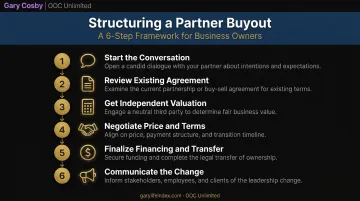
Lender due diligence can slow down step five considerably, so it's worth exploring financing options early. Common approaches include:
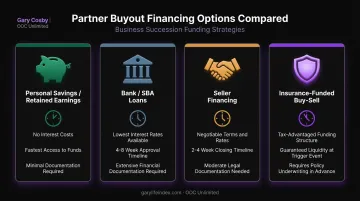
- Bank loans or SBA financing, though these require extensive documentation and can take months to close
- Seller financing, where the outgoing partner accepts installment payments directly
- Insurance-funded buy-sell agreements, drawing on cash value loans or death benefit proceeds already earmarked for this purpose
What to Include in a Buyout Agreement
A vague buyout agreement causes more fights than no agreement at all. The strongest ones spell out every variable before a dispute forces an interpretation.
Core financial terms:
- Purchase price and valuation method: formula-based, independent appraisal, or a fixed value updated periodically
- Payment structure: lump sum, installments, earnout, or seller financing
- Timeline for completing payments, including consequences for missed or late installments
Ownership and control terms:
- Triggering events covered: retirement, death, disability, divorce, bankruptcy, or voluntary exit
- The party holding the right to buy: the partnership, remaining partners, or outside buyers
- Right of first refusal clauses, non-compete and non-solicitation terms, and confidentiality provisions
- Release of claims language that protects both parties once the transaction closes
The detail most partnerships miss:
Very few agreements specify how the buyout will actually be funded if a partner dies or becomes disabled tomorrow. A price formula means nothing if there's no cash to pay it. This is where a life insurance or disability policy tied directly to the agreement earns its place. It turns a paper promise into an immediate, funded obligation.
Financing Options for Your 2026 Buyout
Getting the price right is only half the job. Paying for it is where most buyouts stall.
Personal and Business-Funded Options
- Personal financing: savings, family loans, or liquidating personal assets works for smaller buyouts but stretches an owner's finances thin
- Retained earnings: using cash the business has already built up, if there's enough
- Bank or SBA-backed loans: a common route, though the Fed's Senior Loan Officer Opinion Survey showed tightening credit conditions in early 2026 before leveling off by summer
- New equity partners: bringing in fresh investors to replace the departing owner's stake
Seller and Deferred Financing
Structured seller notes, installment payments, or mezzanine financing spread the cost over time, easing the strain on cash flow. The departing partner essentially becomes a lender to their former business, collecting payments with interest over a set period rather than walking away with a lump sum.
Insurance-Funded Buyouts
This is the option most guides mention in passing and few explain well.
A properly structured, life-insurance-funded buy-sell agreement provides instant liquidity the moment a partner dies or becomes disabled. There's no loan application, no bank underwriting timeline, and no forced sale of the business to raise cash.
The policy simply pays out, and the funds go toward buying the departed partner's share.
The stakes of getting this wrong are real. In Connelly v. United States, a company held $3.5 million in life insurance on each of two brothers who co-owned it.
When one brother died, the business used $3 million of the payout to redeem his shares. The Supreme Court ruled that the redemption obligation didn't reduce the company's value for federal estate-tax purposes, so the family ended up owing far more in estate tax than anyone expected.
Structure matters as much as having a policy at all.
This is where a licensed insurance advisor earns their seat at the table. Gary Cosby Jr. of OOC Unlimited (Global Financial Impact) works with business owners to explore key person and disability funding options for exactly these scenarios.
Gary's role stays focused on the insurance piece: he doesn't draft the legal agreement or determine the company's valuation. Those pieces still belong to the business owner's attorney and CPA, while Gary makes sure the funding mechanism behind the agreement actually works when it's needed.
Tax treatment varies widely by financing method: capital gain versus ordinary income, deductibility of goodwill payments, and how a policy is owned all change the outcome. A tax advisor should review any structure before signatures go on paper.
Frequently Asked Questions
How to structure a partner buyout?
Agree on the trigger and valuation method, negotiate payment terms, document everything in a written buyout agreement, and secure financing before closing. Skipping any step usually causes delays or disputes later.
What should be included in a buyout agreement?
At minimum: the valuation method, payment structure, triggering events, right-of-first-refusal terms, and non-compete clauses. Include funding mechanisms for death or disability as well.
What is a buyout agreement in a partnership?
It's a binding contract, often called a buy-sell agreement, that predetermines how, when, and for how much a partner can sell their interest before a trigger event ever happens.
How is a partner's share valued in a buyout?
Three approaches are most common: an independent professional appraisal, book or equity value from the balance sheet, or a formula tied to revenue or earnings multiples agreed on in advance.
How long does a business partner buyout typically take?
It varies widely. A buyout with an existing agreement and financing already lined up can close in weeks; one starting from scratch, especially with lender due diligence, can take several months.
Can life insurance be used to fund a partner buyout?
Yes. OOC Unlimited's agents structure life-insurance-funded buy-sell agreements that provide immediate cash to buy out a deceased or disabled partner's share, so the business doesn't have to borrow or sell assets under pressure.