Introduction
Picture this: a fund manager who built her firm's reputation over a decade suddenly steps away for a serious health issue. No warning, no transition plan. Investors start asking questions. Deals stall. Valuation takes a hit.
This scenario plays out more often than most business owners want to admit. A 2022 Principal survey found that 40% of small and midsized businesses now report four or more key employees their operations depend on, up from 35% the year before. Yet many partnership agreements and investor contracts still have no formal plan for what happens if one of those people vanishes.
This article breaks down what a key man clause actually does, how it differs from key man insurance, and who should have both in place.
Key Takeaways
- A key man clause pauses major decisions if a named person becomes unavailable.
- Key man insurance is the financial mechanism that funds the plan the clause creates.
- Death, disability, resignation, and extended absence are the most common trigger events.
- Eligibility extends beyond the CEO, based on business impact rather than job title.
What Is a Key Man Clause?
A key man clause (sometimes called a key person clause) is a contractual provision that protects a business, partnership, or investment fund from the operational and financial fallout of losing an indispensable individual.
According to the Corporate Finance Institute's definition, the clause typically stops an investment firm or fund manager from making new investments once a named key person can no longer devote the required time to the business.
That "key person" isn't always the CEO. It could be:
- A sales director who personally holds the client relationships
- A fund manager whose track record attracted the investors
- A product lead who architected the core technology
- A specialized technical employee no one else can replace quickly
A typical clause names the individual directly and spells out what happens if they die, resign, get terminated, or become unavailable for a defined period. The usual mechanism: new decisions, capital calls, or investments freeze until remaining leadership approves a qualified replacement.
Well-drafted language reads something like: "Should [Named Person] cease to devote substantially all business time to the Fund, the General Partner shall suspend the investment period pending approval of a replacement by a majority of Limited Partners."
That pause is a signal, not bureaucratic red tape. Investors and partners see a firm that's planned for disruption, not one hoping it never happens.
Common Trigger Events
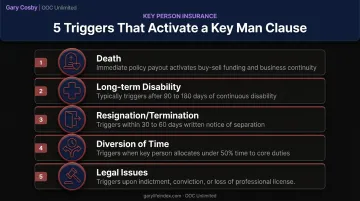
Most key man clauses activate on a short, predictable list of events:
- Death of the named individual
- Long-term disability or serious illness preventing normal duties
- Resignation or termination from the role
- Diversion of time to another venture or outside commitment
- Legal issues, such as criminal investigation or arrest, that impair the person's ability to serve
Each trigger typically has its own notice period and remedy, so the same clause might treat a resignation differently than a sudden medical emergency.
Key Man Clause vs. Key Man Insurance: How They Work Together
Here's where a lot of business owners get confused. The clause and the insurance policy solve two different problems.
The clause is the legal and strategic plan. It says what happens, who approves a replacement, and when decisions freeze. But a clause alone provides zero capital.
If you need to buy out a departing partner's shares, hire a replacement executive, or cover months of lost revenue, someone has to write a check. That's where key man insurance comes in: the funding mechanism that makes the plan in your clause actually executable.
Under a standard structure, the business owns the policy, pays the premiums, and is named the beneficiary. When the named key person dies (or becomes disabled, if the policy includes that rider), the payout goes directly to the company.
How Coverage Amounts Get Calculated
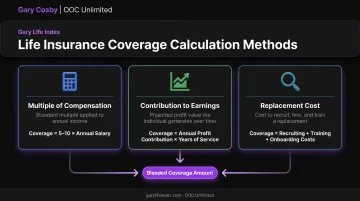
Carriers use three approaches to size a policy, according to Protective Life's guidance on key person coverage:
| Method | How It Works |
|---|---|
| Multiple of compensation | Coverage set at roughly 5 to 10 times the person's annual salary |
| Contribution to earnings | Estimate their annual profit contribution, project it over remaining working years, then discount to present value |
| Replacement cost | Calculate the cost and time needed to recruit, hire, and train a replacement to comparable experience |
A quick example: a fund manager earning $400,000 annually might justify a policy in the $2 million to $4 million range using the multiple-of-compensation method alone. The right number depends on your business's specific risk exposure, not a one-size-fits-all formula.
This is exactly the kind of scenario Gary Cosby, a licensed life insurance agent with OOC Unlimited, works through with business owners.
Gary helps evaluate insurance-funding options for key person coverage, including disability and business overhead expense needs. He also coordinates with the owner's CPA and attorney whenever tax treatment, buy-sell agreements, or ownership structuring require their input.
Pairing a solid clause with adequately funded insurance turns a paper plan into a real continuity strategy, one that reassures investors, partners, and lenders that the business can survive a worst-case scenario.
Key Man Clause in the Music Industry
Artist-management and record label agreements use key man clauses for a very specific reason: artists build relationships with people, not companies.
If an artist signs with a management firm because of one particular manager, that relationship is the entire value of the deal. A key man clause lets the artist walk away, or renegotiate, if that specific manager or A&R representative leaves or becomes unavailable for a defined stretch of time.
One documented example: a 2009 agreement between artist entities and a management company named a specific manager and set two termination triggers:
- Standard trigger: no day-to-day management from him for more than 60 days
- Illness exception: the window extends to 90 days if the absence is due to illness
That's one negotiated contract, not an industry-wide standard, but it shows how these windows typically get structured.
Without this protection, an artist can be reassigned to a disengaged rep the moment their preferred manager exits. Momentum stalls. Disputes follow. Anyone negotiating these terms should work with an entertainment lawyer familiar with the specific label or management company's track record on key person handoffs.
Who Is Eligible for Key Man Insurance?
Eligibility depends on insurable interest, not job title. The business must demonstrate that losing this person would cause measurable financial harm.
Roles that commonly qualify include:
- Fund managers whose track record drives investor confidence
- Top sales performers who personally hold major client accounts
- Specialized founders with proprietary technical knowledge
- Physician-owners in small medical practices
- Technical leads or engineers who are difficult to replace quickly
Underwriting Basics
Getting coverage in place typically involves:
- Establishing insurable interest — the business must show a real financial stake in the person's continued involvement
- Obtaining written consent from the proposed insured before any policy is issued
- Completing medical underwriting, which can include a health history review and exam depending on coverage amount
- Providing financial documentation connecting the requested coverage to compensation, earnings contribution, or replacement cost
Eligibility spans startups with a single technical founder all the way to established firms with dozens of key employees. If you're unsure whether a role qualifies, a licensed OOC Unlimited agent can walk through your specific situation and provide a quote based on your business's actual numbers.
How to Implement a Key Man Clause for Your Business
Getting this right isn't complicated, but it does require sequencing the steps correctly.
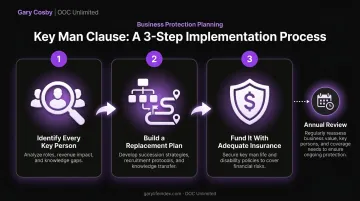
- Identify every key person. Look past the org chart. Anyone whose absence would materially disrupt revenue, operations, or investor confidence belongs on this list. Insert clause language into their contracts or partnership agreements.
- Build a replacement plan. Cover interim leadership coverage, a recruitment strategy for a permanent replacement, and an onboarding process so a successor isn't starting from zero.
- Fund it with adequate insurance. A clause without funding is just a promise. Pair it with a key man policy sized using one of the calculation methods above, so the replacement plan can actually be executed when it matters.
Review this plan annually to confirm coverage amounts still match compensation and business growth, keeping the whole structure from going stale.
Frequently Asked Questions
What is the key man clause?
It's a contractual provision that protects a business from the operational and financial risk of losing an indispensable person. It typically pauses new investments or major decisions until a qualified replacement is approved.
What is the key man clause in the music business?
It lets an artist exit a management or label agreement if a specific manager or A&R representative leaves or becomes unavailable for a defined period. It protects the artist's relationship, not just the contract.
Who is eligible for key man insurance?
Anyone with demonstrable insurable interest whose role materially impacts company revenue — not just C-suite executives. Sales leaders, technical founders, and specialized staff can all qualify.
What events typically trigger a key man clause?
Death, long-term disability, resignation or termination, and extended unavailability are the most common triggers. Some clauses also include diversion of time to another venture.
How is key man insurance coverage calculated?
Three common methods: a multiple of compensation (roughly 5 to 10 times salary), contribution-to-earnings projections, or replacement cost based on recruiting and training a successor.
Is a key man clause legally required for businesses?
No law mandates a key man clause. It's standard practice in investor-backed firms and partnerships, and often one of the most heavily negotiated terms in fund agreements.