But here's the catch: the type of assignment you sign determines whether your family keeps their protection or loses it permanently.
Sign the wrong form, and you could strip your beneficiaries of a death benefit they were counting on, or fail to satisfy a lender who needed something far more limited. This guide breaks down absolute vs. collateral assignment, when each applies, and what happens to your beneficiaries in each scenario.
Key Takeaways
- Absolute assignment permanently transfers full policy ownership to another party
- Collateral assignment temporarily secures a loan while you keep ownership
- Beneficiaries stay protected under collateral assignment but lose all rights under absolute assignment
- Match the type to your intent: permanent transfer versus loan security
- A licensed life insurance professional confirms the paperwork matches your goal
Absolute vs Collateral Assignment: Quick Comparison
| Factor | Absolute Assignment | Collateral Assignment |
|---|---|---|
| Ownership Transfer | Full, permanent transfer to assignee | None — policyholder keeps ownership |
| Reversibility | Irrevocable | Ends when the loan is repaid |
| Beneficiary Impact | Original beneficiaries lose rights; new owner names beneficiaries | Beneficiaries stay in place; they receive any amount above the loan |
| Who Pays Premiums | New owner/assignee | Policyholder (or lender in some programs) |
| Common Use Case | Life settlements, gifting, estate/trust transfers, buyouts | Business, SBA, real estate, and personal loans |
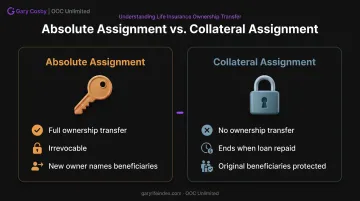
One path hands over the keys entirely. The other only lets someone borrow the car until the debt is paid.
What Is Absolute Assignment?
Absolute assignment is a complete, irrevocable transfer of ownership. New York Life defines it as the transfer of "all incidents of ownership" in a policy : the new owner gains the right to change beneficiaries, access cash value, take policy loans, and even reassign the policy again.
Once processed, the Office of Personnel Management warns that an assignment is irrevocable and cautions against using an assignment form when you only mean to designate a beneficiary. Those are two different actions with very different consequences.
Why people use it:
- Gifting a policy to a charity or family trust
- Estate planning transfers into an Irrevocable Life Insurance Trust (ILIT)
- Business buy-sell agreements
- Divorce settlements
- Life settlements (selling the policy outright)
The process requires an insurer-approved form, and the assignee typically has to sign as well. Once the carrier processes it, the assignor's rights are gone. There is no partial version: you either own the policy, or you don't.
The real risk: you give up all future claims to the policy. Use absolute assignment only when you're certain the policy is no longer needed for your own family's protection.
Use Cases of Absolute Assignment
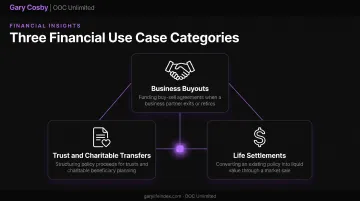
Absolute assignment shows up most often in these scenarios:
- Business buyouts: A surviving partner takes full ownership of a policy on a deceased partner and uses the death benefit to fund a buy-sell purchase from the estate
- Trust and charitable transfers: An owner assigns a policy into an ILIT for estate tax planning, or donates it to a nonprofit (some charities require their own notarized assignment form)
- Life settlements: The policyholder sells the policy to a third party for a lump sum
One nuance on life settlements: there is no single benchmark for how payouts compare to cash surrender value or the full death benefit. Figures vary by policy type, the insured's health, and the buyer.
Treat blanket percentage claims with skepticism and get a specific quote before assuming what your policy is worth.
What Is Collateral Assignment?
Collateral assignment is a narrower arrangement. It secures a loan without transferring ownership at all. Pacific Life's official assignment form states plainly that rights not specifically granted to the assignee remain reserved to the policyholder — and the beneficiary designation stays untouched unless the policyholder changes it.
Here's how the mechanics work:
- The lender is named as a conditional beneficiary, but only up to the outstanding loan balance
- If the insured dies while the loan is active, the lender collects what's owed — nothing more
- Any remaining death benefit goes straight to the policyholder's original beneficiaries
- Once the loan is repaid, the lender files a release, and full rights automatically revert
This is different from naming a lender as your primary beneficiary. That would give the lender a claim on the entire death benefit, regardless of how much is actually owed. Collateral assignment caps the lender's take at the debt amount — full stop.
Security Mutual describes it this way: the assignee's right is limited to collecting the amount of indebtedness from policy proceeds, with only the balance passing to beneficiaries.
Use Cases of Collateral Assignment
Because the policyholder keeps ownership and residual benefits, collateral assignment is the structure most lenders request when they need the debt repaid if the borrower dies before the loan matures.
Common scenarios:
- Business loans, including SBA-backed financing, where lenders want security without requiring full ownership of the borrower's policy
- Real estate financing, particularly for owner-financed or commercial deals
- Private and family loans, where the lender wants formal protection without disrupting the borrower's estate plan
Example calculation:
Say a business owner has a $500,000 policy and takes out a $200,000 loan secured by collateral assignment. Several years later, the owner dies with $150,000 still outstanding — and only that balance is in play:
- The lender collects $150,000 (the remaining balance)
- Beneficiaries receive the remaining $350,000

Absolute vs Collateral Assignment: Which One Applies to You?
Ask yourself one question first: are you securing a loan, or permanently transferring the policy?
That single distinction determines everything else.
- Choose collateral assignment if you want your family's protection to stay intact while satisfying a lender's requirement
- Choose absolute assignment if you no longer need the policy yourself and you're completing a genuine ownership transfer — an estate plan, a business buyout, a charitable gift
Here's the warning that matters most: never sign an absolute assignment when a lender only requires collateral assignment. This mistake happens more often than you'd think, usually because the paperwork looks similar at first glance.
Signing away full ownership when a lender only needed a security interest permanently forfeits your family's protection for nothing in return.
Before you sign anything irrevocable, confirm the assignment type matches your intent. At GFI, agents work with 25+ A-rated carriers and coordinate with your CPA or attorney when insurance funding and legal or tax structuring need to move together—especially in business buy-sell and succession planning.
An agent can't replace your attorney. A short conversation can still keep you from giving up ownership you never meant to transfer.
Frequently Asked Questions
What is the difference between absolute and collateral assignment in life insurance?
Absolute assignment permanently transfers full ownership to a new party. Collateral assignment temporarily secures a loan, with ownership and beneficiaries remaining unchanged until the debt is repaid.
What is an absolute assignment in life insurance?
An absolute assignment is an irrevocable transfer of all rights, benefits, and control over a policy to a new owner—including beneficiary changes, cash value access, and death benefit rights.
What is a collateral assignment in life insurance?
A collateral assignment is a limited, temporary transfer of policy rights used to secure a loan. The lender is paid first from the death benefit, but only up to the amount still owed.
What are the two types of assignment in life insurance?
The two types are absolute assignment (full and permanent) and collateral assignment (partial and temporary, tied to a specific debt).
What is an example of a collateral assignment in life insurance?
A business owner assigns a $500,000 policy to a bank securing a $200,000 SBA loan. If the owner dies with $150,000 still owed, the bank collects $150,000 and beneficiaries receive the remaining $350,000.