
That's different from term life insurance, which only pays out when you die. An IUL policy builds cash value over time, and you have several ways to reach that money while you're alive.
But here's the catch: not every withdrawal works out the same way. Your outcome depends on your cost basis, how long you've had the policy, how the index has performed, and how much you actually pull out. Get the timing or amount wrong, and you could face an unexpected tax bill or even put your coverage at risk.
This article breaks down how withdrawals actually work, when they make sense, the rules you need to know, and the mistakes that trip up policyholders most often.
TL;DR
- Withdrawals up to your cost basis (total premiums paid minus prior withdrawals) are generally tax-free
- Permanent cuts hit both cash value and death benefit; mismanagement can lapse the policy
- Policy loans avoid immediate taxation but accrue interest over time
- Timing, amount, and policy structure decide the long-term cost of taking cash out
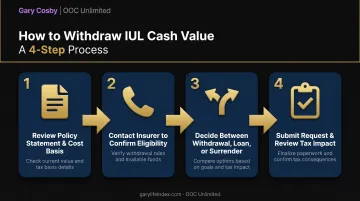
How to Withdraw Cash Value From Your IUL
Withdrawing cash value isn't a one-click process. It requires some homework first.
Step 1: Review Your Policy Statement and Cost Basis
Pull your most recent policy statement. You're looking for three numbers: current cash value, surrender value, and total premiums paid to date.
From there, calculate your cost basis: premiums paid minus any prior withdrawals already taken. This number matters because under IRC Section 72, withdrawals up to your investment in the contract are generally excluded from taxable income for non-MEC policies. Anything above that threshold is taxed as ordinary income.
Step 2: Contact Your Insurer or Agent to Confirm Eligibility
Every carrier sets its own rules. For example, Prudential's PruLife Index Advantage UL requires a $250 minimum withdrawal and charges a $25 withdrawal fee, with possible partial-surrender charges on top.
Allianz's Accumulator IUL may apply a $50 charge and enforces a surrender-charge period during the first 12 policy years.
Before requesting anything, confirm:
- Minimum cash value that must remain in the policy
- Whether you're still inside a surrender-charge period
- Processing timelines specific to your carrier
Step 3: Decide Between Partial Withdrawal, Loan, or Surrender
Each option affects your policy differently:
- Partial withdrawal: Permanently reduces cash value and death benefit
- Policy loan: Can be repaid so your cash-value path stays intact, though interest accrues
- Full surrender: Ends the policy, pays net cash surrender value, and removes the death benefit
Weigh which fits your actual need before submitting anything.
Step 4: Submit the Withdrawal Request and Review Tax Impact
Complete the insurer's withdrawal form with the exact dollar amount you need. Then ask for documentation showing exactly how the withdrawal affects your remaining cash value and death benefit going forward. Don't skip this step. Once the funds move, reversing course is rarely simple.
When Should You Withdraw From an IUL?
Withdrawals aren't always the most efficient way to access IUL cash value. When you take money out matters as much as how much you take.
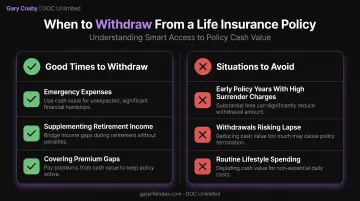
Good use cases:
- Covering a genuine emergency expense
- Supplementing retirement income after the policy has built substantial cash value
- Paying premiums during a tight cash-flow stretch
Situations to avoid:
- Early policy years, when surrender charges are highest (often the first 12-15 years, per carrier examples above)
- Any withdrawal that would push your policy toward lapse
- Routine or lifestyle spending while other liquid savings are still available
Before you request a withdrawal, ask yourself: how much cash value cushion is left after this? A policy stays in force only as long as the cash value covers ongoing insurance costs. Pull out too much, too early, and you risk starving that cushion.
What You Need Before Withdrawing Cash Value
Preparation prevents the three things that catch policyholders off guard: unexpected taxes, fees, and lapse risk.
Documentation and Eligibility
Before submitting anything, gather:
- Your most recent policy statement
- A calculated cost basis
- Confirmation that your cash value sits comfortably above the carrier's required minimum
Working With a Licensed Professional
A second set of eyes matters here. A licensed life insurance agent, such as those at GFI × Team OOC, can review your policy illustration and walk through the tax and coverage impact before you submit a request.
GFI represents 25+ A-rated carriers, including Prudential, Allianz, and Lincoln Financial. An agent who knows your carrier's rules can flag issues a generic online form won't catch.
Key Factors That Affect Your Withdrawal Outcome
A withdrawal's real-world impact depends on several moving parts, not just the amount you request.
Cost Basis vs. Withdrawal Amount
Withdrawals up to your cost basis are generally tax-free. Cross that line, and the excess is taxed as ordinary income. Confirm your cost basis with your carrier before you withdraw a dollar.
Policy Age and Surrender Charges
Older policies typically carry lower or no surrender charges, which makes withdrawals cheaper the longer you've held the contract. Newer policies, still inside their surrender-charge window (12–15 years in the carrier examples we reviewed), face steeper costs for tapping cash value early.
Impact on Death Benefit
Most withdrawals reduce the death benefit. Prudential and Allianz both state that partial withdrawals reduce policy values, including the death benefit your beneficiaries receive.
Neither carrier publishes a universal formula for how much the benefit drops. Ask your carrier for a specific projection before withdrawing.
Modified Endowment Contract (MEC) Status
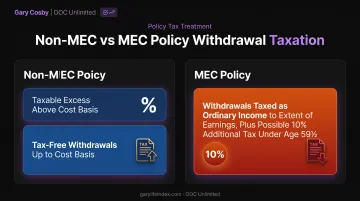
If your policy was overfunded and fails the 7-pay test under IRC Section 7702A, it's classified as a MEC. Withdrawal taxation then works differently:
| Policy Type | Withdrawal Tax Treatment |
|---|---|
| Non-MEC | Tax-free up to cost basis; taxable above it |
| MEC | Taxed as ordinary income to the extent of earnings, plus a possible 10% additional tax if you're under 59½ |
Know your MEC status before assuming any non-MEC withdrawal rule applies to you.
Common Mistakes When Withdrawing From an IUL
These three mistakes show up again and again:
- Withdrawing more than the cost basis without planning for the tax bill. Anything above your basis is taxable income, and that surprise hits hardest at tax time.
- Ignoring the cushion needed for cost-of-insurance charges. Coverage stays active only while cash value can cover those ongoing costs. Drain the cushion, and lapse risk climbs fast.
- Overlooking coverage guarantees. Some no-lapse guarantees stay in force only if you pay required premiums and keep loans and withdrawals clear. Pull cash value, and you may void that guarantee and need extra premiums to keep coverage active.
Withdrawals vs. Loans vs. Surrender: Choosing the Right Option
Each method trades off differently on taxes, repayment flexibility, and long-term policy health.
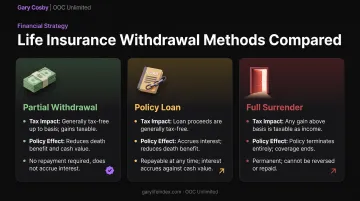
Partial Withdrawal
Best for smaller, one-time needs that stay within your cost basis. The reduction is permanent: both cash value and death benefit drop, and that cut does not reverse the way a repaid loan does.
Policy Loans
Best when you plan to repay and want to avoid immediately reducing cash value. Loans are generally not taxable when taken, but interest accrues the entire time the loan is outstanding. If the policy lapses or gets canceled with a loan still open, that loan balance can become taxable to the extent of gain.
Full Surrender
Best when you no longer need the coverage and want maximum liquidity in one shot. You lose protection entirely, and surrender proceeds above your cost basis are taxable as income. Early surrender charges can also eat into what you actually receive.
| Method | Tax Impact | Effect on Policy |
|---|---|---|
| Partial withdrawal | Tax-free up to cost basis | Permanently reduces cash value & death benefit |
| Policy loan | Generally not taxable when taken; may be taxable on lapse | Creates debt; accrues interest; repayable |
| Full surrender | Proceeds above cost basis are taxable | Cancels the policy entirely |
Frequently Asked Questions
Can I withdraw cash value from an IUL?
Yes, as long as your policy has sufficient cash value above the carrier's required minimum. Withdrawals up to your cost basis are generally tax-free.
How does cash value work with an IUL?
A portion of each premium funds a cash value account that credits interest based on a market index, subject to caps, floors, and participation rates set by the carrier.
Is withdrawing from an IUL taxable?
Withdrawals are tax-free up to your cost basis. Any amount above that is taxed as ordinary income, so knowing your basis before withdrawing matters.
How much can I withdraw from my IUL without penalty?
Surrender charges may apply in early policy years, so check your schedule first. Amounts up to your cost basis are typically income-tax-free; gains above basis are taxed as ordinary income.
What happens to my death benefit if I withdraw cash value?
Most withdrawals reduce the death benefit by roughly the amount withdrawn, unless a specific rider states otherwise. Ask your carrier for a precise projection before withdrawing.
Is it better to take a loan or a withdrawal from my IUL?
Loans avoid immediate taxation and preserve your original cash value if repaid, but they accrue interest. Withdrawals permanently reduce value but skip the interest charges entirely.