
Many owners treat liquidity planning like an item on an estate planning checklist, something to mention to an attorney once and forget. But its real value only shows up the moment a shareholder needs cash, a founder wants to retire, or an heir inherits shares in a business they don't run.
This article looks at why liquidity planning matters in practice, not just in theory, when succession actually happens.
TL;DR
- Liquidity planning ensures cash is available for buyouts, taxes, and inactive shareholders without a rushed sale
- Each new generation makes planning harder as ownership splits among more relatives
- A solid plan preserves control, reduces disputes, protects valuation, and funds buyouts
- Skipping the plan invites forced sales, family conflict, and eroded business value
- Life insurance and buy-sell funding often form the backbone of a workable plan
What Is Liquidity Planning in Family Business Succession
Liquidity planning means figuring out, well before you need it, how you will generate cash to fund a buyout, cover taxes, or pay a departing shareholder. It's typically built around:
- Shareholder and buy-sell agreements that set price, terms, and funding triggers
- Estate transitions between generations, including taxes due when ownership transfers at death
- Retirement exits for founders or senior owners who need to extract equity without straining operations
Done well, it keeps the business intact and the family functional while ownership changes hands.
Key Advantages of Liquidity Planning for Family Business Succession
These advantages show up in metrics families and advisors already track: cash availability, valuation stability, dispute frequency, and whether operations stay steady through a transition.
Advantage 1: Prevents Forced Sales and Fire-Sale Valuations
Without pre-funded liquidity, a death, retirement, or shareholder exit can force a sale under deadline pressure. Estate tax deadlines don't wait for the right buyer to show up.
A funded buy-sell agreement, often backed by life insurance, lets the company buy out an owner on its own schedule instead of the market's.
Why this matters:
- Rushed transactions typically sell at a discount compared to planned, market-tested sales
- The IRS defines fair market value under Rev. Rul. 59-60 as a price between a willing buyer and willing seller, neither under compulsion—so a rushed sale falls short of a fair-value standard
- Pre-funded liquidity keeps negotiating leverage on the family's side, not the buyer's
KPIs impacted:
- Valuation multiple achieved
- Deal timeline
- Debt load taken on to fund the buyout
This matters most when a single owner holds concentrated equity and there's no dedicated funding source lined up for a buyout.

Advantage 2: Reduces Family Conflict Between Active and Inactive Owners
As ownership spreads across generations, active operators and passive heirs often clash over dividends versus reinvestment. One side wants cash. The other wants to grow the business.
Pre-agreed liquidity limits, redemption terms, and valuation methods turn that disagreement into a defined process instead of an emotional standoff.
Why this matters:
- Clear liquidity rules separate a personal cash need from a governance failure
- Research from the University of Connecticut Family Business Program found that 47.7% of family-business collapses were precipitated by the founder's death, and only 16.4% followed an orderly transition, according to Cornell's family business facts compilation
- Defined processes build trust across generations instead of eroding it
KPIs impacted:
- Dispute frequency
- Shareholder retention
- Time-to-resolution on buyout requests
This matters most in third-generation-plus businesses, where ownership has fragmented across relatives with different roles and priorities.
Advantage 3: Protects Business Continuity and Value During Ownership Transfer
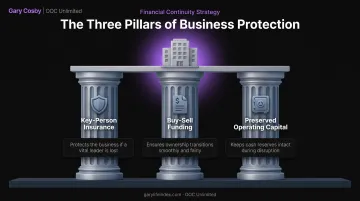
Liquidity planning keeps operating capital and credit lines intact during a transition, instead of draining them to fund a buyout. Tools like key-person insurance and buy-sell funding create liquidity outside the business's operating cash flow.
Why this matters:
- PwC's continuity and succession planning research found that only 34% of US family businesses have a succession plan that's robust, documented, and communicated
- A life insurance policy funding a shareholder buyout delivers cash exactly when a death or disability triggers the need, without touching the company's working capital
- Key-person insurance can specifically help replace lost revenue and fund the recruitment of a successor after losing a founder or essential executive
KPIs impacted:
- Cash flow stability
- Credit terms and borrowing capacity
- Employee and customer retention through the transition
This matters most for asset-heavy or thin-margin businesses that can't absorb a large, one-time cash outflow without disrupting operations.
What Happens When Liquidity Planning Is Missing or Ignored
Skip liquidity planning and the family still faces the fallout—usually at the worst possible time:
- Forced sales at unfavorable valuations under estate tax or shareholder deadlines
- Family disputes over dividends, buyouts, and fairness among heirs
- Leadership gaps and stalled decisions after an unexpected death or incapacity
- Rising legal and financing costs from unstructured, reactive buyouts
- Successor, lender, or buyer hesitation due to perceived instability
These are the default outcomes when no funded plan is in place.
How to Get the Most Value from Liquidity Planning
Liquidity planning works best as an ongoing practice, not a one-time document. A few things separate plans that actually hold up:
- Build it into a funded buy-sell agreement that gets reviewed and revalued on a set schedule
- Coordinate across advisors — legal, tax, financial, and insurance — rather than handling each piece in isolation
- Match funding sources realistically to the amount and timing of cash actually needed, whether that's dividends, redemptions, insurance proceeds, or financing
On the insurance side, the roles split cleanly across three specialists:
- Attorneys draft the legally binding buy-sell agreement
- Valuation professionals determine what the business and ownership stake are worth
- Licensed insurance professionals fund that agreement alongside the family's CPA and attorney, so the insurance-funded portion supports the full succession strategy instead of standing alone

Conclusion
Liquidity planning gives families control and clarity during a transition that's already emotionally loaded. The earlier a family starts, the more those benefits compound: fewer disputes, stronger valuations, and smoother leadership transfers.
Treat it as an ongoing practice, revisited as ownership and circumstances change, not a document that gets signed once and filed away.
Frequently Asked Questions
How do you plan for succession in a family business?
Start early with governance structures, define successor criteria clearly, and coordinate liquidity, tax, and legal strategies well before a transition is forced. Waiting until a crisis hits leaves far fewer good options.
What is the success rate of family business succession?
Reliable generational success rates are hard to pin down. Research does consistently flag weak preparedness and governance as top threats to continuity, and businesses that plan early are far more likely to survive the handoff.
How do you value shares in a family business for a buyout?
Buy-sell agreements typically use one of four methods: a fixed price, independent appraisal, a formula like a multiple of earnings, or book value. Independent appraisal is usually more defensible for tax purposes than a fixed or arbitrary formula.
Can life insurance fund a family business buyout?
Yes. When paired with a buy-sell agreement, life insurance can fund a death-triggered buyout so the business or remaining owners have cash exactly when it's needed. A licensed insurance professional can help structure the funding alongside your legal and tax advisors.
Should inactive family members remain shareholders?
It depends on the family's goals. Keeping inactive members as shareholders preserves their participation in the wealth created, but it can create pressure if they need cash while active operators want to reinvest in the business.
How early should liquidity planning start before a leadership transition?
Several years of lead time is typical. That gives enough runway to structure funding, agree on valuation methods, and put governance in place before a transition is forced by circumstances rather than choice.