
Now what?
This scenario is more common than most business owners assume. The median U.S. worker now stays with an employer just 3.9 years, down from 4.6 years in 2014, according to the Bureau of Labor Statistics. In the private sector, that number drops to 3.5 years. If you bought key man coverage expecting a decade-long tenure, you may be facing this decision sooner than planned.
This guide walks through your options, the tax consequences tied to each, and how to plan ahead so the next departure doesn't leave you scrambling.
Key Takeaways
- The business owns the key man policy, so it controls what happens after the employee leaves.
- Four paths: let it lapse, surrender for cash value, transfer to the employee, or repurpose for a replacement.
- Tax treatment differs by path—confirm the impact with your CPA before you act.
- Buy-sell agreements and annual reviews keep this from becoming a recurring headache.
What Happens to the Policy When a Key Person Leaves
The employee's consent, given when the policy was issued, covered underwriting only. It didn't hand them any ownership rights. The business remains the policyholder and beneficiary the day after the employee walks out, exactly as it was the day before.
Here's the part that trips people up: key man insurance pays out on death (or disability, if a rider was added). It does not pay out because someone resigned, retired, or got poached by a competitor. Voluntary departure triggers zero claim. The policy just... sits there, collecting premiums, unless you act.
That's the problem. A business that doesn't make a decision within a reasonable window ends up paying for coverage on someone who no longer fills a key role.
Your next step depends on the type of exit:
- Retirement on good terms — often opens the door to offering the departing executive a portion of cash value or a negotiated exit payment
- Departure to a competitor — usually calls for a faster decision, since there's no ongoing relationship to manage
- Involuntary termination — similar urgency, plus potential HR and legal considerations around severance
One more distinction matters here: term policies with no cash value are simple to cancel. Permanent policies with years of accumulated cash value require a more deliberate decision, because there's real money on the table.
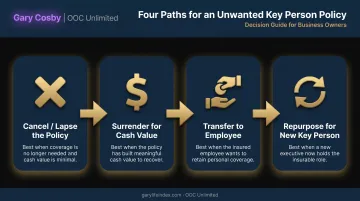
Your Options: Cancel, Surrender, Transfer, or Repurpose
You have four realistic paths. Which one fits depends on the policy type, how much cash value has built up, and your relationship with the departing employee.
Option 1: Let the Policy Lapse or Cancel It
This is the simplest route, and it's typically the right call for term policies with no cash value and no remaining business need.
The catch: any premiums you've paid are gone. You also lose continuity protection the moment the policy ends, so if another key person could benefit from coverage, you're now unprotected until a new policy is issued.
Option 2: Surrender the Policy for Cash Value
Permanent policies (whole life, universal life) can be surrendered for their accumulated cash value. You can redirect that cash wherever the business needs it.
Early surrenders often return less than expected. The National Association of Insurance Commissioners notes that cash values can be low in a policy's early years, and exiting early can be costly. Use the policy illustration and contract schedule—not a rule-of-thumb percentage—to see what you would actually receive.
Option 3: Transfer Ownership to the Departing Employee
Here, the business relinquishes ownership entirely. The employee becomes the new owner, takes over premium payments, and the policy becomes personal coverage.
The handoff looks clean on paper, but it carries real complications:
- The transfer can be treated as compensation to the employee, creating taxable income
- It can trigger the IRS "transfer for value" rule, which affects whether the eventual death benefit stays tax-free
- New York Life's own transfer paperwork explicitly instructs the outgoing owner to consult a tax adviser before signing
Option 4: Repurpose the Policy for a New Key Person
Some policies allow you to swap the insured person entirely, redirecting coverage to a successor or new hire rather than starting from scratch.
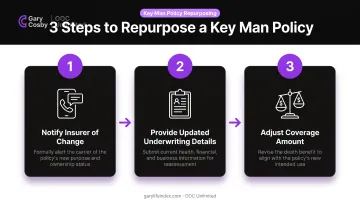
This isn't automatic. You'll need to:
- Notify the insurer of the change
- Provide updated underwriting details on the new insured, including evidence of insurability
- Adjust the coverage amount to match the new person's value to the business
The Insurance Compact's change-of-insured standard confirms this feature is policy-specific — it depends on the form, state law, and conditions like a minimum time in force. Not every policy allows it.
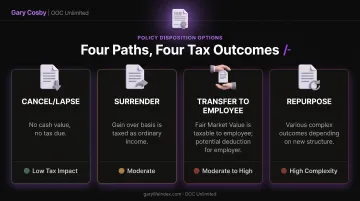
Tax Implications of Each Path
Every dollar of premium you've paid so far came from after-tax income, no matter which option you pick. That fact shapes how each path plays out:
| Option | Tax Consequence |
|---|---|
| Cancel/lapse | None — but you forfeit the after-tax premiums already paid |
| Surrender | Taxable income on proceeds exceeding your cost basis (per IRS Publication 525) |
| Transfer to employee | Often treated as taxable compensation; may trigger transfer-for-value rules |
| Repurpose | Generally no immediate tax event, since the business retains ownership |
Pay close attention to the transfer-for-value rule. The IRS Internal Revenue Bulletin 2009-21 notes an exception: transfers to the insured person themselves generally sidestep this rule. Transferring to a different employee or third party does not get the same pass, so that scenario needs its own analysis.
C corporations should also review whether any corporate AMT or related reporting applies before finalizing a surrender or transfer.
None of this is a substitute for professional tax advice. Talk to a CPA or tax attorney before finalizing any option.
GFI's role stays specific: licensed agents like Gary Cosby focus on the insurance-funding piece, helping structure or restructure the coverage itself, while coordinating with the business owner's own CPA and attorney on ownership questions and tax treatment.
How to Plan Ahead So This Doesn't Catch You Off Guard
The best fix for a surprise key man decision is to stop being surprised.
- Add a policy-review trigger to your HR offboarding checklist so key person coverage gets flagged the moment a key employee gives notice, not months later.
- Pair coverage with a buy-sell agreement that sets a predefined financial plan for departures, retirements, and other exits, not just death.
- Review your key person list every year as the team and business change; who counted as "key" two years ago may not be the right person to insure today.
Frequently Asked Questions
What is a key man insurance policy?
It's a business-owned life insurance policy on a critical employee, owner, or partner. The company pays the premiums and receives the payout if that person dies or becomes disabled under a qualifying rider.
Which losses are covered under key man insurance?
Coverage applies to death, and to disability only if a rider was added. Voluntary resignation, retirement, or termination doesn't trigger a payout on its own.
Who owns the cash value of a key person life insurance policy?
The business owns any accumulated cash value as the policyholder, unless ownership has been formally transferred to someone else, such as the departing employee.
Can I keep the policy active after the key employee resigns?
Yes. The business can maintain the policy as-is, transfer it, or repurpose it for a new key person, as long as premiums keep getting paid.
Do I need a new medical exam if I replace the insured with a new key employee?
Most insurers require updated underwriting on the new insured, which typically includes fresh health information. Requirements vary by carrier and policy form.