This decision matters more than most policyholders realize. Choose wrong, and you could shrink your family's death benefit, trigger a surprise tax bill, or even cause your policy to lapse entirely. Under IRC Section 72, loans and withdrawals from a non-MEC universal life contract are taxed very differently, and the rules aren't always intuitive.
This guide breaks down exactly how policy loans and withdrawals work, where they diverge, and how to figure out which one fits your situation.
Key Takeaways
- Policy loans borrow against cash value tax-free but accrue interest and shrink the death benefit if unpaid
- Withdrawals permanently remove cash value: tax-free up to your cost basis, taxable above it
- Choose based on repayment ability, tax exposure, and how much death benefit protection you need
- Have a licensed agent review your policy terms before you commit to either option
Policy Loan vs Withdrawal: Quick Comparison
Here's how a policy loan and a withdrawal compare side by side.
| Factor | Policy Loan | Withdrawal |
|---|---|---|
| Tax treatment | Generally tax-free while policy stays in force | Tax-free up to cost basis; gains above that are taxable |
| Repayment | Optional, but interest accrues over time | Not applicable — funds are gone permanently |
| Death benefit impact | Reduced by unpaid balance plus interest | Reduced immediately and permanently |
| Cash value growth | May continue growing depending on policy type | Permanently reduced, slowing future growth |
| Lapse risk | Higher if interest compounds unmanaged | Lower short-term, but less cushion for future costs |
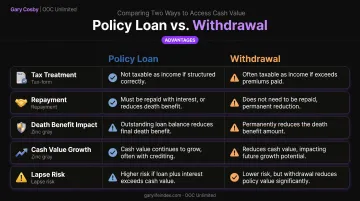
The core tradeoff: a loan preserves your death benefit if you repay it. A withdrawal reduces that death benefit immediately and permanently.
What Is a Universal Life Insurance Policy Loan?
A policy loan lets you borrow against your cash value using the policy itself as collateral. The key distinction: you are not withdrawing cash value. The insurer keeps it in the policy and lends you money against it. Guardian Life confirms no other asset, like a home or car, is required as collateral. Guardian explains this collateral structure here. That distinction has real benefits:
- No credit check or approval process
- Interest rates often set below unsecured personal loan rates
- Flexible repayment — there's typically no fixed schedule
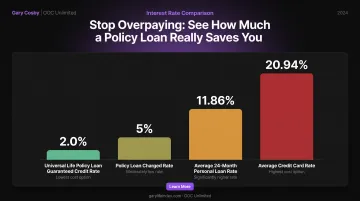
- Cash value may keep growing or crediting interest even while borrowed Loan structures vary by carrier and policy type. Protective's universal life product, for example, credits a guaranteed 2.0% rate on the loaned portion while charging 5% interest in arrears. Compare that with Federal Reserve data on average rates of 11.86% for 24-month personal loans and 20.94% for credit card balances. That gap is why policy loans appeal to people who might otherwise reach for a credit card.
Use Cases of Policy Loans
Loans work best when you:
- Need temporary liquidity for an emergency and plan to repay
- Are funding a one-time cost like a medical bill or business opportunity
- Want to keep your full death benefit intact for your family
What Is a Universal Life Insurance Withdrawal?
A withdrawal, sometimes called a partial surrender, permanently pulls funds out of your policy's cash value. There's no loan balance, no interest, and no repayment obligation. The cash is yours to keep, and the reduction to your policy is permanent.
Key benefits:
- No interest charges accumulating over time
- No pressure to pay anything back
- Straightforward access to cash when you need it
The catch: your death benefit and cash value drop immediately and permanently.
Some carriers also limit how much you can withdraw or charge fees, especially in early policy years. Bankers Life, for instance, allows one free annual withdrawal up to 10% of accumulation value after year one. Anything above that triggers a charge, and surrender charges can apply for up to 15 policy years.
When a Withdrawal Makes Sense
Withdrawals fit best when you:
- Need a smaller, one-time amount you don't plan to repay
- Want cash to bridge a short retirement-income gap
- Are funding a planned expense (for example, tuition) where repayment isn't the goal
- Prefer a clean transaction over managing a loan balance
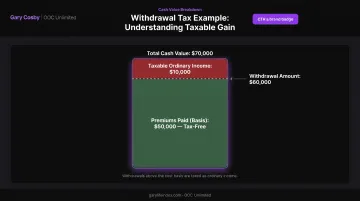
Watch the tax trap: withdrawals are tax-free only up to your cost basis (total premiums paid). Under IRC Section 72(e)(5)(A), only amounts above your investment in the contract are taxed as ordinary income.
Say you've paid $50,000 in premiums and cash value has grown to $70,000. Withdraw $60,000, and the $10,000 above basis becomes taxable ordinary income.
Loan vs Withdrawal: Which Should You Choose?
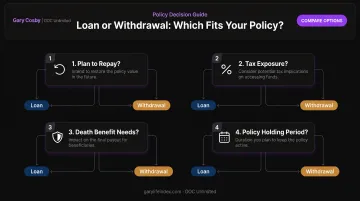
The better option depends on four questions:
- Do you plan to repay the money? If yes, a loan preserves your death benefit. If no, a withdrawal permanently reduces cash value and death benefit.
- What's your tax exposure? Loans stay tax-free as long as the policy remains in force. Withdrawals above cost basis create taxable income right away.
- How much death benefit protection do you need? A loan only reduces the payout if unpaid at death. A withdrawal reduces it immediately, no matter what.
- How long have you held the policy? Early withdrawals may trigger surrender charges that loans don't.
Quick rule of thumb:
- Choose a loan if you intend to repay and want to protect the full death benefit
- Choose a withdrawal if you want a permanent cash-out and can accept a lower payout
Policy contracts vary widely on loan interest rates, withdrawal fees, and free withdrawal allowances. A licensed life insurance agent at GFI × Team OOC can review your policy terms and carrier illustration. That review helps you see which option fits your tax situation and long-term goals.
Real-World Scenario: Choosing Between a Loan and a Withdrawal
Consider Maria, a policyholder who's held a universal life policy for 12 years. Her son's tuition bill lands at $15,000, due in one lump sum.
Maria has two paths. She could take a loan against her $40,000 cash value, keeping her $250,000 death benefit intact as long as she repays the balance. Or she could withdraw the funds outright, permanently reducing both her cash value and death benefit by roughly that amount.
Here's what shapes her decision:
- She plans to rebuild savings within two years, so a loan funds tuition without giving up long-term protection
- Premiums paid total $35,000—below the $15,000 need wait, no: below the withdrawal—so part of a withdrawal would be taxable
- Her family relies on the $250,000 death benefit, so she wants to avoid a permanent cut
Maria chooses the loan. She accepts the accruing interest but avoids taxable income and keeps her family's protection level unchanged — provided she sticks to her repayment plan.
Your situation may look different. If you don't plan to repay the money, or if keeping the full death benefit isn't your top priority, a withdrawal may fit better. Compare both options against your policy values, tax basis, and protection needs before you act.
If you're weighing this decision yourself, book a free consultation with a licensed GFI × Team OOC agent before taking a loan or withdrawal.
Conclusion
Neither a policy loan nor a withdrawal is inherently "better." The right choice hinges on whether you intend to repay the money and how much death benefit protection matters for your family's security. A loan preserves that protection conditionally; a withdrawal gives it up permanently in exchange for a clean, simple payout.
Run the numbers on your own policy before you act—how each option affects your death benefit, tax exposure, and whether the coverage stays in force. A licensed agent can walk through those figures with you so you choose with clarity, not guesswork.
Frequently Asked Questions
What is the difference between a loan and a withdrawal on a universal life insurance policy?
A loan borrows against your cash value with interest, and repayment is optional. A withdrawal permanently removes funds, immediately reducing both cash value and death benefit.
Can I withdraw money from my universal life insurance policy?
Yes, once you've built sufficient cash value. Withdrawals may involve fees, minimum amounts, and tax on any gains above your cost basis.
Do policy loans need to be repaid?
Repayment is optional, but any unpaid balance plus accrued interest gets deducted from your death benefit when you pass away.
Will a loan or withdrawal cause my policy to lapse?
They can, if cash value drops too low. After either action, you still need enough value to cover ongoing insurance charges—especially if loan interest compounds unchecked.
Are policy loans or withdrawals taxable?
Loans are generally tax-free as long as the policy stays in force. Withdrawals are tax-free only up to your cost basis (premiums paid).
How do I know if a loan or withdrawal is right for my situation?
Speak with a licensed life insurance agent who can review your specific policy illustration and financial goals. Book a free consultation to get personalized guidance.