This scenario plays out constantly in businesses with multiple owners. A trusteed buy-sell agreement solves it before it happens by using an independent trustee to hold life insurance policies and manage the entire buyout process.
For businesses with three or more owners, this structure matters because it eliminates the administrative nightmare of standard cross-purchase agreements. This article covers how trusteed buy-sells work, how they compare to other structures, funding mechanics, and what to watch for when setting one up.
Key Takeaways
- An independent trustee holds the policies and administers buyouts in multi-owner businesses
- Policy administration drops versus standard cross-purchase agreements
- Life insurance offers fast, generally tax-free liquidity for buyouts
- Attorneys, CPAs, and insurance professionals each play a distinct role in structuring these agreements
What Is a Trusteed Buy-Sell Agreement?
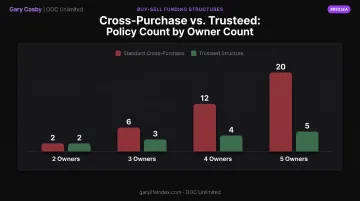
A trusteed buy-sell agreement (also called a trusteed cross-purchase) is a variation of the classic cross-purchase buy-sell agreement. Instead of each owner personally buying and holding a policy on every other owner, an independent trustee holds one policy per owner and manages the entire transaction. Why this matters for businesses with three or more owners: a standard cross-purchase agreement requires N × (N-1) policies. That math gets ugly fast.
- 2 owners: 2 policies
- 3 owners: 6 policies
- 4 owners: 12 policies
- 5 owners: 20 policies A trusteed structure reduces that same four-owner scenario to just four policies instead of twelve, while still preserving the owner-purchase mechanics that cross-purchase agreements are known for.
How the Mechanics Work
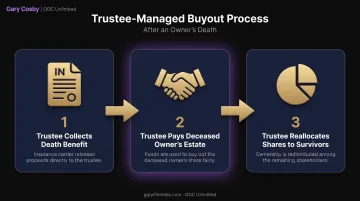
Each owner contributes funds to the trustee, who pays premiums on policies covering every owner. When one owner dies:
- The trustee collects the death benefit
- The trustee pays the deceased owner's estate in exchange for their ownership interest
- The trustee reallocates the remaining shares among survivors This keeps the transaction centralized instead of forcing each surviving owner to individually negotiate with the estate.
Two Risks to Watch Closely
Estate tax inclusion risk. If the trustee isn't genuinely independent, meaning a subordinate party or someone with retained control ends up managing the policies, the IRS can pull those proceeds back into the deceased owner's taxable estate. Section 2042 reaches proceeds when the insured retained "incidents of ownership," and those incidents aren't limited to formal title. Powers like changing beneficiaries, borrowing against the policy, or removing the trustee can all count. Transfer-for-value trap. When the trustee reallocates a deceased owner's policy interests among survivors, that reallocation can trigger the transfer-for-value rule. Under this rule, the normally tax-free death benefit exclusion narrows to just the consideration paid plus any premiums the new owner pays afterward. Certain exceptions apply (transfers to the insured, a partner of the insured, or a partnership where the insured is a partner). Every reallocation needs a fact-specific review before it happens, not after.
How a Trusteed Buy-Sell Agreement Works Step-by-Step
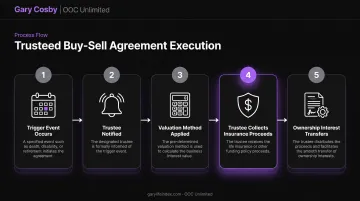
The process follows a predictable sequence once the agreement is in place:
- Trigger event occurs: death, disability, retirement, or another defined event
- Trustee is notified: the agreement should specify notice timelines and required documentation
- Valuation method applied: fixed price, formula, or independent appraisal, as the agreement specifies
- Trustee collects insurance proceeds: funds go to the departing owner or their estate
- Ownership interest transfers: surviving owners receive the interest; the trustee handles the paperwork
The Trustee's Role
An independent trustee—usually a bank, trust company, or attorney acting as a fiduciary—is separate from the owners and has no personal stake in the outcome. That trustee holds every policy, collects and manages premium contributions, and executes the buyout when a trigger event occurs. The trust document should authorize the trustee to hold policies, receive death proceeds, purchase ownership interests, and handle conflicts of interest among the owners. Attorneys who structure these agreements recommend drafting the trust document and the buy-sell agreement together, not as separate afterthoughts.
Defining Triggers Clearly
Vague trigger language causes disputes. Common triggers include:
- Death of an owner
- Permanent disability that ends active participation
- Voluntary or involuntary employment termination
- Retirement under a defined age or service rule
- Divorce that could force an unwanted ownership shift
- Bankruptcy or impermissible transfer of interest Retirement in particular needs a hard definition. Is it age 65? A specific years-of-service threshold? Without clarity, owners can argue endlessly over whether a trigger actually occurred.
Trusteed vs. Other Buy-Sell Structures
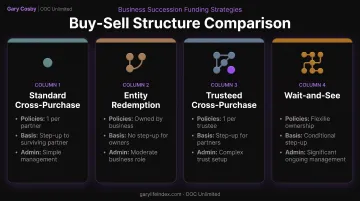
Businesses generally choose among four structures, and each solves the multi-owner problem differently.
| Structure | Policy Count | Basis Treatment | Administrative Load |
|---|---|---|---|
| Standard cross-purchase | N × (N-1) | Buyer's basis increases by purchase price | High policy count, direct owner control |
| Entity redemption | One per owner | C-corp survivors get no basis step-up | Centralized, but entity-level tax issues |
| Trusteed cross-purchase | One per owner | Retains owner-purchase basis benefit | Fewer policies, adds fiduciary/trust work |
| Wait-and-see | Flexible | Depends on final buyer | Drafting-heavy but flexible |
| Trusteed cross-purchase sits between standard cross-purchase and entity redemption: one policy per owner, owner-level basis treatment, and a trustee handling administration instead of each owner. | |||
| Entity redemption solves the policy-count problem differently. The business owns one policy per owner and buys back the departing owner's interest directly, which avoids the N × (N-1) math entirely. | |||
| For C corporations, surviving shareholders don't get the same stock basis increase that a cross-purchase buyer receives. | |||
| Wait-and-see agreements give the business first option to buy, survivors second option, and the entity absorbs whatever remains. Flexible, but they need careful drafting to avoid ambiguity. | |||
| A Buy-Sell Life Insurance LLC is a modern alternative. An LLC (rather than a trust) owns the policies and manages the buyout. | |||
| It can preserve owner-level purchase treatment and may reduce some transfer-for-value concerns tied to trust reallocations. Tax classification of these LLCs isn't fully settled, so review them case by case. |
Funding a Trusteed Buy-Sell Agreement with Life Insurance
Life insurance is the go-to funding vehicle for trusteed buy-sells because it delivers a lump sum exactly when it's needed. Death benefits are generally income-tax-free to the trustee under IRC Section 101(a)(1), and the payout happens fast, without liquidating business assets or forcing a fire sale.
Premium Allocation Approaches
Owners typically fund premium contributions to the trustee in one of two ways:
- Pro-rata allocation: each owner contributes based on ownership percentage
- Pay-your-own-premium: each owner funds the premium on the policy that insures them
The better fit depends on ownership structure, age and health differences among owners, and how partners want to handle disparities in policy cost.
Disability as a Complementary Trigger
If disability is a named triggering event in the agreement, life insurance alone won't cover it since disability isn't death. Many trusteed agreements pair life insurance with disability insurance, which provides liquidity for a buyout when an owner becomes permanently unable to work but hasn't died.
Coverage amounts shouldn't be set once and forgotten. As the business grows in value, the death benefit needs to keep pace, or surviving owners can end up underfunded exactly when they need cash most.
GFI × Team OOC's licensed life insurance agents help business owners evaluate insurance-funding options for these agreements. They work alongside the owner's CPA and attorney on tax and legal structuring.
Insurance is one piece of a coordinated plan: the attorney drafts the agreement, a valuation professional sets the business value, and the agent focuses on funding the liquidity.
Key Considerations and Potential Pitfalls
Before you finalize a trusteed buy-sell agreement, check these points. Skipping them is how estate tax challenges, lost tax-free death benefits, and valuation fights show up later.
The IRS Valuation Test
For a buy-sell agreement's stated price to hold up for estate tax purposes, IRC Section 2703(b) requires three statutory conditions:
- It's a bona fide business arrangement, not a disguised gift
- It's not a device to transfer property to family members for less than full value
- Its terms are comparable to similar arm's-length arrangements
In practice, the price or formula also needs to be fixed, determinable, and binding on all parties during life and after death.
The Estate of Blount case is the cautionary tale. The Tax Court and later the Eleventh Circuit disregarded a buy-sell valuation because one party retained unilateral power to modify the agreement. Independent, binding terms matter more than a neatly written price clause.
The Transfer-for-Value Trap, Revisited
As covered earlier, shifting policies among surviving owners after a buyout can trigger the transfer-for-value rule and limit the tax-free death benefit exclusion. Address ownership and beneficiary structure at drafting—not after a claim is filed—so post-buyout policy moves stay within known exceptions.
Valuation Needs Regular Updates
Whatever method you use, the number needs periodic review:
- Fixed price stated in the agreement
- Formula tied to financial metrics
- Third-party appraisal on a set schedule
A price locked in five years ago rarely matches what the business is worth today. Stale valuations create disputes at the exact moment the agreement is supposed to prevent them.
Setting Up a Trusteed Buy-Sell Agreement: Who to Involve
No single professional can build this agreement alone. Three roles are essential:
- Estate planning attorney — drafts the legal agreement and selects a properly independent trustee, ensuring the trust language avoids estate inclusion risk
- Licensed insurance agent — structures the funding component; agents at GFI × Team OOC help business owners evaluate life insurance options that fund the buyout
- CPA — evaluates the tax consequences of premium allocation, death benefit distribution, and how the buyout affects the business's books
Bring all three in from day one. When legal structure, funding, and tax treatment are aligned early, you avoid costly rework later.
Frequently Asked Questions
What's an example of a trusteed buy-sell agreement?
In a three-partner setup, a trustee holds one policy on each owner. When one partner dies, the trustee collects the death benefit, pays the deceased's estate for their stake, and reallocates that share to the two surviving partners.
What triggers a buy-sell agreement?
Common triggers include death, permanent disability, retirement, divorce, and voluntary or involuntary departure from the business. The agreement should define each trigger precisely to avoid disputes.
How is a trusteed buy-sell agreement different from a cross-purchase agreement?
A trusteed version uses one independent trustee holding a single policy per owner. A standard cross-purchase requires each owner to personally hold and manage multiple policies on every other owner.
Who should serve as trustee in a trusteed buy-sell agreement?
A genuinely independent third party, such as a bank, corporate trust company, or attorney, is preferred. Using someone with ties to the owners risks estate tax inclusion under IRC Section 2042.
Is life insurance the only way to fund a buy-sell agreement?
No. Life insurance is the most common method, but cash reserves, promissory notes, and installment loans are alternatives—each with tradeoffs in speed, cost, and reliability.