The tax rules around premiums, death benefits, and policy structure are unforgiving. Miss a notice-and-consent form or transfer a policy the wrong way, and a tax-free death benefit can become taxable ordinary income. With Connelly v. United States decided by the Supreme Court in June 2024, even the estate tax side of these agreements got more complicated.
This guide breaks down how premiums, death benefits, and agreement structure each get taxed, plus the pitfalls that catch owners off guard.
Key Takeaways
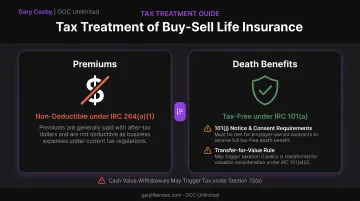
- Death benefits are generally income-tax free under IRC Section 101(a)—if transfer-for-value and IRC §101(j) rules are satisfied
- Premiums paid by the business or owners are not tax-deductible under IRC Section 264(a)(1)
- Cross-purchase agreements give surviving owners a basis step-up that can cut capital gains; entity redemptions generally do not
- IRC Section 101(j) requires notice, written consent, and Form 8925 filing, or proceeds may become taxable
- Coordinate a CPA, attorney, and licensed insurance agent before any policy is issued
What Is a Buy-Sell Agreement and Why Life Insurance Funds It
A buy-sell agreement is a binding contract that spells out what happens to an owner's stake when they die, become disabled, or retire. It names a buyer, sets a price (or a formula for one), and locks in the terms before anyone needs them.
The hard part isn't writing the agreement. It's funding it.
When an owner dies unexpectedly, the business or the remaining owners need cash fast, often within weeks. Without a dedicated funding source, that usually means:
- Liquidating business assets at a discount
- Taking out a loan under pressure
- Forcing a fire sale of the deceased owner's stake
Life insurance solves this. It delivers a guaranteed lump sum exactly when it's needed, without touching operating capital or business equipment. That's why it's the most common funding vehicle for buy-sell agreements among closely held businesses, family companies, and professional practices.

Coordinating this properly takes more than an insurance policy. An attorney drafts the legal agreement, a valuation professional sets the business's worth, and a licensed agent structures the funding. Gary Cosby Jr. and OOC Unlimited help business owners explore insurance-funding options for buy-sell agreements as one piece of that team effort—not a standalone fix.
Tax Treatment of Premiums and Death Benefits
This is where most confusion starts. Premiums and proceeds are taxed completely differently, and the rules change depending on who owns the policy.
Premiums Are Generally Not Deductible
Under IRC Section 264(a)(1), no deduction is allowed for premiums on a life policy if the taxpayer is directly or indirectly a beneficiary. Since the business or the co-owners are typically the beneficiary in a buy-sell arrangement, those premiums come out of after-tax dollars. There's no workaround here — don't budget for a deduction that doesn't exist.
Death Benefits Are Usually Tax-Free — With Conditions
Death proceeds are generally excluded from gross income under IRC Section 101(a)(1). But two rules can strip away that exclusion:
****Section 101(j) employer-owned life insurance rules. If the business owns a policy on an owner or key employee, the exclusion is capped at premiums paid unless the employer meets all three requirements:
- Provides written notice before issue, stating intent to insure and the maximum coverage amount
- Obtains written consent from the insured, including consent to coverage after employment ends
- Files Form 8925 annually while the policy is in force
The transfer-for-value rule. Selling or transferring a policy for valuable consideration can turn a tax-free death benefit into taxable income. Taxable gain is generally limited to the buyer's basis plus later premiums, unless an exception applies (for example, a transfer to the insured or to a partner).
Missing the 101(j) paperwork is not fixable after death. IRS Notice 2009-48 makes clear that written consent obtained posthumously doesn't count, and relief for an inadvertent failure is narrow and time-limited.
One more wrinkle: cash value withdrawals or full surrenders during the insured's life can trigger income tax on gain above basis under IRC Section 72(e). Treat cash value as potentially taxable, not automatically tax-free.
Cross-Purchase vs. Redemption Agreements: Tax Implications Compared
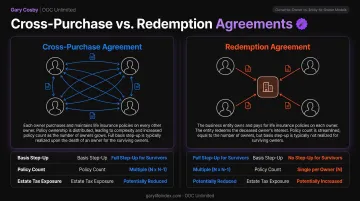
The structure you choose changes the tax outcome for everyone involved. Here's the breakdown:
| Feature | Cross-Purchase | Redemption (Entity-Purchase) |
|---|---|---|
| Policy owner | Each individual owner | The business |
| Proceeds go to | Surviving owners directly | The business entity |
| Basis step-up for survivors | Yes, equal to purchase price | No |
| Policy count (3 owners) | 6 policies | 3 policies |
| Policy count (4 owners) | 12 policies | 4 policies |
| Administrative burden | Grows quickly with owner count | Simpler to manage |
| Estate tax exposure | Lower for controlling owners | Higher risk under Connelly |
Why Redemption Carries Estate Tax Risk
When the business owns the policy and receives the death benefit, that cash can inflate the entity's value right when a controlling owner dies.
Connelly v. United States (2024) confirmed the risk: the Supreme Court held that corporate-owned life insurance proceeds increase the company's fair market value, and a redemption obligation does not automatically offset that increase. A controlling owner's estate can face a larger taxable estate than planned.
Hybrid Options Worth Discussing
- Wait-and-see agreements let the business decide at death whether it or the surviving owners buy the interest, deferring the cross-purchase-versus-redemption choice until you need it.
- Insurance-only LLCs centralize policy administration in a separate entity and ease the multiplying-policy problem in cross-purchase deals.
These hybrids add legal complexity, so loop in a tax advisor before committing to one.
Estate Tax and Valuation Considerations
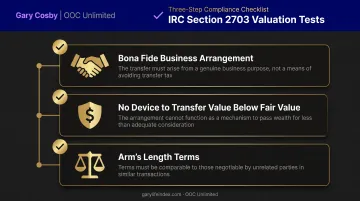
A buy-sell agreement can lock in a fixed value for estate tax purposes, but only if it clears three tests under IRC Section 2703:
- Bona fide business arrangement, not a family wealth transfer disguised as a contract
- No device to move value to family members below fair value
- Terms that match what unrelated parties would negotiate at arm's length
A stale valuation formula undermines all three. If the price hasn't been updated in years and no longer reflects the business's real worth, the IRS can challenge it and substitute its own valuation.
Redemption-funded agreements create a separate estate risk. Insurance proceeds paid to the entity can inflate its value right when a controlling owner dies, pulling more value into the taxable estate.
The agreement should specify what happens to proceeds that exceed fair market value: whether they stay with the company or pass to the deceased owner's family. Put that treatment in writing before a claim is ever filed.
Common Pitfalls That Trigger Unexpected Taxes
Three mistakes come up again and again:
- Skipping the 101(j) paperwork. Notice and consent must happen before the policy is issued. There's no fixing this retroactively once the insured has died.
- Triggering transfer-for-value between surviving owners. When a cross-purchase agreement passes a policy between owners after a death or exit, that transfer can inadvertently convert a tax-free benefit into taxable income.
- Letting the valuation formula go stale. A price set five or ten years ago rarely reflects current fair market value, inviting IRS disputes and penalties down the road.
None of these are exotic tax traps. They're paperwork and timing issues that get missed because nobody owns the annual review.
Frequently Asked Questions
What is a buy-sell agreement life insurance policy?
A buy-sell life insurance policy funds a contractual obligation so owners or the business can buy out a deceased or departing owner's interest. It supplies the cash without forcing a sale of business assets.
Are life insurance proceeds from a buy-sell agreement taxable?
Generally no. Proceeds are income-tax free under IRC Section 101(a). They can become taxable if the transfer-for-value rule applies or if Section 101(j) notice and consent requirements weren't met.
Can a business deduct premiums paid for buy-sell life insurance?
No. Under IRC Section 264(a)(1), premiums aren't deductible when the business or owners are the policy's beneficiary, which is the case in nearly every buy-sell arrangement.
What's the tax difference between cross-purchase and redemption agreements?
Cross-purchase gives surviving owners a basis step-up equal to their purchase price, which reduces future capital gains. Redemption is administratively simpler but offers no basis step-up and carries more estate tax exposure.
Do buy-sell life insurance proceeds affect estate taxes?
Yes, particularly under redemption agreements. Proceeds paid to the business can raise its value right when a controlling owner dies, potentially increasing that owner's taxable estate.
Who should help set up a buy-sell agreement funded with life insurance?
Use a team: a licensed insurance agent for funding, plus a CPA and attorney for tax treatment and legal drafting. OOC Unlimited's agents handle the insurance funding piece and coordinate with the owner's existing CPA and attorney.