
This scenario plays out more often than most owners realize. The valuation method written into a buy-sell agreement determines what each owner actually gets paid, how funding needs are calculated, and what tax consequences follow. Get it wrong, or let it go stale, and you've built a dispute machine instead of a succession plan.
This guide walks through the four major valuation methods, how to pick the right one for a partnership buyout, common triggers that activate these clauses, and why funding through life insurance has to move in lockstep with your valuation approach.
Key Takeaways
- The valuation method (fixed price, book value, formula, or appraisal) determines what owners actually get paid
- Formula and appraisal-based methods are more defensible than outdated fixed prices
- Even a perfect valuation clause fails without matching funding, often through life insurance
- Annual reviews (or after major business changes) keep valuations aligned with reality
- Pair a licensed insurance professional with your CPA and attorney so funding matches the agreed valuation
The Four Core Buy-Sell Valuation Methods
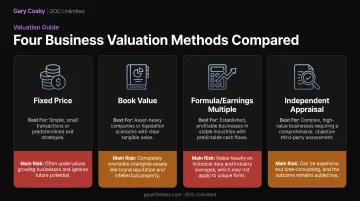
Most buy-sell agreements rely on one of four valuation approaches. Each has distinct strengths, risks, and ideal use cases.
| Method | Best For | Main Risk |
|---|---|---|
| Fixed price | Simple structures, few owners | Values go stale fast |
| Book value | Asset-heavy businesses | Undervalues goodwill |
| Formula/earnings multiple | Predictable, repeatable pricing | Distorted by unusual earnings |
| Independent appraisal | Complex or disputed valuations | Higher upfront cost |
Fixed Price (Agreed-Upon Value)
Owners agree on a specific dollar figure and write it into the contract, typically with an annual update requirement. The appeal is simplicity: everyone knows the number.
The problem: these numbers are rarely updated. Owners get busy, forget the annual review, or avoid an awkward conversation about changing values. Years later, the agreement locks in a price that has nothing to do with what the business is actually worth.
Book Value
This approach ties the buyout price to the company's net asset value from its financial statements. It's straightforward to calculate and works reasonably well for asset-heavy businesses like manufacturing or equipment-based operations.
The catch: book value often ignores goodwill, client relationships, and brand value entirely. Service-based businesses (consulting firms, medical practices, agencies) can be worth far more than their balance sheet suggests, leaving departing owners significantly undervalued.
Formula/Earnings Multiple Approach
This method ties value to a multiple of earnings (often EBITDA or seller's discretionary earnings) or revenue. Formula clauses might read something like "four times EBITDA" or "50% of prior 12 months' revenue."
Current small-business transaction data from BizBuySell shows revenue multiples ranging from 0.42 to 1.2, with an average of 0.67, and cash-flow multiples ranging from 2.0 to 3.3, averaging 2.58. These figures reflect actual sold businesses over a trailing five-year window, not a guaranteed number for any specific company.
Common pitfalls with formula clauses:
- Negative earnings years that break the formula entirely
- Artificially inflated EBITDA from one-time gains
- No adjustment for non-recurring expenses or windfalls
- Confusing SDE (seller's discretionary earnings) with EBITDA — they're not the same metric
Independent Appraisal
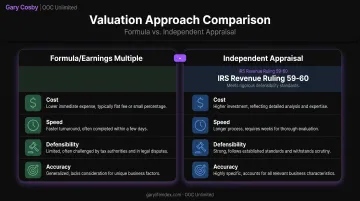
A qualified valuation professional analyzes the business at the triggering event and determines value using recognized methods. The foundational standard for this process in the U.S. is IRS Revenue Ruling 59-60, which defines fair market value as the price a willing buyer and willing seller would agree to, with neither party under compulsion and both having reasonable knowledge of relevant facts.
The ruling states outright that no single formula applies to every valuation case. It requires informed judgment across factors like earning capacity, industry conditions, and comparable company sales.
Independent appraisal costs more upfront and takes longer than a formula calculation. For tax purposes and dispute resolution, it remains the most defensible method available.
Choosing the Right Method for Your Business and Partnership Buyout
Most well-drafted agreements pair two tools: a formula for routine updates and an independent appraisal as a backstop. The appraisal typically kicks in when earnings are negative, unusual, or disputed.
Several factors influence which method (or combination) fits your situation:
- Business size and complexity — larger, more complex operations lean toward appraisal
- Industry and asset intensity — asset-heavy businesses often rely more on book value
- Number of owners — more owners raise disagreement risk, which favors appraisal
- Controlling vs. minority stake — minority interests may warrant discounts
Valuation Discounts Worth Understanding
Three discounts can move the final number in a meaningful way:
- Lack of marketability (DLOM) — harder to sell privately held shares
- Lack of control (DLOC) — minority stakes without decision power
- Key-person risk — value tied heavily to one owner or executive
None of these apply automatically. They depend on your agreement’s language, the standard of value you chose, and applicable case law. Spell out whether and how discounts apply before a dispute forces the question.
Different triggers can also justify different standards in the same agreement:
- Death or disability — fair market value with no discounts to protect the family
- Voluntary departure — a discounted price as a disincentive to leave
Common Triggers That Activate Valuation Provisions
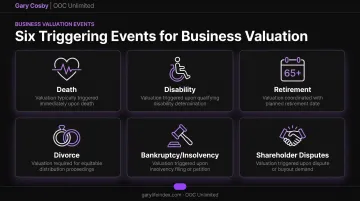
A comprehensive buy-sell agreement should address each of these triggering events:
- Death — usually requires near-immediate liquidity
- Disability — often needs a waiting period before the buyout activates
- Retirement — typically planned well in advance
- Divorce — protects the business from an ex-spouse becoming an owner
- Bankruptcy or insolvency — prevents creditors from gaining ownership access
- Shareholder disputes or deadlock — especially relevant for 50/50 ownership splits
Each trigger may call for a different "as of" valuation date. Death, for instance, usually locks value as of the date of death; a planned retirement can use a date set months in advance.
Funding the Buyout: Why Valuation and Insurance Must Work Together
Here's the piece that gets overlooked often: even a perfectly designed valuation method is worthless if there's no money to execute the buyout.
Common funding mechanisms include:
- Life insurance (for death-triggered buyouts)
- Disability insurance (for disability-triggered buyouts)
- Cash reserves
- Installment notes paid over time
Life insurance proceeds provide immediate liquidity when a death triggers the agreement. Under IRS rules, death benefit proceeds are generally excluded from gross income, subject to certain exceptions like transfer-for-value rules or employer-owned policy requirements. That liquidity lets surviving owners complete a buyout without scrambling for financing or draining operating cash.
Valuation and funding still have to stay aligned. A $2 million buyout price backed by only $750,000 of coverage leaves a gap the survivors or the company must fill. When you change the valuation method or update the number, review policy face amounts at the same time.

At GFI × Team OOC, licensed insurance professionals work alongside your CPA and attorney to structure coverage that matches the agreed valuation. Legal and valuation work set the price; the insurance makes sure cash is available when a trigger hits.
Best Practices to Avoid Valuation Disputes
Three practical steps reduce the odds of a fight later:
- Name a specific appraiser or firm in the agreement. One named firm upfront eliminates the "dueling appraisers" problem where each side hires someone favorable to their position.
- Review annually or after major changes. Revisit the valuation clause each year, and reopen it when new partners join, you complete a large acquisition, or revenue shifts significantly.
- Document the standard of value clearly. Specify fair market value versus fair value, whether discounts apply, and the exact "as of" date. Ambiguity here fuels most disputes.
Frequently Asked Questions
How do you value a partnership buyout?
Follow the method in the partnership's buy-sell agreement. Most use a formula tied to earnings or an independent appraisal done when the triggering event occurs.
How many times profit is a company worth?
Multiples vary widely by industry and business size. Current small-business data shows cash-flow multiples averaging around 2.58x, though your specific industry may run higher or lower.
What are the four valuation methods in a buy-sell agreement?
Fixed price, book value, formula/earnings multiple, and independent appraisal. Most agreements rely on one of these or a hybrid combination.
Who determines the value of the business in a buy-sell agreement?
The method is pre-agreed within the contract itself, typically executed by a named appraiser, appraisal firm, or a formula applied by the parties or their accountants.
Can a buy-sell agreement be funded by insurance?
Yes. Life insurance commonly funds death-triggered buyouts, while disability insurance covers disability-triggered scenarios, providing liquidity matched to the agreed valuation.
How often should a buy-sell agreement's valuation be updated?
Review it annually, or immediately after significant changes in ownership, earnings, or market conditions, so the number written into the agreement stays connected to reality.