
Introduction
A partner suffers a stroke on a Tuesday. By Thursday, the remaining physicians are arguing over what her shares are worth, who can buy them, and whether her husband now owns a piece of the practice. Medical groups face this exact fight every year—after death, disability, retirement, or a partner’s exit—and without a written plan it rarely ends cleanly.
A buy-sell agreement is the written plan that prevents that chaos. It sets who must sell, who may buy, how the practice is valued, and how the buyout gets paid—so patient care keeps moving and the remaining partners stay out of court.
This guide walks through the four main agreement structures, the events that trigger a buyout, how practices set value and fund the transition, and the drafting mistakes that most often end in lawsuits.
Key Takeaways
- Buy-sell agreements are essential protection for multi-owner medical practices
- Choose among four structures: cross-purchase, redemption, hybrid/wait-and-see, and one-way
- Plan for common triggers: death, disability, retirement, divorce, and license loss
- Life insurance is the most common funding tool but requires careful tax structuring
- Regular reviews with legal, tax, and insurance professionals keep agreements enforceable
What Is a Medical Practice Buy-Sell Agreement?
A medical practice buy-sell agreement is a legally binding contract that governs how ownership transfers among physician-owners. It restricts equity transfers and forces a sale when an owner's employment ends, or when they retire, become disabled, or die.
Medical practices need these agreements more urgently than most businesses because of Corporate Practice of Medicine (CPOM) restrictions. Many states limit who can own equity in a medical practice to licensed professionals.
- California's Business and Professions Code section 2400 strips corporations and non-physician entities of professional ownership rights
- Texas limits ownership in certain jointly owned entities to physicians, optometrists, or therapeutic optometrists
- Other CPOM states apply similar rules, blocking non-physicians from holding practice equity
Without a buy-sell agreement, a deceased or departing owner's shares could pass to an unlicensed heir, such as a spouse or adult child. That single event can create a compliance violation for the entire practice.
The Four Types of Medical Practice Buy-Sell Agreements
The Three Types of Medical Practice Buy-Sell Agreements
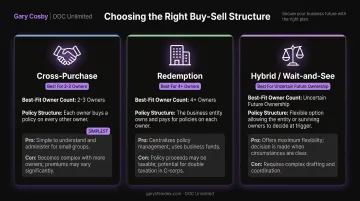
Each structure handles the "who buys" question differently, and the choice ripples into insurance costs and tax treatment.
Cross-Purchase Agreements
Remaining owners individually buy the departing owner's interest. Each owner needs a life insurance policy on every other owner:
- 3 owners require 6 policies
- 4 owners require 12 policies
This gets unwieldy fast, but it can offer buyers a favorable cost-basis position.
Redemption (Entity Purchase) Agreements
The practice entity itself buys back the departing owner's equity. This simplifies administration since the entity owns one policy per owner rather than a web of cross-policies, making it a better fit for larger groups.
One drafting risk matters: redemption structures can turn buyout proceeds into ordinary income dividends instead of capital gains if the agreement isn't handled carefully.
Hybrid/Wait-and-See Agreements
These combine both models. The entity gets a right of first refusal on the departing owner's shares; if it declines, individual owners can step in. That flexibility lets the practice pick the cleaner funding or tax path when the triggering event actually happens.
Which Structure Fits Your Practice
- 2-3 owners: Cross-purchase usually works best. Policy counts stay manageable.
- 4+ owners: Redemption typically wins on administrative simplicity.
- Uncertain future ownership changes: Wait-and-see agreements offer flexibility without locking in a structure too early.
Trigger Events That Activate the Agreement
A buy-sell agreement is only as strong as its trigger definitions. Vague triggers invite disputes over whether an exit occurred and who gets to decide.
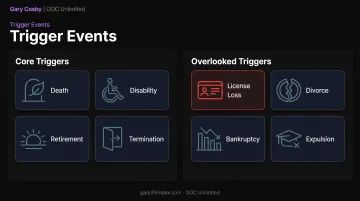
Core triggers:
- Death of a physician-owner
- Disability (short-term vs. long-term should be defined separately)
- Voluntary retirement
- Termination of employment
Less obvious triggers physicians often overlook:
- Loss or suspension of medical license
- Divorce (protects against an ex-spouse acquiring ownership rights)
- Bankruptcy of an owner
- Expulsion for misconduct or ethics violations
License loss deserves special attention. In states with strict Corporate Practice of Medicine (CPOM) rules, an unlicensed person legally cannot hold shares in a professional medical corporation. The agreement should require immediate redemption or transfer the moment a license is revoked or suspended, with no waiting period for a vote or negotiation.
The same precision matters for disability. If the term isn't defined by a specific duration or inability to perform core duties, partners will fight over interpretation exactly when tensions are already high.
Valuation and Funding: The Financial Core of the Agreement
This is where most buy-sell disputes originate. Getting the formula wrong, or leaving it vague, causes more litigation between former partners than any other provision.
Valuation Methods
| Method | How It Works |
|---|---|
| Book value | Uses balance-sheet net worth; simple but often understates goodwill |
| Multiple of earnings/revenue | Applies a multiplier that varies by specialty, location, and practice size |
| Independent third-party appraisal | An outside appraiser applies income, asset, and market approaches |
A cautionary example: a New Jersey pediatric group's operating agreement used "last agreed value adjusted for changes in net worth," but never defined "net worth." After more than two years without revaluation, a retiring partner's buyout was calculated below fair market value.
He sued, and a court found the agreement had improperly excluded goodwill from the calculation. That single undefined term produced years of litigation.
Funding Mechanisms
- Lump-sum cash: simplest option, but rarely available for a sudden departure
- Installment payments: spreads the burden over time but ties up the practice's cash flow
- Practice-financed loans: shifts risk onto the entity's balance sheet
- Life and disability insurance: delivers funds exactly when the trigger occurs
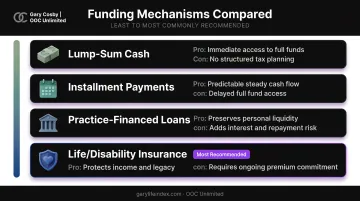
Life insurance is often the most efficient tool because it produces cash at the moment of a death trigger, without forcing the practice to take on debt or drain reserves. Structure matters as much as the coverage amount:
- Who owns the policy
- Who is named beneficiary
- How premiums are paid
This is where licensed insurance professionals, such as the agents at OOC Unlimited, work alongside a practice's CPA and attorney. Their role is specific: they design and fund the life-insurance component that supports the buy-sell agreement. The attorney still drafts the legal agreement, and valuation professionals still determine the practice's value. Insurance funding turns the written plan into cash that is ready when a trigger occurs.
Key Provisions Every Agreement Should Include
Beyond triggers and valuation, a well-drafted agreement needs these elements spelled out in plain language:
- Ownership transfer rules: who may buy (existing partners only or outside buyers), and any non-compete limits tied to the sale
- Payment terms: timelines, interest on installment balances, and remedies if a payment is missed
- Right of first refusal: an internal offer to existing owners before any outside sale
- Funding method: how the buyout will be paid when a trigger hits—often life insurance so cash is available without draining practice reserves
Skipping any one of these tends to surface as a fight later, usually at the worst possible time: right after a partner has died or been diagnosed with a serious illness.
Legal, Tax, and Compliance Pitfalls to Avoid
Several traps catch physician groups off guard, even when the agreement looks complete on paper.
Dividend vs. capital gains risk. Redemption structures that aren't drafted with tax treatment in mind can cause buyout proceeds to be taxed as ordinary dividend income rather than capital gains, a meaningfully worse outcome for the departing owner.
Entity-owned insurance and estate tax valuation. The Supreme Court's decision in Connelly v. United States illustrates the risk. Two brothers owned a business insured with $3.5 million in entity-owned life insurance per shareholder. When one brother died, the IRS argued the insurance proceeds increased the company's fair market value for estate tax purposes. The redemption obligation, the agency said, did not offset that increase.
The Court agreed, producing an additional tax assessment of nearly $890,000. Any medical practice funding a redemption with entity-owned insurance should review this ruling with counsel.
Anti-Kickback Statute and Stark Law exposure. Physician buyouts tied even loosely to referral patterns can trigger scrutiny. The federal Anti-Kickback Statute prohibits exchanging anything of value to induce referrals for federal healthcare programs. Common ownership alone does not create an exemption. Buyout pricing should reflect fair market value, not referral volume.
Periodic review. Ownership changes, practice revenue shifts, and valuation formulas go stale. An agreement written for a three-partner practice in 2015 may no longer fit a six-partner group in 2026.
Frequently Asked Questions
What are the four types of medical practice buy-sell agreements?
The main structures are cross-purchase (owners buy individually), redemption or entity purchase (the practice buys back shares), and hybrid or wait-and-see (entity gets first option). One-way agreements are typically used for sole-owner exits.
What events typically trigger a medical practice buy-sell agreement?
Common triggers include death, disability, retirement, and termination of employment. Healthcare-specific triggers also include license revocation or suspension, divorce, and bankruptcy.
What should be included in a medical practice buy-sell agreement?
A solid agreement defines trigger events precisely, sets a clear valuation method, spells out payment terms, and includes transfer restrictions like right of first refusal.
How is a medical practice typically valued for a buyout?
Practices are valued using book value, a multiple of earnings or revenue, or an independent third-party appraisal that blends income, asset, and market approaches. The right method depends on specialty and practice size.
How is a buy-sell agreement usually funded?
Life and disability insurance are the most common funding tools since they deliver cash exactly when a trigger occurs. Installment payments and cash reserves are also used, often alongside insurance.
Do all physician-owned practices legally need a buy-sell agreement?
No state mandates one by law, but without it, Corporate Practice of Medicine (CPOM) compliance risks and ownership disputes become far more likely. Most multi-owner practices treat it as essential, not optional.