This happens more often than owners realize. A buy-sell agreement and key man insurance are two different tools that need to work together. The agreement sets the legal terms. The insurance provides the cash. Without both, you have a promise you can't keep.
This guide breaks down how key man insurance funds a buy-sell agreement, who actually owns the policy and its cash value, and what the tax rules mean for your business.
Key Takeaways
- Key man insurance funds a buy-sell so survivors can buy out a partner without draining the business
- Business owns the policy under redemption; owners hold it under cross-purchase
- Redemption, cross-purchase, and hybrid structures each create different tax and control outcomes
- Align the agreement and funding with a licensed insurance pro, CPA, and attorney
What Is a Buy-Sell Agreement and Why It Matters
A buy-sell agreement is a legally binding contract that requires one party to sell, and another to buy, a specific business interest when a triggering event occurs.
Without one, an owner's stake could pass to a spouse, adult child, or estate with no role in the business. That creates friction fast. Surviving partners suddenly answer to someone who never signed on for the day-to-day grind.
Common triggering events include:
- Death
- Permanent disability
- Divorce
- Bankruptcy
- Retirement
- Voluntary exit
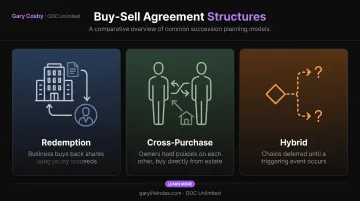
Redemption vs. Cross-Purchase vs. Hybrid Structures
The way the agreement is written determines who buys, who owns the insurance, and where the money flows.
- Redemption (entity purchase): The business owns the policies, pays the premiums, and buys back the departing owner's shares.
- Cross-purchase: Each owner holds a policy on every other owner. Survivors use the death benefit to buy shares directly from the estate.
- Hybrid ("wait-and-see"): The choice between redemption and cross-purchase waits until the triggering event, with the business usually holding the first option to buy.
A buy-sell agreement alone does not create liquidity. It is only a contract. Someone still needs cash to fund the purchase, and that is the gap key man insurance is built to close.
How Key Man Insurance Funds the Buy-Sell Agreement
The mechanics are straightforward once you see them laid out. The business (or the individual owners, depending on structure) takes out a life insurance policy on each key owner. Whoever owns the policy pays the premiums and is named beneficiary.
When a triggering event occurs, the death benefit pays out to whoever holds the policy. That payout then funds the buyout at the valuation already agreed upon in the contract.
Why this matters: without insurance-funded liquidity, businesses are often forced into one of three bad options:
- Liquidating equipment, real estate, or other assets under time pressure
- Taking on new debt to cover the buyout
- Delaying the purchase, which can violate the agreement and strain relationships with the deceased owner's family
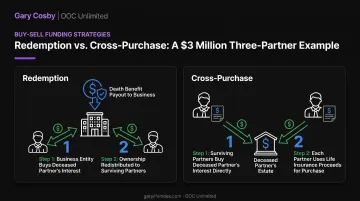
Example: Three partners each own a third of a business valued at $3 million.
- Under redemption: The business owns a policy on each partner, collects the death benefit, buys back the shares, and redistributes ownership among the survivors.
- Under cross-purchase: Each partner owns policies on the other two; the survivors collect those payouts and buy the deceased partner's shares from the estate.
Disability riders extend the same protection beyond death. A disability buy-out rider funds the purchase if a partner becomes permanently disabled and cannot return to work. The agreement stays useful during the owners' working years, not only when someone dies.
At GFI × Team OOC, agents work alongside a business owner's CPA and attorney to structure the insurance funding. The attorney drafts the legal agreement. A valuation professional determines what the business is worth. The insurance agent's job is making sure the funding mechanism matches exactly what the agreement requires.
Who Owns the Cash Value and Why Ownership Structure Matters
Ownership isn't just a technicality. It determines who can borrow against the policy, who controls beneficiary designations, and who decides whether to keep or lapse coverage.
- Redemption agreements: the business owns the cash value, along with the death benefit. The business controls any policy loans or withdrawals.
- Cross-purchase agreements: individual co-owners hold the cash value on the policies they own on each other. Each owner separately controls their own policies.
This distinction becomes complicated fast with more than two or three owners, since cross-purchase requires a separate policy for every owner-pair combination.
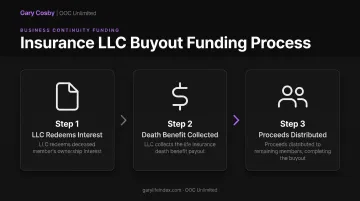
An Insurance LLC solves that scale problem. Instead of each owner holding multiple policies, a dedicated LLC owns one policy per member and elects partnership tax treatment.
When a member dies, the structure works like this:
- The LLC redeems that member's interest and collects the death benefit
- Proceeds go to the remaining members so they can complete the buyout
- Administration stays centralized, and the setup can add creditor protection
It still needs careful legal drafting. There is no blanket IRS rule on how these structures are taxed.
Tax Considerations Owners Should Understand
Tax treatment trips up a lot of owners who assume insurance premiums work like other business expenses. Here's what generally holds true:
- Premiums are not tax-deductible. Whoever pays (the business or an individual owner) cannot write premiums off as a business expense.
- Death benefits are typically income-tax-free when Section 101(j) notice and consent requirements are met for employer-owned policies issued after August 17, 2006.
- Cash value grows tax-deferred in permanent policies, and loans against that value generally aren't taxable if the policy stays in force.
Section 101(j) calls for written notice before issue plus the insured employee's signed consent. Skip that paperwork on an employer-owned policy, and a tax-free death benefit can become taxable.
Work with a CPA or tax attorney before you lock in ownership and funding. Estate tax exposure tied to the agreed valuation also deserves a professional review before you finalize the contract.
Choosing the Right Policy Type for Your Buy-Sell Funding
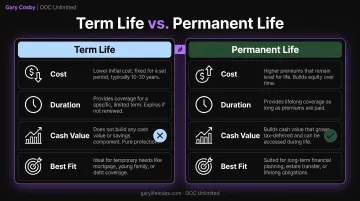
Term and permanent life insurance solve the same basic problem: liquidity at a triggering event — but they behave very differently over time.
| Feature | Term Life | Permanent Life |
|---|---|---|
| Cost | Lower premiums | Higher premiums |
| Duration | 10, 20, or 30 years, then expires or renews at higher cost | No set expiration if premiums continue |
| Cash value | None | Builds over time, tax-deferred |
| Best fit | Short-term ownership plans, younger partners | Long-term ownership, retirement overlap |
Most buy-sell arrangements favor permanent policies for one simple reason: business partnerships tend to outlast a 20-year term. If coverage lapses before a triggering event happens, the agreement is unfunded again. You are right back to the original problem.
Permanent policies also do double duty. The accumulating cash value can supplement an owner's retirement income later on, on top of covering the buyout obligation.
Whichever type you choose, revisit coverage amounts as the business grows. A policy sized for a $2 million valuation five years ago won't cover a buyout if the business is now worth $5 million.
Frequently Asked Questions
What is key person insurance?
It's business-owned life insurance on an essential owner or employee. The company pays the premiums and receives the payout if that person dies or becomes disabled, depending on the policy terms.
What does a buy-sell agreement do?
It sets legally binding terms for transferring ownership when an owner dies, becomes disabled, or exits. This prevents disputes and keeps uninvolved heirs from gaining control of the business.
Who owns the cash value of a key person life insurance policy?
Ownership depends on structure. Under redemption agreements, the business owns the cash value. Under cross-purchase agreements, individual owners hold it on the policies they own for each other.
Is the maturity value of a key man insurance policy taxable?
Death benefits are generally received tax-free when notice and consent requirements are met. Cash value withdrawals above the policy basis, however, may be taxable.
How much key man insurance coverage does a business need?
Coverage should reflect lost revenue, the cost of replacing the key person, and the buyout obligation set in the buy-sell agreement. Review the amount as the business valuation changes.
Can a solo business owner use key man insurance and a buy-sell agreement?
Yes. A solo owner can use coverage to fund a structured sale, wind-down, or transition plan, protecting employees, clients, and the owner's family if something happens unexpectedly.