
For most owners, the honest answer is: nobody knows.
Succession planning gets pushed to "someday" because owners are busy running the business they're supposed to be planning to leave. But the numbers are sobering. PwC's research found only 34% of U.S. family businesses have a robust, documented, and communicated succession plan PwC 2025 survey. Most either have nothing in writing or a plan that exists only in someone's head.
That gap creates real risk: business disruption, family conflict, and lost value at exactly the moment you can't afford it. This guide walks through the steps, strategies, and funding tools owners need to build a plan that actually works.
Key Takeaways
- A succession plan protects against disruption from retirement, death, disability, or an unexpected exit
- Strong plans combine a valuation, a buy-sell agreement, a named successor, and funding (typically life insurance)
- Family businesses face unique communication and readiness risks separate from day-to-day operations
- Starting 3-5 years ahead of a planned exit significantly improves the odds of a smooth transition
What Is a Business Succession Plan?
A business succession plan is the logistical and financial roadmap for transferring management and ownership when a triggering event happens. Those events aren't limited to retirement. According to SCORE's succession guide, owners should plan for the 5 D's: death, disability, divorce, distress, and disagreement.
At the center of most plans sits a buy-sell agreement, a legal document that spells out:
- What events trigger a required transfer
- Who has the right (or obligation) to buy
- How the purchase price gets calculated
- How the buyout gets funded
Succession Planning vs. Business Continuity Planning
People often use these terms interchangeably, but they're not the same thing.
- Succession planning addresses long-term leadership and ownership transition: who runs the company in five years, and who owns it.
- Business continuity planning addresses crisis response: how operations keep running during and immediately after a disruption, according to the U.S. Chamber of Commerce.
You need both. One protects the company's future. The other protects it from Tuesday's emergency.
Why Business Owners Delay Succession Planning (and What It Costs Them)
Here's the uncomfortable truth: planning your succession means confronting your own mortality, your eventual irrelevance to the business, or both. That's a hard conversation to have with yourself, let alone your family.
There's also a financial reason owners freeze up. The Exit Planning Institute reports that 80%-90% of a typical owner's net worth is tied up in their business. When your entire financial future depends on one illiquid asset, the pressure to "get it right" can lead to doing nothing at all.
The cost of that inaction shows up later. EPI's State of Owner Readiness research finds that only 20%-30% of businesses that go to market actually sell — meaning up to 80% of owners hoping to cash out never do.
Consequences of delay include:
- Business discontinuity if a trigger event hits before a plan exists
- Diminished valuation from a rushed or forced sale
- Family discord over who's "in charge" without clear documentation
- Missed opportunities for tax-efficient wealth transfer
The Five Steps of Business Succession Planning
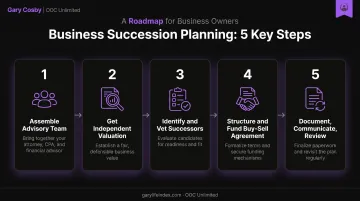
Most succession plans follow the same five-step sequence. Skip one and the transfer usually stalls when ownership, price, or cash actually have to move.
Step 1: Assemble Your Advisory Team
You need specialists, not generalists. A typical team includes a financial advisor, CPA, attorney, valuation expert, and insurance consultant. Each handles a different piece. Trying to DIY this with one advisor usually leaves gaps.
Step 2: Get an Independent Valuation
You can't sell, transfer, or insure what you haven't valued. Three methods are commonly used:
| Method | Best For |
|---|---|
| Asset-based | Capital-intensive or asset-holding businesses |
| Income / DCF | Companies with predictable, forecastable cash flow |
| Market comparables | Businesses with sufficient comparable sale data |
Step 3: Identify and Vet Successors
Options include family members, key employees, co-owners, or an outside buyer. Vetting matters as much as identifying. A successor on paper isn't the same as one ready to run the company—confirm skills, commitment, and a realistic path to fund the purchase.
Step 4: Structure and Fund a Buy-Sell Agreement
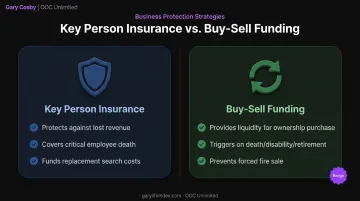
This is where the plan gets teeth. The attorney drafts the legal agreement. The valuation professional sets the price mechanism. Life insurance typically funds the buyout, covering:
- Key person insurance — protects the business against lost revenue if a critical person dies unexpectedly
- Buy-sell funding — provides liquidity for remaining owners or the business to purchase a departing owner's interest after death, disability, or retirement
Licensed insurance agents at GFI work specifically within this funding piece, coordinating alongside a business owner's CPA and attorney rather than replacing them. The insurance component supplies the cash when a death, disability, or retirement triggers the buyout.
Step 5: Document, Communicate, Review
Write it down. Share it with the people affected. Then revisit it annually, or immediately after a major life or business event such as a divorce, a new partner, or a health scare. An outdated plan can be as risky as having no plan.
Essential Strategies for a Successful Transition
A few disciplined moves protect value and cut conflict when ownership changes hands:
- Start early. Citizens Bank recommends beginning three to five years before a planned exit to build leadership depth and protect business value (Citizens Bank's succession guide). Rushed transitions rarely preserve full value.
- Separate ownership from leadership. A family member can hold equity without running daily operations. That distinction alone resolves many family succession conflicts.
- Coordinate with personal estate planning. Per the IRS, the estate tax exemption is scheduled to rise to $15 million for deaths in 2026, up from $13.99 million in 2025. That shift changes the calculus for owners tying a business exit to personal wealth transfer. Timing matters.
- Use key person and buy-sell funding. Sudden loss of an owner or critical employee shouldn't sink the business. Insurance-funded protection gives the company room to recruit, train, or execute the buyout without a fire sale.
- Build a mentorship runway. Don't hand over the keys overnight. Set milestones: shadowing, decision-making authority, and client relationships transferred in phases, not all at once.
Special Considerations for Family-Owned Businesses
Family businesses carry risks that pure operational planning doesn't touch. Cornell research found that 47.7% of family business collapses were tied directly to the founder's death, often because no transition plan existed.
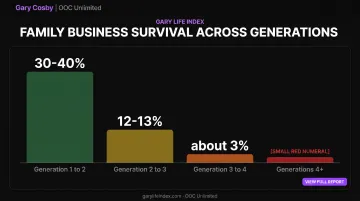
Industry estimates tell a similar story: roughly 30-40% of family businesses make it to a second generation, 12-13% to a third, and only about 3% survive to a fourth. Closing that gap takes more than a will—it takes clear family governance and a funded path for ownership to change hands.
Tools that help:
- Family councils or advisory boards to formalize decision-making
- A written family charter defining roles and expectations
- Separate ownership and leadership tracks so heirs can keep equity without taking unwanted jobs
- Buy-sell terms and funding so a death or exit does not force a fire sale
- Transparent communication with employees and key customers, not just family
PwC data shows 70% of family businesses now have a documented vision statement and 69% have a defined code of conduct. Formal governance is becoming standard practice, and pairing it with a workable ownership transfer is what keeps the business intact across generations.
Frequently Asked Questions
What is a business succession plan?
A documented strategy for transferring business ownership and leadership when a triggering event occurs, such as retirement, death, disability, or disagreement between owners.
What are the five steps of business succession planning?
Assemble an advisory team, get an independent valuation, identify successors, structure and fund a buy-sell agreement, then document and review the plan annually.
What are the 5 D's of business succession planning?
Death, disability, divorce, distress, and disagreement: the common triggering events that force an ownership transfer, planned or not.
What is an example of a business succession plan?
A typical example: a family business owner sets up a buy-sell agreement with a co-owner, funded by life insurance that provides liquidity to purchase the departing owner's interest after death or retirement.
What is the success rate of family business succession planning?
Roughly 30-40% of family businesses survive to a second generation, 12-13% to a third, and about 3% to a fourth. Formal planning improves those odds.
What are the key trends in business succession planning for 2026?
Earlier planning timelines, greater use of insurance-funded buyouts, and closer attention to the federal estate tax exemption rising to $15 million for deaths in 2026.