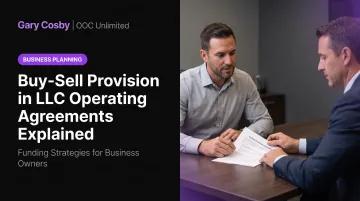
A buy-sell provision is the clause that prevents this. It spells out how a member's ownership stake gets valued and transferred when specific events happen. Every multi-member LLC needs one, whether it's baked into the operating agreement or kept as a separate document.
This article covers the triggers that activate a buyout, how to value a departing member's interest, where the money comes from, and why life insurance often shows up as the funding mechanism of choice.
Key Takeaways
- A buy-sell provision governs how an LLC member's interest is valued and transferred when a triggering event occurs.
- Common triggers include death, disability, divorce, bankruptcy, retirement, and member disputes.
- Valuation methods range from fixed prices to formulas to independent appraisals.
- Life insurance frequently funds death-triggered buyouts because it delivers cash exactly when it's needed.
- These provisions can sit inside the operating agreement or exist as a standalone buy-sell agreement.
What Is a Buy-Sell Provision in an LLC Operating Agreement?
A buy-sell provision is a binding contractual clause that dictates what happens to a member's ownership interest when a defined event occurs, such as death, disability, or voluntary departure. It sets the valuation method, the buyer (whether that's the LLC itself or other members), and the payment terms.
Think of it as a prenup for your business. Nobody wants to plan for a breakup—but skipping the conversation almost always makes the exit messier and more expensive.
Where Should the Provision Live?
Buy-sell terms can be built directly into the operating agreement, or drafted as a separate, standalone buy-sell agreement. Both approaches work, but they suit different situations:
- Integrated into the operating agreement: Makes sense for smaller LLCs with few members and simpler ownership structures.
- Standalone agreement: Better for LLCs with complex funding arrangements, multiple insurance policies, or frequent membership changes.
The American Bar Association's Business Law Today notes that generic operating agreement templates often address transfer restrictions but skip full buyout mechanics. In practice, that usually means:
- Members can't freely sell their interest
- The agreement never explains how a buyout price gets calculated or funded
That gap leaves owners stuck when someone actually needs to exit.
Is a Buy-Sell Agreement the Same as an Operating Agreement?
No. A buy-sell agreement covers ownership transfer only—who can buy, at what price, and on what terms. An operating agreement governs the LLC as a whole, including management, voting, and profit allocation. Buy-sell terms often appear as one provision inside the operating agreement rather than as a separate contract.
Common Triggering Events for a Buyout
Triggering events are the specific circumstances that activate the buy-sell provision. Every LLC should match these events to its ownership structure before a transfer is forced.
Death, Disability, Divorce, and Bankruptcy
When a member dies, their LLC interest typically passes to their heirs unless the operating agreement gives remaining members the right—or obligation—to buy it back first. Without that clause, a surviving spouse or adult child can become a co-owner overnight with no business experience.
The Exit Planning Institute reports that roughly 50% of owner exits are involuntary, driven by what it calls the "5 Ds": death, disability, divorce, distress, and disagreement.
Other forced-transfer scenarios:
- Disability can force a member to liquidate their interest, and without a defined process valuation disputes drag on for months
- Divorce may put LLC interest in play as marital property and pull the business into family court
- Bankruptcy can let creditors attempt to seize a member's ownership stake to satisfy debts
Voluntary and Involuntary Triggers
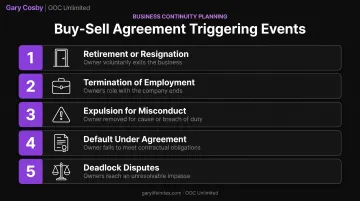
Life events are only part of the picture. Buy-sell provisions also cover planned exits and operational breakdowns:
- Retirement or resignation — a planned, voluntary exit that still needs a valuation and payment schedule
- Termination of employment — relevant when a member also works for the LLC as an employee
- Expulsion for misconduct — removing a member who breaches fiduciary duty or engages in fraud
- Default under the operating agreement — failing to meet capital contribution obligations, for example
- Deadlock disputes — often handled with a "shotgun clause," where one member sets a price and the other must buy or sell
Valuation Methods: How Much Is a Member's Interest Worth?
Valuation is where most buy-sell provisions get tested. Pick the wrong method, or fail to update it, and you're inviting a fight.
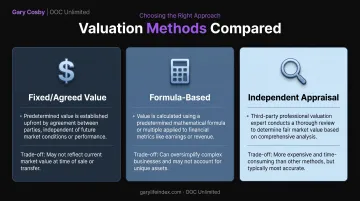
Fixed Value vs. Formula vs. Appraisal
| Method | How It Works | Trade-Off |
|---|---|---|
| Fixed/agreed value | Members agree on a set dollar amount at drafting | Simple to apply, but goes stale fast if not updated regularly |
| Formula-based | Uses book value, EBITDA multiples, or a hybrid calculation | Must be tailored to the specific business; generic formulas rarely fit |
| Independent appraisal | A qualified appraiser values the business at the time of the trigger | Objective and defensible, but costly and time-consuming |
According to The Tax Adviser, a fixed price set at drafting may not hold up for tax purposes if it no longer reflects fair market value at the actual triggering date. IRS Revenue Ruling 59-60 backs this up, stating flatly that no rigid formula can substitute for a fact-specific valuation.
Practical approach: Many LLCs combine methods over the business lifecycle. Use book value or a simple formula in year one, when the business has little established value, then shift to a professional appraisal once revenue and complexity grow.
Funding the Buyout: Where the Money Comes From
A valuation method is only useful if there's actual money to complete the purchase. This is where many buy-sell provisions fall apart in practice.
Internal Funding Options
- Cash reserves: Simple, but few LLCs keep enough on hand to buy out a member's full interest without straining operations.
- Installment payment plans: The LLC or remaining members pay the departing member over time, often through a promissory note, easing the immediate cash burden.
- Sinking fund: The LLC sets aside money over time specifically for a future buyout, so liquidity exists before a trigger event hits.
Life Insurance as a Dedicated Funding Source
For death-triggered buyouts specifically, life insurance solves the timing problem: the payout arrives right when it's needed, without draining business cash or forcing a fire sale of assets.
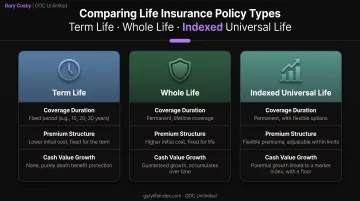
Three common policy types show up in buy-sell funding:
- Term life: Affordable, temporary coverage for 10, 20, or 30 years, often sized to match a specific ownership timeline.
- Whole life: Permanent coverage with predictable premiums and guaranteed cash-value growth.
- Indexed universal life (IUL): Permanent coverage with cash value linked to market-index performance and downside protection.
Structuring this correctly means matching the coverage amount to the current valuation, naming the right policy owner and beneficiary, and reviewing coverage as the business grows.
Most owners split the work: a licensed life insurance agent designs the funding, an attorney drafts the agreement, and a valuation professional sets the business value. Gary Cosby Jr. at OOC Unlimited focuses on that insurance-funding piece alongside the owner’s existing advisors.
Disability can also trigger a buyout. Disability buyout coverage can fund that scenario, though policy design varies and should be reviewed with a licensed professional.
External Financing
When internal cash and insurance proceeds fall short, LLCs sometimes turn to bank loans. The SBA's 7(a) loan program explicitly lists "complete or partial changes of ownership" as an eligible use, giving business owners another lever for closing a funding gap.
Types of Buy-Sell Agreement Structures
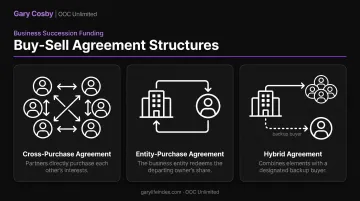
How the purchase gets executed matters almost as much as how it gets valued. Most LLC buy-sell provisions use one of three structures:
- Cross-purchase agreements: Members buy each other's interests directly. Clean with two or three members; administratively heavy in larger groups because each member may need coverage on every other member.
- Entity-purchase (redemption) agreements: The LLC buys back the departing member's interest. Easier to administer in larger LLCs—one buyer instead of many.
- Hybrid agreements: The LLC gets the first right to buy; if it declines or can't complete the purchase, individual members step in. Spell out who must buy so no interest is left without a buyer.
Match the structure to membership size and be explicit about who is obligated to purchase when a trigger event hits.
Drafting and Maintaining Your Buy-Sell Provision
A buy-sell provision isn't a one-time document. It needs upkeep.
Start with the right team:
- Work with a business attorney to draft triggers, valuation terms, and buyout mechanics tailored to your LLC's structure and your state's laws.
- Bring in a valuation professional to establish or update the business's fair market value.
- Coordinate with a licensed insurance agent to size and structure any life insurance funding component.
Review triggers:
The ABA's Business Law Today flags changed market conditions, new members, and shifting valuations as issues that frequently get neglected after the initial drafting. Revisit the provision:
- Annually, as a baseline check
- After a marriage, divorce, or new member joins
- Whenever the business's valuation shifts meaningfully
Insurance-funded buyouts require coordination across three roles:
- Attorney drafts the enforceable agreement
- CPA supports the broader succession strategy
- Insurance agent structures the coverage amount and policy ownership to match
None of these roles substitutes for the others.
Frequently Asked Questions
What should be included in a buy-sell agreement?
It should name the members, define triggering events, specify a valuation method, outline the funding source, and address tax implications. Leaving any of these out creates gaps that often surface during a death, divorce, or departure.
What should an LLC operating agreement include?
Beyond the buy-sell provision, it should cover ownership structure, management roles, capital contributions, and how profits and distributions get allocated among members.
Is a buy-sell agreement the same as an operating agreement?
No. They can be combined into one document or kept separate, but a buy-sell agreement specifically addresses ownership transfer, while an operating agreement governs the entire business.
What are common mistakes in LLC agreements?
Outdated valuations, missing triggering events, and relying on generic templates that only restrict transfers without explaining buyout mechanics are the most frequent issues.
How is a buyout typically funded?
Common sources include business cash reserves, installment payment plans, and life or disability insurance, often used in combination depending on the trigger.
Do I need a lawyer to draft a buy-sell provision?
Yes. An attorney should draft the legally binding agreement, while a licensed insurance agent can help structure the funding component. Each role covers a different part of the process.