That's the gap a disability buy-sell agreement closes. Paired with disability insurance funding, it protects owners, partners, and families from exactly this kind of scramble. This article covers what these agreements are, why they matter, the structures available, and how to set one up correctly.
Key Takeaways
- A disability buy-sell agreement locks in how a disabled owner’s share is valued and transferred
- Disability strikes far more often than death during working years, yet standard buy-sell agreements often skip it
- Fund the agreement with disability buy-sell insurance, or the terms cannot be carried out when disability hits
- Choose cross purchase, entity purchase, or wait-and-see based on partner count and business setup
What Is a Disability Buy-Sell Agreement and Why Do You Need One?
A disability buy-sell agreement is a legally binding contract that spells out buyout terms if an owner becomes disabled and can't return to work. It names the trigger, the buyer, the price, and the payment terms in advance, before anyone's under emotional or financial pressure.
That structure answers why you need a buy-sell agreement: it prevents disputes, protects business continuity, and locks in a fair outcome before anyone has to negotiate mid-crisis.
The Numbers Most Owners Miss
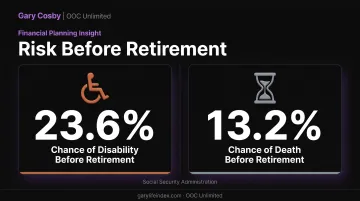
Owners plan for death. Fewer plan for disability, even though it's statistically more likely.
According to Social Security Administration data, a worker turning 20 in 2026 has a 23.6% chance of becoming disabled before normal retirement age, compared with a 13.2% chance of dying in that same window. The Council for Disability Awareness reaches a similar conclusion: just under one in four 20-year-olds will be out of work for at least a year due to disability before retirement.
Without a written agreement:
- A disabled owner's spouse or heirs could become unintended co-owners
- Remaining partners could be forced to negotiate a buyout under duress
- The business could stall entirely while everyone argues over what's "fair"
Types of Disability Buy-Sell Agreement Structures
The structure you choose shapes who buys, who pays, and how smoothly the transition goes.
Cross Purchase Agreement
The remaining partners individually buy the disabled owner's share. Each partner typically owns a policy on the other, pays the premium, and collects the payout if that partner becomes disabled.
Cross purchase works best in two-partner setups. Add more owners, and the policy math gets messy fast. Six owners would need 30 separate policies to cover everyone, which is why larger partnerships usually look elsewhere.
Entity Purchase Agreement
With an entity purchase (also called a stock redemption), the business itself buys back the disabled owner's shares. The company owns the policy, pays the premium, and uses the proceeds to redeem the ownership stake.
This structure centralizes administration and works better for businesses with three or more owners, since it avoids the multiplying-policy problem cross purchase creates.
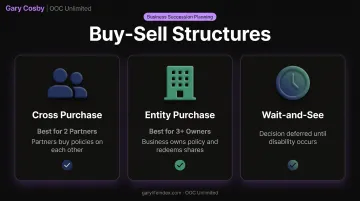
Wait-and-See Agreement
This hybrid defers the decision. At the time of disability, the partners decide whether the company, the remaining partners, or both will fund the buyout. It gives flexibility as tax laws or business circumstances shift over time.
Choosing the right fit depends on:
- Partner count — two partners lean cross purchase; three or more lean entity purchase
- Business entity type — S-corps, C-corps, and partnerships each carry different tax implications
- Tax and basis treatment — who owns the policy and who receives the proceeds affects basis, premiums, and how the buyout is taxed
None of this is a do-it-yourself exercise. Consult a business attorney to draft the actual agreement. It's a legal document, not an insurance product, and getting the language wrong can undo the entire plan.
Funding the Agreement: How Disability Insurance Makes the Plan Work
An agreement without funding is a promise with no teeth. This is where disability buy-sell insurance comes in, and it's often misunderstood. A disability buy-sell insurance policy funds a predetermined buyout. It pays a lump sum or installments to the purchasing party—the remaining partners or the entity, depending on structure—not directly to the disabled owner.
Don't Confuse This With Other Coverage
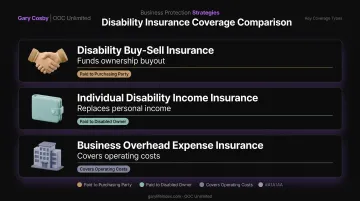
Three different products solve three different problems:
- Disability buy-sell insurance — funds the ownership buyout itself
- Individual disability income insurance — replaces the disabled person's personal income
- Business overhead expense insurance — covers ongoing operating costs while the business adjusts Mixing these up leaves gaps. A business owner might have personal disability income coverage and still have zero funding for the actual ownership transfer.
How the Payout Works
Most policies use a waiting period, sometimes called an elimination period, before the buyout triggers. Industry practice commonly runs in the 12 to 24-month range, giving the disabled owner time to potentially recover before triggering a permanent buyout. Settlement options matter too. A fixed-period settlement pays benefits over a set timeframe—such as several years—rather than as a single lump sum or a lifetime income stream. Payout size has no universal number. The amount is set in the agreement based on business valuation and the funding structure chosen. A $2 million company and a $200,000 company will fund very different buyouts. Matching policy design to the agreement takes coordination. GFI × Team OOC's licensed agents help business owners explore disability buy-sell funding options and work alongside the owner's CPA and attorney on tax and agreement details. Insurance funding, legal drafting, and valuation each play a distinct role.
Best Practices for Structuring a Strong Disability Buy-Sell Agreement
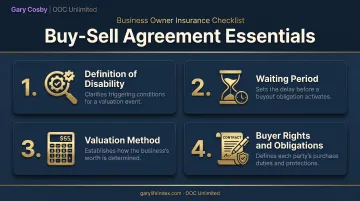
A strong agreement leaves nothing open to interpretation when a claim actually happens. Every agreement should clearly define:
- What constitutes "disability" — total, partial, own-occupation, or any-occupation
- The waiting period — how long before the buyout obligation kicks in
- Valuation method — a fixed price, a formula, or an independent appraisal
- Who has the right or obligation to buy — spelled out explicitly, not assumed
Those definitions only hold up if the price and the document stay current. Get a professional business valuation: Prudential's guidance on buy-sell planning notes that a formal valuation from a qualified appraiser or valuation professional helps minimize disputes and reduces the risk of an IRS challenge later. Without it, the buyout price becomes a negotiation at the worst possible moment.
Review the agreement every 2-3 years, or immediately after major changes:
- New partners joining
- Significant business growth or decline
- Changes in tax law affecting the funding structure
An agreement written for a two-partner business ten years ago may no longer fit a five-partner operation today.
Frequently Asked Questions
Why do I need a buy-sell agreement?
It protects business continuity, prevents disputes, and ensures a fair, predetermined outcome if a partner becomes disabled, dies, or exits the business.
What type of disability buy-sell agreement works best for small partnerships?
A cross-purchase agreement typically works best for two-partner businesses. Entity purchase or wait-and-see agreements tend to suit larger partnerships better.
How does a disability buy-sell insurance policy work?
It funds a predetermined buyout after a waiting period set in the policy. Benefits go to the purchasing party, not the disabled owner.
What are fixed-period settlement options?
Benefits are paid over a set, agreed length of time instead of one lump sum or a lifetime benefit.
How much is a permanent disability payout?
There's no fixed industry figure. The payout depends on the business valuation and the policy terms established in the buy-sell agreement itself.