
That gap is more common than you'd think. Only about 40% of family-owned businesses successfully transition to a second generation, and roughly 13% make it to a third, according to Cornell's family business research. Without a plan, families and companies are left scrambling during the worst possible moments.
This guide walks through the legal, financial, and insurance-based steps Texas business owners need for a smooth ownership transition — and where each piece of the puzzle fits.
Key Takeaways
- Succession planning protects business continuity, family relationships, and company value during ownership changes
- Texas's community property laws and lack of a state estate tax shape how plans should be structured
- Buy-sell agreements, trusts, and insurance funding work together, not separately
- Starting 3-10 years before a transition produces the best outcomes
What Is Business Succession Planning and Why Does It Matter in Texas
Succession planning is the legal, financial, and operational process of transferring business ownership or leadership, whether triggered by retirement, disability, or death. It is a coordinated set of decisions made ahead of time so a crisis doesn't force them on you.
Texas adds a few wrinkles most other states don't have.
Community property complicates ownership. Texas is one of nine community property states. Property acquired during marriage is generally considered jointly owned by both spouses, subject to specific exceptions. That means a spouse's interest in a business built during marriage often needs to be addressed directly in transfer documents, and often requires spousal consent before a sale or transfer can proceed cleanly.
Texas has no state estate tax. The state's inheritance tax was repealed effective September 1, 2015. But don't mistake that for a free pass.
Federal estate and gift tax rules still apply. For 2026, the federal basic exclusion amount sits at $15 million, with an annual gift exclusion of $19,000 per recipient. Most small and mid-sized Texas businesses won't hit that federal threshold, but any business approaching it needs proactive tax planning.
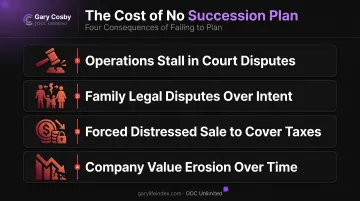
The risk of doing nothing is real. Without a plan:
- Operations can stall while ownership questions get sorted out in court
- Family members may end up in legal disputes over what the owner "would have wanted"
- The business may be forced into a distressed sale to cover taxes or buy out heirs
- Company value erodes while everyone waits
Key Steps to Building a Successful Succession Plan
Step 1: Start Early and Define Your Goals
Research on CEO transitions, including McKinsey's analysis of family business successions, describes an eight- to 15-year succession journey, with five to 10 years often needed just to identify and prepare candidates. A 3- to 10-year runway is realistic for most owners.
Before drafting anything, clarify:
- Your target retirement timeline (even a rough one)
- Your financial needs post-transition
- What legacy or values you want the business to carry forward
Step 2: Identify and Prepare Your Successor
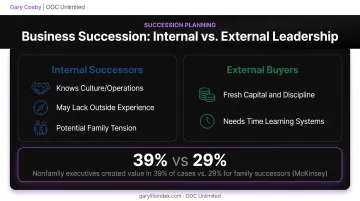
You generally have two paths: internal (family or existing employees) or external (an outside buyer).
Internal candidates:
- Know the business culture and operations already
- May lack outside experience or objectivity
- Can create family tension if multiple candidates want the role
External buyers:
- Bring fresh capital and stronger operational discipline
- May need more time to learn culture, systems, and key relationships
McKinsey's family-business research found nonfamily executive transitions created value in 39% of cases, versus 29% for family successors. Family handoffs that do work often produce larger gains, but less consistently.
Whichever path you choose, build a gradual training period. Dropping someone into full ownership overnight rarely works.
Step 3: Put Legal Structures in Place
A buy-sell agreement is the backbone of most succession plans. It spells out exactly what happens if an owner dies, becomes disabled, retires, or simply wants out — including who can buy in, how the price is set, and what triggers a forced sale or purchase.
Beyond the buy-sell agreement, make sure these are aligned:
- Operating agreements or bylaws with clear succession clauses
- Wills directing where your business interest goes
- Revocable living trusts, which can keep a business interest under a successor trustee's control if you become incapacitated
- Durable powers of attorney, tailored to include specific business authority
None of these documents work well in isolation. They need to be reviewed together so they don't contradict each other. In Texas, community property rules can also affect how ownership interests transfer between spouses, so your attorney should align business documents with your marital property situation.
Step 4: Address the Financial and Tax Strategy
Before you can set fair transfer terms, you need a real number. A professional business valuation establishes that number and flags any tax exposure tied to the transfer.
Texas has no state estate tax, but federal estate and capital gains rules still shape timing and structure. Once you know the value, you need liquidity to act on it. This is where funding becomes the make-or-break detail:
| Funding Approach | How It Works | Main Risk |
|---|---|---|
| Unfunded buy-sell | Buyer pays out of pocket or over time | Strains cash flow, may delay or derail the buyout |
| Insurance-funded buy-sell | Life insurance proceeds pay for the ownership purchase | Requires ongoing premium commitment, but delivers cash exactly when needed |
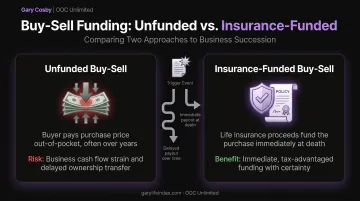
An unfunded agreement looks fine on paper until the triggering event actually happens — then the surviving partners are stuck finding cash fast, often at the worst possible time.
Step 5: Communicate the Plan and Document Everything
A plan that sits in a drawer helps no one. Talk to your family, business partners, and key employees about what the plan says and why. Transparency here isn't just courtesy — it heads off disputes before they start.
Revisit the plan every few years, or whenever there's a major shift: a new partner, a divorce, a change in business value, or a change in tax law.
Insurance and Financial Tools That Protect the Transition
Legal documents set the rules. Insurance provides the cash to follow through on them.
Two tools do most of the heavy lifting:
- Key person life insurance: A business-owned policy on an essential employee, founder, or partner. If that person dies, the company receives proceeds to offset lost revenue or fund hiring and training a replacement.
- Buy-sell funding: Life insurance proceeds purchase a departing or deceased owner's stake so the company isn't forced into a fire sale to cover the buyout.

Gary Cosby Jr. at OOC Unlimited works with business owners on this insurance-funding piece, exploring options for key person coverage and buy-sell funding. He handles the insurance design. An attorney drafts the legally binding agreement, and a valuation professional determines the business's worth.
Coordinating the attorney, CPA, and insurance professional keeps the funding strategy aligned with the legal and tax structure rather than working against it.
Special Considerations for Family-Owned Texas Businesses
For family-owned Texas businesses, succession carries an emotional layer that formal governance can help manage. Separating family roles from business roles reduces the chance that holiday dinners turn into shareholder meetings.
Practical steps that help:
- Create a family council or bring in an outside advisor for sensitive ownership decisions
- Evaluate successors on readiness and performance, not birth order
- Mentor the next generation early, giving them real operational exposure before they're handed authority
A study of Chinese family businesses found that non-firstborn succession was linked to lower innovation investment, tied to legitimacy and role-expectation pressures. For Texas owners, the practical point is simple: whoever takes over needs clear authority and buy-in from the rest of the family, not just the title.
Common Succession Planning Mistakes to Avoid
Most failed transitions trace back to a few avoidable errors. Steer clear of these:
- Waiting too long. A sudden illness or death should not be what forces a plan into place. Start while you still control the timeline and the options.
- Keeping it informal or secret. Verbal promises and undocumented intentions rarely hold up when ownership is contested, and they often shock heirs and co-owners.
- Skipping professional guidance. Attorneys, CPAs, and licensed insurance professionals each catch different risks—legal structure, tax treatment, and buy-sell funding. Leave one out and the fix usually costs more later.
Frequently Asked Questions
What are the laws of succession in Texas?
Without a will or business succession documents, Texas intestacy and probate laws under the Estates Code determine how a business interest passes. This often creates delays, court involvement, and ownership outcomes the owner never intended.
How do I plan for succession in a family business?
Start early, choose a successor based on readiness rather than birth order, and put governance documents in writing. Open communication with family members and key employees reduces disputes down the road.
When should a Texas business owner start succession planning?
Ideally, planning begins 5-10 years before a transition. That timeline gives you room to train a successor properly and get legal and tax structures in place without rushing.
What is a buy-sell agreement, and do I need one?
A buy-sell agreement sets the terms for transferring ownership among co-owners when someone dies, retires, or exits. Any business with more than one owner needs one to avoid disputes and forced sales.
How does life insurance fit into a succession plan?
Key person and buy-sell funded insurance provide the liquidity needed to keep the business running and complete an ownership buyout. Without that funding, a triggering event can force a distressed sale.
Does Texas have a state estate tax that affects business succession?
No. Texas repealed its inheritance tax in 2015 and has no state estate tax. Federal estate and gift taxes may still apply, depending on the size of the transfer.
Conclusion
A working succession plan is a coordinated legal, financial, and insurance strategy built well before you need it. Draft the buy-sell agreement, get a current business valuation, and secure funding so the plan can execute smoothly when the time comes.
Start with an attorney and a CPA on the legal and tax structure. Then work with a licensed insurance professional, such as Gary Cosby Jr. at OOC Unlimited, on the funding that keeps the plan from stalling when it matters most.