
New York adds its own wrinkle here. State intestacy rules, entity laws for LLCs and corporations, and probate procedures all shape what happens to a business when an owner steps away unexpectedly. Generic succession advice often misses these specifics entirely.
This article breaks down the core succession strategies available to New York owners, explains how life insurance funding makes those strategies workable, and outlines how to choose the right approach for your situation.
Key Takeaways
- A documented plan protects the business, family, and employees when an owner exits unexpectedly
- New York intestacy and entity laws , not the owner's wishes, determine outcomes without a plan
- Common strategies include family transfer, buy-sell agreements, key employee buyouts, and third-party sales
- Life insurance often provides the liquidity these strategies require
- The right approach depends on ownership structure, family involvement, and available cash
What Is Business Succession Planning?
Succession planning is the process of documenting how leadership and ownership transfer when an owner retires, becomes incapacitated, dies, or otherwise exits the business. In New York, this documentation has to align with two separate legal frameworks:
- Entity laws governing your specific business structure (LLC, corporation, or partnership)
- Estate and probate rules that determine how a deceased owner's interest gets handled Treat the plan as a living document. Revisit it as your business grows, your partners change, and your family situation evolves.
Why Succession Planning Is Critical for New York Business Owners
Nearly half of family-owned companies operate without a formal succession plan, according to Kreischer Miller's 2025 Family Business Survey, which found that 45.9% have no documented plan in place. That's a lot of businesses gambling on smooth transitions.
The Five Ds That Force Rushed Decisions
The Exit Planning Institute identifies five triggers that commonly force owners into unplanned exits:
- Death — sudden, with no transition roadmap in place
- Disability — the owner can no longer run daily operations
- Divorce — ownership stakes become part of a settlement
- Distress — financial pressure forces a fast, often unfavorable sale
- Disagreement — partners can't align on direction Any one of these can hit without warning. Without a plan, you're negotiating under pressure instead of on your own terms.
New York's Intestacy Problem
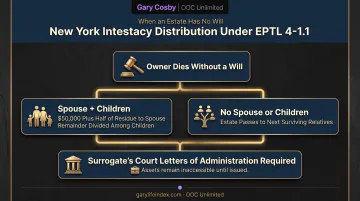
Here's where it gets specifically relevant to New York owners. Under EPTL 4-1.1, if you die without a will, state law, not your preferences, dictates who inherits your estate, including your business interest. A spouse with children receives $50,000 plus half the residue, with the rest split among children. No spouse or children? The whole estate goes to your next surviving relatives by statute. That's a legal formula deciding who ends up owning a piece of your business. It may not be the partner who's spent a decade helping run it, and it may not even be someone equipped to run it at all. There's also a practical timing issue. In New York, Surrogate's Court must issue Letters of Administration before anyone, including a co-owner, can access certain business accounts or assets tied to the deceased owner's estate. Until that fiduciary authority is granted, those funds aren't accessible. That's a real operational gap at the exact moment your business needs stability.
Key Business Succession Planning Strategies for New York Owners
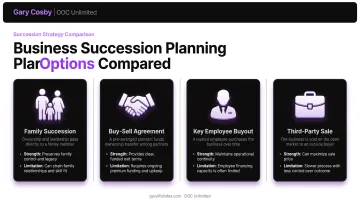
New York owners typically choose among four paths: family transfer, partner buy-sell, management buyout, or a third-party sale. Each option trades off control, speed, tax complexity, and how much of the culture you keep.
Family Succession (Intergenerational Transfer)
This strategy gradually transfers ownership and shares to a family member while training them to lead.
Best suited for: Family-owned businesses with a willing, capable next generation ready to step in.
Strengths:
- Preserves company legacy and culture
- Maintains existing client and vendor relationships
- Allows a phased, low-disruption handoff
Limitations:
- Family conflict is common when roles aren't documented in writing
- Willingness doesn't guarantee the operational skills the business needs
Buy-Sell Agreement Among Partners
A buy-sell agreement is a legally binding contract dictating how ownership transfers when a partner exits, dies, or becomes disabled. According to the Journal of Accountancy, these typically take one of two forms:
- Cross-purchase: remaining owners individually buy the departing owner's interest
- Entity-purchase (redemption): the business itself redeems the departing owner's interest
Best suited for: Multi-partner LLCs, corporations, and professional practices.
Strengths:
- Sets valuation formulas and triggering events in advance
- Gives remaining partners first right to purchase, keeping ownership in the group
Limitations:
- Needs a funding mechanism (life insurance is common)
- Requires periodic valuation updates as the business grows
New York adds entity-specific rules. Under LLC Law 603, membership interests are assignable, but an assignment alone does not transfer management or voting rights; that depends on the operating agreement. Business Corporation Law 1511 similarly restricts share transfers for professional service corporations to eligible individuals or trusts.
Key Employee or Management Buyout
This involves selling the business to trusted employees or managers who already understand the operations.
Best suited for: Owners with no family successor who want continuity of culture and staff.
Strengths:
- Preserves institutional knowledge inside the company
- Eases client transitions because buyers already hold those relationships
Limitations:
- Employees rarely have capital for an outright purchase
- Usually needs seller financing or an insurance-funded arrangement to bridge the gap
Third-Party Sale or External Transition
This path sells the business to a strategic buyer, competitor, or private equity firm—or winds it down through liquidation.
Best suited for: Owners maximizing exit value with no internal successor available.
Strengths:
- Can yield the highest purchase price
- Supports a clean, complete exit
Limitations:
- Longer timeline than most internal transitions
- Higher risk of losing company culture and key staff
- Heavier New York due diligence and tax review, which can raise deal cost and delay closing
Funding Your Succession Plan: The Role of Life Insurance
Here's the part that trips up a lot of owners: even a perfectly structured buy-sell agreement or family transfer plan can fail without the cash to actually execute it.
If a partner dies, the agreement might say the surviving partners must buy out their share. But where does that money come from? Without a funding source, the business often ends up:
- Draining operating cash reserves
- Taking on debt at an inopportune time
- Forcing a fire sale of assets to raise funds
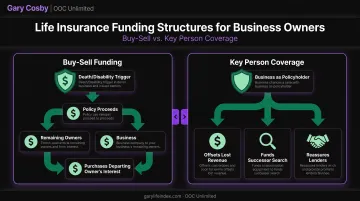
Life insurance solves this liquidity gap. Two structures are common:
- Buy-sell funding: Policy proceeds give remaining owners or the business cash to purchase a departing owner's interest when a trigger event occurs
- Key person coverage: The business owns the policy and uses proceeds to offset lost revenue, fund a successor search, and reassure lenders
OOC Unlimited's licensed agents work specifically within this insurance lane. They design and place the insurance component of a succession plan. Attorneys draft the legally binding buy-sell agreement, and valuation professionals determine what the business—and each owner's share—is actually worth.
That division of labor matters: your insurance strategy should complement the legal and tax structure your CPA and attorney build, not replace it.
How to Choose the Right Succession Strategy
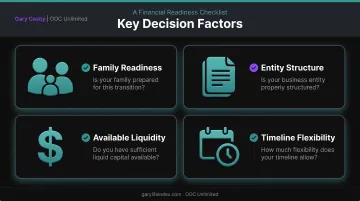
There's no single "best" strategy. The right fit depends on a handful of concrete factors:
- Family readiness — Is there a capable family successor who actually wants the role? Skill without desire—or desire without skill—creates problems later.
- Entity structure — How does New York law treat ownership transfers for your entity type? An LLC operating agreement can restrict transfers in ways corporate bylaws often don't.
- Available liquidity — Can the business or remaining owners fund a buyout in cash, or is insurance funding needed to bridge the gap?
- Timeline flexibility — How much runway do you have for training, valuation, and agreement structuring before you intend to step away?
That last point matters more than owners often realize. Citizens Bank recommends starting the planning process three to five years before the intended transition. Edward Jones research found 31% of owners wait until just one to two years before transition to even start these conversations. That's a tight window for a decision this large.
What to Check Before Finalizing Your Plan
Before you treat a succession plan as final, run through this checklist:
- Current valuation — An outdated business valuation drives an inaccurate buyout price, which can shortchange either the departing owner or the remaining partners.
- Insurance coverage amounts — As the business grows, coverage tied to a buy-sell agreement should scale with it; a policy sized for a $2 million business won't cover a $5 million buyout.
- Written family expectations — Verbal understandings about "who gets what" create disputes later; put them in writing.
- Full professional team — Assemble an attorney, CPA, and insurance advisor rather than relying on one advisor to cover all three roles.
Have that team review valuation, funding, and documentation together before you sign. A gap in any one area can undo months of planning.
Conclusion
A succession plan isn't paperwork for paperwork's sake. It's what stands between an orderly transition and a scramble that puts your business, your family, and your employees at risk.
New York owners face a specific set of legal and tax considerations — from intestacy defaults to entity-specific transfer rules — that make early, structured planning worth the effort. Waiting until a triggering event forces the issue rarely produces good outcomes.
Put your attorney, CPA, and insurance advisor in the same room now, and lock in how ownership transfers and buy-sell obligations will be funded—before a death, disability, or exit forces the timeline.
Frequently Asked Questions
How do I plan for succession in a family business?
Start by identifying a willing, capable successor and documenting their role clearly. Use tools like buy-sell agreements and life insurance funding to make the transition financially workable, not just a verbal handoff.
What is the success rate of family business succession?
Succession often stalls when no plan exists—and roughly 45.9% of family-owned businesses have none, according to Kreischer Miller's 2025 survey. Common failure points include unclear roles, family conflict, and lack of funding for buyouts.
What are the 5 D's of business succession planning?
Death, disability, divorce, distress, and disagreement. These are the unexpected triggers most likely to force a rushed, unplanned business transition.
What are the key trends in business succession planning for 2026?
More owners are using insurance-funded buy-sell agreements, starting planning earlier, and building full advisory teams that include attorneys, CPAs, and insurance specialists rather than relying on one advisor.
Do I need a lawyer for succession planning in New York?
New York's entity laws and probate rules make legal guidance essential for drafting a valid buy-sell agreement. Insurance and financial advisors play a complementary role by funding that agreement, not replacing it.
How early should I start succession planning?
Begin three to five years before your anticipated transition. That timeline allows enough room for valuation, successor training, and structuring agreements properly.